Divya Toshniwal

Practical Psychology, Relationships & Personal Growth

Menu
  • Home
  • Blogs
  • Podcasts
  • Books
  • Web Stories
  • Connect
Menu

Category: Relationships

setting boundaries peaceful time

Reclaim Your Time, Reclaim Your Peace: Setting Boundaries with a Graceful ‘No’

Posted on July 19, 2025September 14, 2026 by Divya Toshniwal

In our fast-paced world, where connection is constant and demands are endless, there’s one tiny word that holds immense power, yet often feels like the most challenging to utter. That word is “No.”ย We are conditioned to be helpful, accommodating, and agreeable, often to our own detriment. The request comes, our minds scream “no,” but since we have forgotten setting boundaries , our mouths automatically utter “yes,” leaving us stretched thin, resentful, and utterly drained.

Do you often find yourself nodding along to commitments you secretly dread? Do you feel a wave of guilt wash over you the moment you consider declining a request? If so, you’re not alone. This article is your compassionate guide to mastering the empowering art of gracefully declining requests and, more importantly, shedding the heavy cloak of guilt that often accompanies it. It’s time to reclaim your time, protect your energy, and say a resounding “YES!” to your own well-being.

The Invisible Chains: Why “Yes” Becomes Our Default

Before we learn to say “no,” it’s crucial to understand why we say “yes” so often, even when our inner voice is screaming the opposite. Unpacking these underlying reasons is the first step towards breaking free from automatic agreement:

The People-Pleasing Instinct:ย For many, the desire to be liked, accepted, and seen as helpful is deeply ingrained. We fear that saying “no” will lead to disapproval, disappointment, or even rejection. Our self-worth sometimes becomes intertwined with our ability to meet others’ expectations.

Fear of Missing Out (FOMO):ย Especially in social circles or professional opportunities, the fear that declining an invitation or a project might mean missing out on something significant โ€“ a valuable connection, a fun experience, or a career advancement โ€“ can drive us to overcommit. So even when you do not want to go on that road trip you still end up saying yes to it.

Feeling Obligated or Indebted:ย If someone has helped us in the past, or if the request comes from a superior, a close family member, or a long-standing friend, we might feel an overwhelming sense of obligation to reciprocate or comply, regardless of our own capacity. This can happen with family a lot of times since we believe we have an unsaid obligation to them for taking care of us as a child.

Guilt as a Pre-emptive Strike:ย Often, the guilt isn’t just about saying “no”; it’s aboutย consideringย saying “no.” We feel guilty about even contemplating not meeting a request, leading us to agree just to avoid that uncomfortable emotion.

Cultural Conditioning:ย Many cultures emphasize harmony, collective good, and deference to elders or authority.Direct refusal can be perceived as rude or disrespectful, making “no” a culturally challenging word to articulate.

Lack of Clear Boundaries:ย Without a well-defined understanding of our own limits โ€“ what we can and cannot do, what aligns with our priorities โ€“ it’s easy to let others’ requests dictate our schedules and energy levels.

Underestimating Our Own Value:ย We might unconsciously believe that our time and energy are less valuable than others’, leading us to prioritize their needs above our own. Believe me it is not. You are the most important person in your life.

The Hidden Cost of Constant “Yes”: Burnout and Beyond

While saying “yes” can feel good in the short term (avoiding conflict, getting temporary approval), the cumulative effect of perpetually overcommitting is incredibly detrimental. The “cost” extends far beyond a packed schedule:

Burnout and Exhaustion:ย The most immediate and tangible consequence.ย Constantly taking on more than you can handle leads to mental, emotional, and physical exhaustion, often resulting in reduced productivity even in tasks you enjoy.

Resentment and Frustration:ย When you say “yes” out of obligation or fear, it builds a subconscious dislike towards the person who asked you and some times even towards yourself for not being able to speak up your mind. This erodes relationships from the inside.

Diminished Quality of Work/Engagement:ย When you’re spread too thin, your focus is fragmented. The quality of your work, whether professional or personal, suffers because you can’t give anything your full attention. You might show up, but you’re not truly present.

Loss of Personal Time and Priorities:ย Your own goals, passions, and self-care activities get pushed aside. The very things that nourish you are sacrificed for others’ demands, leading to a profound sense of loss and dissatisfaction.

Erosion of Authenticity:ย Living a life dictated by others’ requests means you’re not living authentically. You’re not aligning your actions with your true values and desires, which can lead to a feeling of being unfulfilled and disconnected from yourself.

Stress and Anxiety:ย The constant pressure of an overflowing to-do list and the fear of letting someone down can significantly increase stress levels and anxiety, impacting your mental health.

Missed Opportunities:ย By saying “yes” to things that don’t align with your goals, you are implicitly saying “no” to opportunities that truly matter to you.

Establishing Your Non-Negotiables: The Foundation of Setting Boundaries

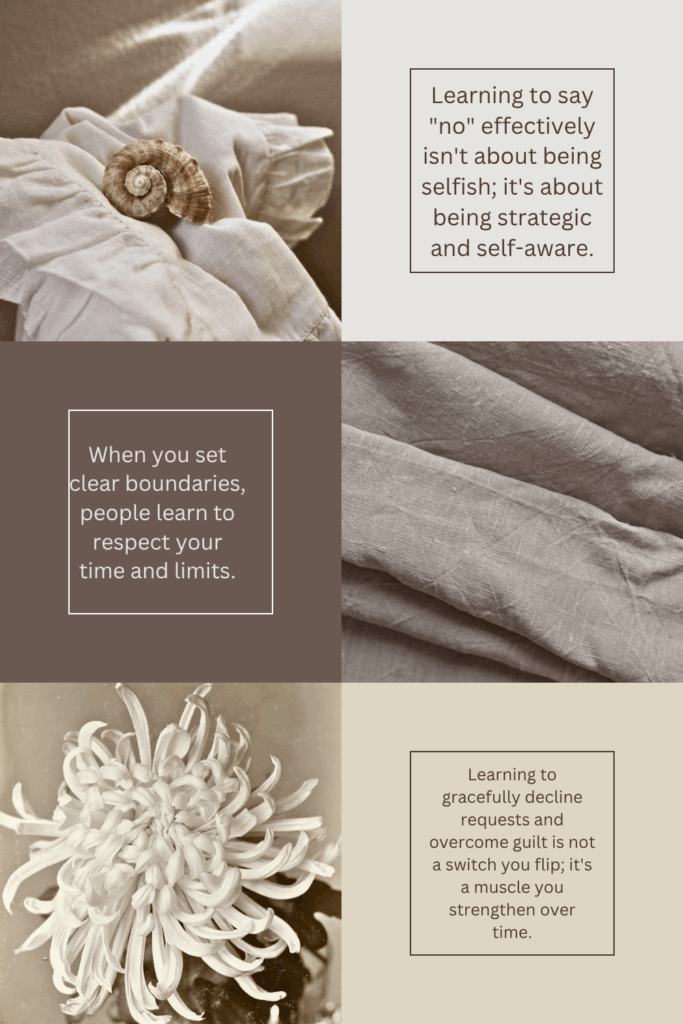
Learning to say “no” effectively isn’t about being selfish; it’s about being strategic and self-aware. The bedrock of graceful refusal is understanding and respecting your own boundaries.

Identify Your Values and Priorities:ย What truly matters to you in life? What are your core values? What goals are you working towards? When you have clarity on these, it becomes easier to assess whether a request aligns with what you want to invest your time and energy in.

Know Your Limits (Energy Audit):ย Be honest with yourself about your physical, mental, and emotional capacity. Are you an introvert who needs downtime? Do you have recurring health needs? How many hours can you realistically commit to work, family, and personal projects without feeling overwhelmed? Regularly “audit” your energy levels. Also read : What Are Energy Vampires And How To Identify Them

Recognize Your Triggers:ย What types of requests or from whom do you find it hardest to decline? Understanding these triggers can help you prepare your response in advance.

“No” to Others, “Yes” to Yourself:ย Frame saying “no” not as a rejection of someone else, but as a “yes” to your own well-being, your priorities, and your mental health. This reframe is incredibly powerful in dismantling guilt.

The Art of the Graceful “No”: Principles for Poise

Saying “no” doesn’t have to be harsh or apologetic. It can be delivered with kindness, respect, and clarity. Here are the principles and techniques to master the art of graceful refusal:

Be Clear and Concise:ย Avoid rambling excuses or vague language. Be direct, but not blunt. A simple, clear statement is far more effective than a complicated explanation.

Be Kind and Empathetic:ย Acknowledge the request and show empathy for the other person’s need. For example, “I understand this project is important,” or “I appreciate you thinking of me.”

Be Firm and Unwavering:ย Once you’ve said “no,” stick to it. Don’t let yourself be swayed by persistent persuasion. A hesitant “no” often invites further negotiation.

Don’t Over-Explain (But Offer a Reason if Appropriate):ย You are not obligated to provide a detailed justification for your decision. A brief, honest reason (e.g., “My plate is full right now,” “I don’t have the capacity,” “That doesn’t align with my current priorities”) is usually sufficient. Over-explaining can sound like an excuse and invite debate.

Offer Alternatives (Optional and Genuine):ย If you genuinely want to help but cannot fulfill the specific request, you can offer an alternative solution. This could be recommending someone else, suggesting a different time, or offering a partial contribution. Only do this if it feels authentic and feasible.

Practice Makes Perfect:ย Start small. Decline a minor request first, then gradually tackle more challenging ones. Rehearse your responses if it helps. The more you practice, the more natural it becomes.

Timing is Key:ย Respond promptly. Delaying your “no” can cause more anxiety for you and inconvenience for the other person. A timely “no” is often more respected than a late, reluctant “yes.”

Separate the Request from the Person:ย Remember that you are declining the request, not rejecting the person. A healthy relationship can withstand a “no.”
LEARINING TO SAY NO, SETTING BOUNDARIES QUOTES

Scripts for Common Scenarios: Practical Phrases to Empower You

Here’s an article on learning to gracefully decline requests without guilt, crafted in a similar encouraging, accessible, and practical style.

Work-Related (Extra Projects/Meetings):

“Thank you for thinking of me for this, but my current commitments mean I can’t take on anything new right now.”

“I appreciate the offer, but I need to focus on X and Y to ensure they’re completed to the best of my ability.”

“I can’t take that on right now, but I could potentially help with [smaller task] if that’s an option.”

“My bandwidth is completely full at the moment.”

Social Invitations:

“Thank you so much for the invitation! Unfortunately, I won’t be able to make it.”

“That sounds like fun, but I already have a prior commitment.” (You don’t need to specify what it is).

“I appreciate you inviting me, but I need to prioritize some downtime/personal errands that day.”

“I’m so sorry, I won’t be able to make it. I hope you have a wonderful time!”

Favors from Friends/Family (Time, Money, Physical Help):

“I wish I could help, but I genuinely don’t have the capacity right now.”

“That’s not something I’m able to do at this time, but I hope you find someone who can.”

“I’m really trying to guard my time for personal well-being this week, so I won’t be able to.”

“Unfortunately, my budget/schedule doesn’t allow for that right now.” (For financial requests).

“I can’t physically help with that, but I can offer [alternative, e.g., research, moral support].”

Volunteering/Committees:

“I admire the work you’re doing, but I’m currently unable to take on any new volunteer commitments.”

“My time is fully committed to X and Y at the moment.”

“That sounds like a wonderful initiative, but it doesn’t quite align with my current focus areas.”

The Guilt Trap: Releasing the Emotional Baggage

Even with the perfect script, the feeling of guilt can still linger. This is often the hardest part, but it’s crucial for truly mastering the art of “no.”

Acknowledge, Don’t Suppress:ย The first step is to simply acknowledge the feeling of guilt without judgment. It’s a natural emotion, especially if you’re used to always saying “yes.”

Reframe “No” as “Yes”:ย Constantly remind yourself that by saying “no” to something that doesn’t serve you, you are saying a powerful “yes” to something else that truly matters โ€“ your health, your peace, your priorities, your family, your passions.

You Are Not Responsible for Others’ Feelings:ย You are responsible for your own actions and intentions, but you cannot control how others react to your boundaries. Their disappointment or frustration is their emotion to manage.

Self-Compassion, Not Self-Criticism:ย Be kind to yourself. Learning to set boundaries is a journey, not a destination. There will be times you falter, and that’s okay. Treat yourself with the same compassion you’d offer a friend.

Focus on the Long-Term Benefits:ย While the immediate discomfort of guilt might be strong, remember the long-term rewards: reduced stress, more energy, stronger relationships built on authenticity, and a greater sense of control over your own life.

The World Won’t End:ย It rarely does. Most people are understanding, and even if there’s initial disappointment, they will move on. Your relationship with them is unlikely to crumble over a single “no.”

The Positive Ripple Effect: Benefits of Setting Boundaries

Embracing the power of “no” doesn’t just benefit you; it creates a positive ripple effect that can surprisingly enhance your relationships and overall life quality:

  • Increased Respect:ย When you set clear boundaries, people learn to respect your time and limits. They will understand your “yes” is genuine and valuable, because your “no” is equally firm.
  • Higher Quality “Yes”:ย When you do say “yes,” you do so wholeheartedly, with genuine enthusiasm and full commitment. This means you can show up authentically and deliver your best, enriching the experience for everyone involved.
  • More Time for What Truly Matters:ย By freeing up your schedule from unwanted obligations, you create space for your passions, your well-being, your loved ones, and the goals that truly light you up.
  • Reduced Resentment, Stronger Relationships:ย Saying “no” prevents the buildup of resentment, which is toxic to any relationship. When you’re not feeling exploited or overwhelmed, you can engage with others from a place of genuine care, not obligation.
  • Improved Mental and Physical Health:ย Less stress, less burnout, and more time for self-care directly translate into better mental clarity, improved mood, and enhanced physical health.
  • Authenticity and Integrity:ย Living in alignment with your values and boundaries builds integrity. You become a person whose actions reflect their true self, leading to a profound sense of peace and inner strength.
  • Empowering Others:ย By modeling healthy boundaries, you subtly empower others to do the same, contributing to a culture of mutual respect and understanding.

Practice Makes Progress: A Lifelong Skill

Learning to gracefully decline requests and overcome guilt is not a switch you flip; it’s a muscle you strengthen over time. There will be moments of awkwardness, and sometimes, you might still feel a pang of guilt. That’s perfectly normal. The key is consistent practice and unwavering self-compassion.

Start small. Choose one area where you frequently overcommit and try practicing a graceful “no” this week. Observe how you feel. Acknowledge your efforts. With each gentle refusal, you’re not just saying “no” to a request; you’re saying a powerful “YES!” to your own peace, your priorities, and a life lived on your own terms by setting boundaries for your benefit . It’s time to reclaim your power, one thoughtful “no” at a time.

Further Readings:

1.ย Set Boundaries, Find Peaceย by Nedra Glover Tawwab

A therapistโ€™s guide to creating healthy boundaries with confidence. Includes real-life examples and scripts for saying no without guilt.
Best for: Beginners who want clear, practical tools.


2.ย The Book of Noย by Susan Newman

Over 250 ways to say no in all areas of lifeโ€”friends, family, workโ€”without damaging relationships.
Best for: People-pleasers and overcommitters.


3.ย Boundaries: When to Say Yes, How to Say Noย by Dr. Henry Cloud & Dr. John Townsend

A foundational read with a faith-based lens, helping you understand why boundaries matter and how to implement them.
Best for: Deep healing in personal and professional relationships.


4.ย Radical Compassionย by Tara Brach

Focuses on setting inner and outer boundaries with compassion through the RAIN method (Recognize, Allow, Investigate, Nurture).
Best for: Mindful individuals seeking gentle empowerment.


5.ย Stop People Pleasingย by Patrick King

Teaches assertiveness, emotional independence, and how to stop seeking validation through over-accommodation.
Best for: Anyone ready to break the habit of putting others first at their own expense.
the orange peel theory

The Orange Peel Theory: The Berries That Sealed Our Love

Posted on July 14, 2025September 14, 2026 by Divya Toshniwal

Imagine this: you’re curled up on the couch after a long day. You’re craving an orange, but you’re too tired to get up. Your partner silently walks into the kitchen, peels one, and hands it to youโ€”without being asked.
Itโ€™s such a small gesture, right?
Or is it?

Welcome to the Orange Peel Theoryโ€”a beautiful metaphor that reminds us that love is not always loud. Sometimes, it speaks softly through everyday actions.

a girl peeling orange for her partner - orange peel theory

Table of Contents

  • The Orange Peel Theory: A Simple Test for Deeper Connections
  • Why It Resonates So Deeply
  • Orange Peel Theory In Everyday Life
  • Your Longest Commitment: Cultivating Deeper Connections
  • Download a Free Printable Journal Worksheet

I didn’t know about the “Orange Peel Theory” when I chose my life partner, but looking back, I realize it was a massive driver in my decision. Our relationship was long-distance, a challenge that often magnifies the importance of small gestures.

One ordinary day, a courier arrived. When I opened the package, I was ecstatic to find Red Indian berries (Indian jujube), also known asย “ber”. These aren’t common where I lived, but they’re abundant in state of Rajasthan(where he was those days), and I absolutely love them. Overwhelmed with delight, I immediately called him. “Why did you send these?” I asked, my voice bubbling with happiness. His simple reply resonated deeply: “I remembered you said you loved them, so when I saw them in the market, I thought of you. I just had to send them.”

It wasn’t the berries themselves, but the thought behind them. The fact that he remembered a casual comment, that he took the time and effort to source and send something so specific just because it would bring me joy โ€“ that was the magic. There were several such instances, subtle yet powerful demonstrations of his attentiveness and care, that made me fall deeply in love. These weren’t grand romantic gestures; they were genuine acts of noticing and prioritizing my happiness, proving that the Orange Peel Theory, in its essence, was guiding us all along.

The Orange Peel Theory: A Simple Test for Deeper Connections

In our busy lives, it’s easy to overlook the small gestures that truly matter. We often find ourselves seeking grand declarations or significant events to validate our relationships, whether with a partner, friend, or even a family member. But what if the strongest indicators of genuine connection and care lie in the simplest of acts? This is where the “Orange Peel Theory” comes in โ€“ a wonderfully insightful concept that encourages us to notice and appreciate the subtle cues of true partnership.

The Orange Peel Theory suggests that these seemingly insignificant actions are powerful indicators of how deeply someone understands and prioritizes your needs, even before you explicitly ask.ย It’s about proactive care, observation, and a genuine desire to contribute to your comfort and happiness. It’s a beautiful reflection of what it means to be truly seen and supported.

The “Orange Peel Theory” originated as a viral trend on TikTok. It gained widespread popularity through a specific TikTok video that featured a text exchange between former partners. In this exchange, one person expressed missing the simple act of their ex-partner peeling oranges for them.This sparked a trend where users began sharing stories and videos of their own partners performing small, unsolicited acts of service, such as peeling an orange, as a sign of genuine care and commitment.ย The theory quickly resonated with audiences as a simple, yet profound way to assess attentiveness and love in a relationship


Why It Resonates So Deeply

In therapeutic and emotional work,ย attunementย is a key concept. It refers to the ability to emotionally “tune in” to someone elseโ€”to pick up on their subtle signals, moods, or needs, even when they’re unspoken. Itโ€™s the art of paying attention, feeling with someone, and acting with sensitivity.

On the surface, peeling an orange might seem trivial. But the profound impact of the “Orange Peel Theory” lies in its psychological resonance. These small acts tap into fundamental human needs .

Mindfulness and Presence:ย For the giver, performing these acts requires mindfulness โ€“ being present enough to observe and anticipate. For the receiver, it highlights that the other person is truly present and engaged in the relationship.

Validation and Being Seen:ย When someone performs an unsolicited act of service, it communicates, “I see you. I understand your needs, even the unexpressed ones.” This feeling of being truly seen and understood is incredibly validating and builds deep emotional intimacy.

Effort and Prioritization:ย In a world demanding constant attention, taking a moment to perform a small act of service demonstrates effort and shows that you are a priority. It’s a tangible expression that someone is willing to invest their time and energy into your comfort.

Acts of Service (Love Language):ย For many, “Acts of Service” is a primary love language. While not everyone expresses or receives love this way, these gestures are universally appreciated as concrete demonstrations of care, bridging communication gaps and fostering a sense of security.

Building Trust Incrementally:ย Trust isn’t built in one grand gesture, but through consistent, small, reliable actions. Each “orange peel moment” contributes to a foundation of trust, making you feel safer and more secure in the relationship.

Theย Orange Peel Theoryย resonates so strongly because itโ€™s a perfect, everyday example of attunement in action.

In a world that often celebrates grand gestures, it’s easy to dismiss the subtle acts of kindness.

Orange Peel Theory In Everyday Life

Here are a few more everyday examples of the “Orange Peel Theory” in action, showcasing how small gestures can speak volumes:

The Proactive Helper:ย You’re cooking, and your hands are full or messy. Your partner, without you saying a word, grabs the spice jar you’re reaching for, or washes a used utensil for you to reuse.

The Thoughtful Communicator:ย You mention in passing that you’re having a particularly stressful day at work. Later that afternoon, your friend sends you a message with a funny meme or a link to a relaxing song, just to brighten your mood.

The Observant Host:ย You’re at someone’s house, and you casually mention you’re a little cold. Before you even think to ask, they quietly bring you a blanket or adjust the thermostat.

The Prepared Partner:ย You’re heading out the door, clearly running a bit late. Your partner already has your keys, wallet, or phone waiting for you on the counter, knowing you might forget them in your rush.

The Empathetic Commuter:ย On a crowded bus or train, someone notices you’re struggling with heavy bags and, without a word, adjusts their position slightly to give you more room or offers to hold one of your items.

The Remembering Colleague:ย You’ve had a particularly challenging deadline, and once it’s met, a colleague brings you your favorite coffee or a small treat, remembering how hard you’ve been working.

The Caring Family Member:ย You’re feeling under the weather, and a family member quietly makes you a cup of tea, brings you a book, or fluffs your pillow, anticipating your need for comfort.

Your Longest Commitment: Cultivating Deeper Connections

Understanding the Orange Peel Theory isn’t just about evaluating others; it’s also about becoming more mindful of your own actions. How often are you the one peeling the metaphorical orange for those around you? By proactively looking for ways to offer small acts of kindness and support, you can deepen your connections and enrich your relationships.By consciously looking for opportunities to perform these small, unsolicited acts, you can significantly deepen your connections:

Start Small and Be Consistent:ย You don’t need to perform grand feats. Consistency in small, thoughtful actions builds trust and warmth over time far more effectively than sporadic large gestures.

Cultivate Observational Awareness:ย Pay closer attention to the people in your life. What small struggles do they face? What subtle preferences do they have? Do they always forget their keys? Do they prefer their coffee a certain way?

Anticipate Needs:ย Try to anticipate what might make someone’s day a little easier or brighter. If you know a friend has a big presentation, could you send them a supportive text or bring them their favorite snack?

Act Without Being Asked:ย The power lies in the unsolicited nature of the act. If you see an opportunity to help or show care, do it without waiting for a request.

Personalize Your Gestures:ย Just like the berries I received, the most impactful “orange peels” are often tailored to the individual. They show you truly know and remember them.

No matter what happens in life, keep moving towards building more empathetic and attentive relationships. You are your longest commitment, and investing in the quality of your connections is an investment in your own well-being. Start noticing the orange peels, both given and received, and watch how your relationships blossom with genuine care and understanding.

While the “Orange Peel Theory” offers a beautiful lens to appreciate acts of care, it’s crucial to remember it’s aย theoryย and not a definitive pass/fail test for a relationship. Do not hand them an orange and ask them to peel it . It will lead you no where , no matter what their reaction is. Healthy relationships thrive on a myriad of factors, withย open communicationย being paramount. Not everyone expresses love through acts of service, and sometimes life circumstances might prevent someone from performing these gestures. Use this theory to deepen appreciation and inspire your own actions, rather than as a rigid checklist to judge others. The most profound connections are built on understanding, empathy, and continuous conversation.

Download a Free Printable Journal Worksheet

Orange_Peel_Theory_Journal_WorksheetDownload

are you stuck in a situationship

Are You Stuck in a Situationship? Signs, Benefits and Breaking Free From an Unwanted Situationship

Posted on May 16, 2023September 14, 2026 by Divya Toshniwal

“I don’t want to ruin what we have by putting too much pressure on it.”

“I’m not sure if I’m ready to be exclusive.”

“I’m not looking for anything serious.”

“I like spending time with you, but I’m not sure what I want.”

“I’m not seeing anyone else, but I’m not ready to commit to you either.”

“Let’s just see where this goes.”

Are such sentences sounding familiar to you? Then this article is what you need to read right now. You might be in a situationship without even knowing it.

situationship

Table of Contents

  • What is a Situationship?
  • Situationship Vs Dating
  • Signs That Show You Are in a Situationship
  • How To Get Out of an Unwanted Situationship
  • How Can a Situationship Benefit You?

What is a Situationship?

A situationship is when you have a romantic relationship where the status of your relationship is not defined. It is an undefined, unlabeled, non-committed relationship that is mostly sexual or casual in nature.

Sometimes this situationship may be a mutual decision but sometimes it so happens that you do not even know but you are stuck in such a relationship, where you give your 100% in a relationship while the other person is not ready to commit.

Situationship Vs Dating

Here is how a situationship is different than dating :

The first and foremost difference between situationship and dating is that while dating the status of the relationship is defined. Both partners know well the rules of dating and the boundaries of the relationship are also set. While in a situationship mostly both partners do not know where the relationship is going, what expectations one should have and where one should set the boundaries.

The level of commitment in a situationship and in dating also differ. Dating involves a deeper connection and a stronger commitment. Situationships on the other hand may have weaker commitments or no commitments at all.

Dating offers more clarity about the relationship and its future. It is hence good for people who want a long-term relationship. A situationship is short-term and temporary. It gives you more freedom of moving in and out of the relationship.

Signs That Show You Are in a Situationship

Here is how you can identify if you are in a situationship:

How To Identify If You Are In A Situationship

How To Get Out of an Unwanted Situationship

While a situationship can be a mutual unsaid decision between two people, sometimes you may get into one without knowing it consciously. Sometimes it may happen that you get into a relationship with more expectations while your partner may not be ready for it. This can create stress and also lead the relationship to become toxic.

Getting out of a situationship can be challenging, especially if you’ve developed feelings for your partner. However, it’s important to remember that you deserve to be in a relationship that meets your needs and provides you with the emotional support and commitment you desire. Here are some steps to help you get out of a situationship:

1. Accept your feelings and acknowledge them: It is not right or wrong to feel a certain way. Make sure you are fully aware of your emotions. Be honest with yourself about whether this situationship/ relationship is meeting your needs or is it taking away more from you than it can give back.

2. Communicate honestly: Have an honest conversation. If you have decided that you want to end this situationship for the better, you need to have an honest conversation with your partner. Communicate clearly your needs and issues. Make sure you give them closure and have one for yourself.

3. Set Boundaries: There may be situations when your partner does not want to end things and may persuade you to stay in the situationship. You should set clear boundaries and declare them to your partner.

4. Focus on self-care: Anything and everything that is hampering your peace of mind and impacting you negatively in any way need to go. The most important thing is self-care. Take some time out of your busy world and the toxicity of relations. This time needs to be only yours. Focus on things that you love, that help you grow and all this should be without bothering about the world. (Learn more about self-care here )

5. Do not hesitate to take support: Taking help from others is not a bad thing. If you are in a situation of cofusion or you need any kind of support you can always turn to people who are your well wishers. If you do not want to discuss your conditions with known people or you are not comfortable with and friends or family you can always connect for professional help to a counselor or coach.

Remember, getting out of a situationship can be difficult, but it’s important to prioritize your own needs and happiness. By taking the steps above, you can begin to move on from the situationship and find a relationship that provides you with the emotional support and commitment you desire.

How Can a Situationship Benefit You?

Situationship is not all bad if both partners are on the same page. A successful situationship can provide a lot of benefits, some of which are listed below:

1.Freedom and Independence: Being in a situationship keeps you away from the burden of expectations that many relationships carry. It can help you focus more on yourself and your own growth both personally and in your career.

2.Emotional companionship: At the end of the day, you do have someone to talk to and that is one of the major benefits that a situationship gives you.

3.Physical companionship: Physical intimacy releases hormones like oxytocin and endorphins, which can help reduce stress, promote relaxation, and improve overall well-being. It can serve as a way to unwind and escape from the pressures of daily life.

4.Exploration and self-discovery: A situationship can help you identify the various dynamic of different relations and help discover your needs from a relationship. It offers an opportunity to learn about one’s preferences, boundaries, and compatibility without the immediate commitment associated with a traditional relationship.

5.Being in the moment: In a situationship you can avoid all the pressure of creating a future together and just live in the moment. enjoy and explore this kind of relationship without any complications of thinking about what will happen next.

Situationships may have their benefits but they may not be suitable for everyone. Communication, honesty, and clear expectations are crucial to ensuring that both partners are on the same page and content with the arrangement.

Mindful Relationships

Mindful Relationships: Building Strong Bonds and Understanding Mental Health in Relationships

Posted on February 10, 2023September 14, 2026 by Divya Toshniwal

Maintaining relationships is not an easy task. It is about adjusting to a new person, understanding and delicately balancing both your needs. With so much going on in your own personal life, adding the aspect of a relationship can be very taxing, but everyone needs a companion and hence we crave that togetherness. The problem arises when this relationship becomes a burden instead of a support. There are a variety of reasons why this may happen but let us talk about solutions and not problems. The solution is simple and that is maintaining mindful relationships.

Maintaining mindful relationships can be affected your mental health and having mindful relationships can turn around your mental health for the better too. Nobody is perfect, but two imperfect people can also make a perfect relationship that works for them.

Table of Contents

  • What are Mindful Relationships?
  • Effect of Bad Mental Health on Relationships
  • How To Maintain Mindful Relationships
  • Benefits of Mindful Relationships on Your Mental Health

What are Mindful Relationships?

Most of us today are not paying too much attention to our relationships these days. We do a lot of stuff to get into a relationship with someone we like and then once we are comfortable with each other we start taking each other for granted. We spend more time on our phones than with our partners and this creates relationship loneliness. There are people in this world who don’t have someone to share their life with, but I believe the worst is the case for those who do have someone and still are lonely. It is extremely important for us to realize this loneliness and turn it around by being more mindful in our relationships.

Mindful relationships are relationships where individuals practice mindfulness and consciously be aware of their interactions and communication with one another. This type of relationship is characterized by open and honest communication, empathy, non-judgment, and a focus on personal growth and self-improvement. The goal is to cultivate a deeper connection, understanding, and appreciation for one another.

Effect of Bad Mental Health on Relationships

Effect of Bad Mental Health on Relationships

When you are in a relationship, your personal mental health will matter a lot. If you carry the baggage of emotional setbacks and mental health issues it is bound to affect your relationships too. Bad mental health can have a significant impact on relationships in several ways:

  • Communication issues: Mental health struggles can make it difficult for individuals to express themselves, leading to misunderstandings and conflict. People may also be hesitant to express themselves or too arrogant and loud in their expressions due to previous bad experiences. These little misunderstandings and communication gaps can create a big rift between the partners.
  • Intimacy issues: These can be both physical and mental. When someone goes through mental health issues it may become tougher for them to be physically intimate in their relationships. But it is not restricted to only physical intimacy, any form of intimacy where they feel vulnerable may become tough for them.
  • Stress and Burnout: Troubled mental health in one person can create stress and burnout in both partners when in a relationship. This puts an additional strain on the relationship, which itself is going through its own phase of adjustments. Your stress can create an unpleasant atmosphere where it can become the cause of killing the positivity and joy in your relationship and may put off your partner too. [ Also read: The unrecognized signs of stress and how to effectively deal with stress and burnout]
  • Emotional outbursts: Mental health problems can lead to mood swings, irritability, and outbursts, making it challenging to manage emotions in a healthy and productive way. When you have unregulated emotions even the littlest of things can tip you. This makes it extremely tough for your partner to navigate through. It is like always walking on eggshells and never knowing how you would react.
  • Toxicity: A toxic relationship is where you are suffering from dynamics and behaviors that are physically, mentally, or emotionally taxing. One of the things that majorly lead to a toxic relationship is the mental health conditions of one/both partners. [Also read how to deal with toxic relations]
  • Insensitivity: Your mental health issues can make you insensitive towards your partner’s feelings and vice versa.

In a mindful relationship, partners prioritize their mental and emotional well-being and make an effort to stay present in the moment. They listen actively, communicate openly, and seek to understand each other’s perspectives and emotions. They also work to recognize and manage their own thoughts, feelings, and reactions and avoid reactivity.

Practicing mindfulness in relationships can lead to greater empathy, compassion, and intimacy. It can also help to reduce conflicts, increase resilience, and promote personal growth for both partners.

However, it requires effort and commitment from both partners and requires continuous self-reflection and communication. Maintaining a mindful relationship requires regular intentional practices and a commitment to personal growth and development.

How To Maintain Mindful Relationships

How To Maintain Mindful Relationships

It’s important to seek professional help if mental health struggles are affecting a relationship. With the right support, individuals can learn to manage their mental health, improve communication, and strengthen their relationships. But here are a few practices that can help you cultivate a mindful relationship.

Practice Self Awareness

To know and understand your partner, you need to understand yourself first. If you do not know where you stand you cannot create a path to where you want to go. Hence self-awareness is the first step in any journey you want to take. Understand your value systems, temperament, your personality, your interests, your strengths, and weaknesses before you try to analyze the other person. [Also read: Vitals of self-awareness]

Open Communication

While getting into a relationship, the worst mistake we do is creating a fake impression. After a few days when we cannot carry the burden of the fake personality we were carrying, the relationship collapses. Hence, it is very important to be true to yourself and to your partner from the beginning of a relationship. Encourage open, honest, and non-judgmental communication with your partner.

Listen Actively

Most of us listen with a purpose and sadly the purpose is to give back a reply. This is where miscommunication starts when you do not listen to understand what the other person is saying but give them a reply. Practice active listening, showing empathy and understanding of your partner’s perspective.

Stay Present

One of the biggest issues that are faced by most people in a relationship is that their partners spend more time on their phones than with them. Every individual has so many distractions that the ability to just be there in the moment is almost disappearing. Make an effort to stay present at the moment, instead of getting lost in thoughts or distractions.

Regulate Your Emotions

Your unmanaged emotions can be a big issue not only for you but also for your partner. Learn to regulate your emotions in a healthy way and avoid reactivity. Try to build emotional resilience. Understand more about emotional intelligence and how you can use the power of your emotions.

Practice Gratitude

The need to always have more is what is killing relationships these days. We focus more on what our partners did not do for us than whatever they have done for us. If they have a good sense of humor, we complain they are not caring enough, if they are caring we say they are possessive, if they give us freedom and space then we complain they don’t spend enough time with us, and so on. Nothing ever is enough. We have forgotten to appreciate what they do for us. Express appreciation and gratitude for your partner and the relationship. It will change your relationship to a great extent.

Foster empathy

Empathy is a very crucial tool to cultivate mindful relationships. The ability to understand something from your partner’s point of view will help you see the larger picture and avoid any kinds of miscommunications and misunderstandings. Seek to understand and empathize with your partner’s feelings, experiences, and perspectives.

Be Kind and Give Compliments

A few words of kindness on a hectic and stressful day can bring a smile to your partner’s face. If they have had a tough day take the burden off their shoulders, help them relax, treat them with something they love, or maybe give them some ‘me time’. Tell them you are proud of them. Tell them they deserve this break. Show kindness and compassion to your partner, even in challenging times.

Set Boundaries

Clearly define and communicate your needs and boundaries in the relationship. Both you and your partner should be aware of your respective boundaries. Both of you should respect each other’s individuality and identity in this relationship.

Invest in Self-Growth

A very crucial aspect of mindful relationships is that you do not forget yourself and your personal growth. Personal stagnation can also lead to stagnation in your relationships which may lead to feelings of being stuck. Cultivate personal growth and self-improvement to enhance your relationship and bring more positivity to it.

Benefits of Mindful Relationships on Your Mental Health

There are a number of improvements that you will notice in your mental health when you start practicing mindfulness in your relationships. Here are a few that may motivate you to do so.

Reduced Stress and Anxiety

When you are in a mindful relationship, your partner becomes your companion and not a competitor. You do not have to fight with them to make them understand your stressors and anxiety. They would know your needs and respect your boundaries. They will make your life easier, hence, reducing overall stress and anxiety in your life and improving your mental health.

Increased Feelings of Security

Mindful relationships lead to a sense of security in relationships. It assures you that you have a safe space to talk. A place where you will not be judged and where you can open your heart in front of your partner without the fear of what they would think.

Improved Connectedness

In a world that is full of profit and loss-based relationships, you have someone whom you can rely on for good and honest opinions and suggestions. Someone is there to love you and guide you without being biased. When you are attentive toward each other and listen to each other you can connect to each other smoothly.

Decreased Loneliness and Depression

Mindful relationships can provide a source of support and reduce feelings of loneliness and depression. Having a space that is safe and non-judgmental helps you process your emotions well. Having someone to listen to you and empathize with you reduces feelings of loneliness. But most importantly compassion, compliments, kindness, and appreciation are what help you deal with the feelings of depression and loneliness that a lot of us suffer from today.

Increased Resilience and Emotional Regulation

Mindful relationships help you to manage your own emotions and build better emotional resilience. Your partner acts as a support towards your personal emotional growth. They help you develop greater resilience and coping skills in managing difficult emotions, promoting overall well-being.

Increased Self-confidence

Hearing the words of kindness and appreciation gives your self-confidence a boost. Even when the world is against you, there is a feeling of support from your partner and sometimes that is more than enough to keep going and achieving your goals.

Personal Growth

In a mindful relationship, your partner makes sure that you are not held back. They will support your growth and work for it along with you. They will inspire you to grow and achieve goals that you could not even imagine for yourself. Since they show unconditional confidence in you and you can trust them for putting on the table their honest opinions and suggestions, it helps you a lot in your personal journey of growth.

Remember, mindfulness in relationships takes effort and commitment, and it’s a continuous process of self-reflection, growth, and communication.

P.S. It’s important to seek professional help if mental health struggles are affecting a relationship. With the right support, individuals can learn to manage their mental health, improve communication, and strengthen their relationships. To build stronger connections and cultivate mindful relationships you can also connect to a relationship coach to help you navigate through this wonderful journey.

dealing with a toxic relationship

Dealing with a Toxic Relationship: Tips and Strategies for Protecting Yourself

Posted on January 16, 2023September 14, 2026 by Divya Toshniwal

Toxic relationships can be harmful to your well-being. Learn to recognize the warning signs of a toxic relationship and take steps to protect yourself. From constant criticism to physical abuse, these tips will help you identify and address toxic behavior.

Table of Contents

  • What is a Toxic Relationship?
  • How Can a Toxic Relationship Harm You?
  • Signs of a Toxic Relationship
  • How to Deal With a Toxic Relationship?

What is a Toxic Relationship?

A toxic relationship is where you are sufferring from dynamics and behaviors that are physically, mentally or emotionally taxing. So much so that they hamper you peace of mind and sometimes can go to so extreme that you are not able to carry out even your day to day activities.

In a toxic relationship, one or both parties may feel trapped, controlled, or manipulated and the relationship is often characterized by a lack of trust and healthy communication. These types of relationships can have a negative impact on a person’s self-esteem, mental health, and overall well-being. It’s essential to recognize and address toxic behavior in order to improve or end the relationship.

How Can a Toxic Relationship Harm You?

Being in a toxic relationship can be extremely harmful for you. Here are a few impacts that it may have on your life.

  1. Physical abuse can lead to injuries, chronic pain, and long-term health problems.
  2. Constant criticism or disrespectful behavior can lead to feelings of worthlessness and self-doubt.
  3. Living in a constant state of stress or fear can lead to mental health issues such as anxiety and depression.
  4. A toxic relationship can make it hard for you to trust others in future relationships. Being in a toxic relationship can make it hard for you to maintain healthy relationships with others
  5. Being in a toxic relationship can make you shut down your feelings as you are used to being denied validation for your own feelings.
  6. Sometimes a toxic relationship can be so traumatic that it can lead to major psychological issues like PTSD.
signs of a toxic relationship

Signs of a Toxic Relationship

There are various warning signs that we keep ignoring in case of a toxic relationship. Sometimes because of love and affection, sometimes because of lack of courage, and sometimes just because it is easier to tolerate than to fight for our peace. Here are a few signs that you should consider being a red flag in a relationship.

  1. If your partner is physically abusive, there is no second thought about it. You immediately need to take action against them and save yourself from such a relationship.
  2. Gaslighting or manipulation by your partner. If you feel you are being controlled by your partner and that you are stuck somewhere it’s a clear red flag.
  3. Your partner is not willing to take any responsibility for their own actions and blames you for everything that goes wrong.
  4. If your partner criticizes you for your every move and nothing you do is ever enough for them your relationship has turned toxic.
  5. Your partner is disrespectful towards you and humiliates you in private and/ or public.
  6. When your partner is emotionally unstable and their own emotional burdens are hampering your peace and your life it is better to start searching for solutions.
  7. Another hidden sign of a toxic relationship is when your partner makes it your responsibility to keep them happy and guild you into feeling bad if they are upset for some reason.
  8. You and your partner do not have any healthy communication and every conversation turns into a fight.
  9. Another red flag is your partner being overly possessive about you and jealous of every person you talk to or connect to.
how to deal with toxic relationship

How to Deal With a Toxic Relationship?

If you suspect that you are in a toxic relationship, it’s important to take steps to protect yourself and address the problem. Here are some things you can do:

Setting Boundaries : You need to make it very clear to the other person what is and what isn’t acceptable to you. Be very clear in communication your likes and dislikes. Tell them what is acceptable to you and what are the things that you cannot tolerate. Boundaries have to be both emotional and physical at times. Assess both your needs and find the right balance that is acceptable to both of you. It’s also important to remember that boundaries can change over time and to be willing to adjust them as needed.

Recognize and Accept the Issues : Every relationship has their own issues. There will be differences between you and your partner no matter how well you blend in with each other. The problem arises when you are not ready accept that there is a problem. Recognize the problem and do not deny it. You can address and issue only when you understand it.

Work on Your Communication Patterns : Identify your communication pattern. Are you passive aggressive, do you avoid having difficult conversations, are you very competitive towards one another , are you both emotionally volatile and so on . Work on validating each others feelings. You may not agree with each other’s point of views but validate their feelings and perspectives. This leads to open and effective communication.

Consider Couple’s Therapy : Being stuck in a toxic relationship does not always mean that you partner is purposely making your life hell. At times they might not even realise what is happening and at times you may not realise that the issues are not that big as you think them to be. Consider going for couples therapy to get more clarity and balance your relationship in a way that works for both of you.

Get out of the relationship : Ultimately, if the relationship is toxic and cannot be repaired, it may be best to end it. Remember that you deserve to be in a healthy and happy relationship. It’s also important to seek help as soon as possible if you feel that you’re in a toxic relationship which cannot be saved, as this can help to mitigate some of the harmful effects that such a relation may leave on you.

Focus on self: To maintain your physical and mental health , it is important that you work on building your strengths, developing your mental health and focus on your growth. Build a self-care routine focusing on overall growth.

It’s important to remember that toxic relationships often progress over time, so it’s important to address issues as soon as they arise. Don’t hesitate to reach out for help if you need it.

Also Read : 7 Steps To Have A Healthier Relationship With Your Partner

7 steps to a healthier relationship

7 Steps To Have A Healthier Relationship With Your Partner

Posted on February 22, 2022September 14, 2026 by Divya Toshniwal

Of all relationships you have in your life, be it with friends or family, a romantic relationship is the most special. You expect the most from it and you give the most in it. In spite of all you give and all you receive, you still have so many complaints from each other. You have so many fights and so many disagreements. To help you out in having a healthier relationship here are a few suggestions from my personal experience.

Solve problems without a third party

Every relationship has its share of fights. How you resolve your fight is of utmost importance, much more than how important the matter of fight was. If you bring in other people to resolve your fights, it is a red flag. Whether it be friends or family, do not take your unresolved issues to any third person. That is the first rule.

Reason one is because they don’t know this relationship as well as you do and two, they may find their own interest or may carry their own burdens in their suggestions.

couple fight pic

Don’t compare your relationship with those in books and movies

This is one mistake that most of us make. Growing up we admire some Mr or Ms. Perfect from one of our favorite novels or perhaps a movie and then start imagining our life partner to be like them. You see the beautiful love stories and wish yours would turn out the same. You choose a partner that you think is like them and later in the relationship you realize they are not. The problem arises when you expect them to become the fictional character that you were in love with.

Shake yourself and realize, those were fictional characters created by storytellers so that you would love their stories. Such people don’t exist and nor do perfect relationships. The extra romantic and flawless relationships are just a work of fiction. In real life, you will fight, sometimes you will want the kill each other but the beauty lies in the fact that you still will want to live with each other.

My husband says, ‘ Marry the person you can fight with your entire life and still be together.’ Though I hated this when he said it to me for the first time, I can’t agree more today.

Love the person, not their image in your head.

Divya Toshniwal

Give each other space

Give each other the space to be themselves. Give them space to do what they love to do and allow them to spend their time as they wish to. Different interests and lifestyles mean more clashing if you want to stick around all the time with your partner. It is ok to do things separately. If you like reading while your partner loves to watch movies, it is absolutely ok. You are allowed to spend your leisure time without clinging to each other sometimes. It is good to spend time together but it isn’t necessary to always do that.

Listen

Most people suggest communicating well and no doubt that is extremely important for couples but to have a healthier relationship, it is more important to listen. Listen to each other’s stories, even when they don’t interest you. Your partner should always know that they have a safe space to go. No matter what’s good and what’s bad in the world there is one place where you can be you and no one is judging you.

In my opinion: If your partner thinks of you every time they have anything to say, then you have won. You have won at giving them safe space and becoming the comfort of your partner.

Also Read : How To Improve Your Communication Skills

Eat atleast one meal together

No matter how busy your days are, have at least one meal together. For most of us, we cannot have lunch together because of our work engagements, but breakfast or dinner together can be turning points. Having that time with each other where you can talk about your days and about further plannings can give you the ultimate communication you have been missing. Make a point to not talk about controversial topics at this time. Keep your conversations pleasant. If you don’t have much in common to talk about someday, watch a light comedy show like The Big Bang Theory, FRIENDS, Sarabhai vs Sarabhai, Sumit Sambhal Lega ( these are some of my personal favorites).

Another suggestion is to eat from the same plate. Though it may not seem to make a difference, trust me it does. ( unless you are having 2 different meals)

steps to have a healthier relationship

Understand the power of physical intimacy

Whether it is to resolve a fight or to express your love, physical intimacy can be the master key. Physical Intimacy doesn’t always mean having sex. A gentle touch, a kiss, or a hug, all are forms of physical intimacy. Physical intimacy is about the closeness between your bodies and the comfort you feel in them. A long hug gives you a release of oxytocin, increasing your feelings of love and trust towards each other. Hugs and cuddles are also said to reduce your stress, pain and also reduce the cravings for alcohol or any other substance abuse.

Find one common activity that both of you like

Most couples I have seen, try to highlight the ways they are different. Our food habits don’t match, our hobbies don’t match, our lifestyle is different or our life purpose is different. So, wake up. Your partner is a different person. If you wanted a person who is exactly like you then you should have cloned yourself to date with. Every person is different and so is your partner.

So to create that intimacy and spend some quality time together, find one activity that you can do together. Like me and my partner, we are poles apart in many aspects of our lives but the thing that is common is we love going on long bike rides and we love traveling. Every now and then even if it’s just for 2 days we go someplace away from our busy city life and enjoy a relaxing vacation. It refreshes both of us.

Following these 7 suggestions can bring about major changes in your relationship. Do let me know your experiences when you apply them.

Recent Posts

  • Adulting is Hard, Micro-Retirements are Your Sassiest Escape Hatch
  • Reclaim Your Time, Reclaim Your Peace: Setting Boundaries with a Graceful ‘No’
  • The Orange Peel Theory: The Berries That Sealed Our Love
  • (no title)
  • Mimetic Desire: Do you really want what you think you want?
© 2026 Divya Toshniwal | Powered by Minimalist Blog WordPress Theme