Mira, a 23-year-old graphic designer, was living the “dream.” A sleek apartment in the city, a job at a cool startup, and a constant stream of new projects. But behind the perfectly curated Instagram grid was a growing sense of dread. The late nights fueled by cold brew, the endless feedback loops, and the pressure to always be “on” were turning her creativity into a chore. She felt a constant, low-grade hum of anxiety, a feeling of being perpetually depleted. One day, while mindlessly scrolling, she saw a post about a friend who was taking a month-long trip to Bali. It wasn’t a sabbatical; it was a “micro-retirement.” A lightbulb went off. What if she didn’t have to wait for a distant, mythical retirement to feel alive again? What if she could just… take a break?
That’s the idea behind the micro-retirement. It’s a psychological lifeline for a generation that’s been told to hustle relentlessly. This isn’t just about a vacation; it’s a deliberate and strategic break from the demands of work to prevent burnout, a state of chronic workplace stress that leads to physical and emotional exhaustion, cynicism, and a reduced sense of accomplishment.
The Psychological Viewpoint: Why Micro-Retirements are a Mental Health Hack
From a psychological perspective, the micro-retirement is a brilliant form of proactive self-care. Our brains aren’t designed for sustained, high-intensity work without periods of rest. The constant barrage of deadlines, notifications, and performance metrics puts our nervous system in a state of perpetual stress. This chronic stress can lead to a cascade of negative effects, including anxiety, depression, cognitive impairment, and a weakened immune system.
Psychologists have long advocated for the importance of psychological detachment from work. This means mentally disengaging from job-related tasks and thoughts during non-work hours. While a weekend can offer some detachment, it’s often not enough to fully recharge a depleted mind.
A micro-retirement, however, provides a more complete and extended period of detachment. This allows the prefrontal cortex, the part of the brain responsible for complex thinking and decision-making, to rest and recover. It also helps to break the cycle of rumination—the repetitive thinking about negative thoughts and problems—that often fuels anxiety and stress.
Gen Z: Masters of the Mini-Escape
Gen Z is a generation uniquely attuned to the psychological toll of the modern workplace. They’ve grown up with constant connectivity, a pressure to perform, and a front-row seat to the burnout experienced by older generations. They’re not just looking for a break; they’re actively seeking to reclaim their sense of agency and identity outside of their professional lives.
For them, a micro-retirement is a way to combat the “identity foreclosure” that can happen when your entire sense of self is tied to your career. It allows them to explore hobbies, travel, volunteer, and reconnect with their values. This intentional time away helps to build psychological resilience—the ability to bounce back from adversity—by reminding them that their worth is not solely defined by their productivity.
How Gen Z is Rocking the Micro-Retirement:
Strategic Saving: They’re not just saving for some distant future; they’re actively budgeting and strategizing for these shorter, more frequent breaks. Think aggressive saving periods followed by intentional “escape funds.”
Skill-Based Breaks: Many are using micro-retirements to pursue passions, learn new skills, or even volunteer. It’s not just about lounging on a beach (though that’s definitely part of the appeal); it’s about personal growth and exploration. Imagine taking a coding bootcamp for three months, or volunteering at an animal shelter in another country.
Freelancing & Gig Economy Flexibility: The rise of remote work and the gig economy makes micro-retirements more feasible than ever. Gen Z is leveraging this flexibility to weave in periods of dedicated work followed by intentional time off.
Prioritizing Mental Health: Let’s be honest, the pressure to constantly hustle can take a serious toll. Micro-retirements offer a proactive way to address burnout before it becomes a full-blown crisis. It’s about recognizing the need to step back, recharge, and come back stronger and more focused.
Experiences Over Everything (Almost): While financial security is still a goal, Gen Z places a high value on experiences. Micro-retirements offer opportunities to travel, explore hobbies, and create memories that a traditional work structure might not allow for until much later in life.
The Practical Psychology of the Micro-Retirement
Boundary Setting: Planning a micro-retirement forces individuals to set firm boundaries with their employers and themselves. This act of saying “no” and prioritizing one’s well-being is a powerful psychological tool.
Novelty and Dopamine: Taking a break to travel or learn a new skill provides the brain with a fresh dose of novelty. This stimulates the release of dopamine, a neurotransmitter associated with pleasure and motivation, which can help to combat feelings of boredom and apathy.
Renewed Perspective: Stepping away from the day-to-day grind allows for a new perspective on one’s career and goals. It can lead to moments of insight and a renewed sense of purpose, often resulting in increased creativity and productivity upon return.
By embracing the micro-retirement, Gen Z is not just avoiding burnout; they’re actively cultivating a healthier, more sustainable relationship with work. They’re proving that the best way to thrive is not to grind relentlessly but to pause, recharge, and live a little.
In our fast-paced world, where connection is constant and demands are endless, there’s one tiny word that holds immense power, yet often feels like the most challenging to utter. That word is “No.” We are conditioned to be helpful, accommodating, and agreeable, often to our own detriment. The request comes, our minds scream “no,” but since we have forgotten setting boundaries , our mouths automatically utter “yes,” leaving us stretched thin, resentful, and utterly drained.
Do you often find yourself nodding along to commitments you secretly dread? Do you feel a wave of guilt wash over you the moment you consider declining a request? If so, you’re not alone. This article is your compassionate guide to mastering the empowering art of gracefully declining requests and, more importantly, shedding the heavy cloak of guilt that often accompanies it. It’s time to reclaim your time, protect your energy, and say a resounding “YES!” to your own well-being.
The Invisible Chains: Why “Yes” Becomes Our Default
Before we learn to say “no,” it’s crucial to understand why we say “yes” so often, even when our inner voice is screaming the opposite. Unpacking these underlying reasons is the first step towards breaking free from automatic agreement:
The People-Pleasing Instinct: For many, the desire to be liked, accepted, and seen as helpful is deeply ingrained. We fear that saying “no” will lead to disapproval, disappointment, or even rejection. Our self-worth sometimes becomes intertwined with our ability to meet others’ expectations.
Fear of Missing Out (FOMO): Especially in social circles or professional opportunities, the fear that declining an invitation or a project might mean missing out on something significant – a valuable connection, a fun experience, or a career advancement – can drive us to overcommit. So even when you do not want to go on that road trip you still end up saying yes to it.
Feeling Obligated or Indebted: If someone has helped us in the past, or if the request comes from a superior, a close family member, or a long-standing friend, we might feel an overwhelming sense of obligation to reciprocate or comply, regardless of our own capacity. This can happen with family a lot of times since we believe we have an unsaid obligation to them for taking care of us as a child.
Guilt as a Pre-emptive Strike: Often, the guilt isn’t just about saying “no”; it’s about considering saying “no.” We feel guilty about even contemplating not meeting a request, leading us to agree just to avoid that uncomfortable emotion.
Cultural Conditioning: Many cultures emphasize harmony, collective good, and deference to elders or authority.Direct refusal can be perceived as rude or disrespectful, making “no” a culturally challenging word to articulate.
Lack of Clear Boundaries: Without a well-defined understanding of our own limits – what we can and cannot do, what aligns with our priorities – it’s easy to let others’ requests dictate our schedules and energy levels.
Underestimating Our Own Value: We might unconsciously believe that our time and energy are less valuable than others’, leading us to prioritize their needs above our own. Believe me it is not. You are the most important person in your life.
The Hidden Cost of Constant “Yes”: Burnout and Beyond
While saying “yes” can feel good in the short term (avoiding conflict, getting temporary approval), the cumulative effect of perpetually overcommitting is incredibly detrimental. The “cost” extends far beyond a packed schedule:
Burnout and Exhaustion: The most immediate and tangible consequence. Constantly taking on more than you can handle leads to mental, emotional, and physical exhaustion, often resulting in reduced productivity even in tasks you enjoy.
Resentment and Frustration: When you say “yes” out of obligation or fear, it builds a subconscious dislike towards the person who asked you and some times even towards yourself for not being able to speak up your mind. This erodes relationships from the inside.
Diminished Quality of Work/Engagement: When you’re spread too thin, your focus is fragmented. The quality of your work, whether professional or personal, suffers because you can’t give anything your full attention. You might show up, but you’re not truly present.
Loss of Personal Time and Priorities: Your own goals, passions, and self-care activities get pushed aside. The very things that nourish you are sacrificed for others’ demands, leading to a profound sense of loss and dissatisfaction.
Erosion of Authenticity: Living a life dictated by others’ requests means you’re not living authentically. You’re not aligning your actions with your true values and desires, which can lead to a feeling of being unfulfilled and disconnected from yourself.
Stress and Anxiety: The constant pressure of an overflowing to-do list and the fear of letting someone down can significantly increase stress levels and anxiety, impacting your mental health.
Missed Opportunities: By saying “yes” to things that don’t align with your goals, you are implicitly saying “no” to opportunities that truly matter to you.
Establishing Your Non-Negotiables: The Foundation of Setting Boundaries
Learning to say “no” effectively isn’t about being selfish; it’s about being strategic and self-aware. The bedrock of graceful refusal is understanding and respecting your own boundaries.
Identify Your Values and Priorities: What truly matters to you in life? What are your core values? What goals are you working towards? When you have clarity on these, it becomes easier to assess whether a request aligns with what you want to invest your time and energy in.
Know Your Limits (Energy Audit): Be honest with yourself about your physical, mental, and emotional capacity. Are you an introvert who needs downtime? Do you have recurring health needs? How many hours can you realistically commit to work, family, and personal projects without feeling overwhelmed? Regularly “audit” your energy levels. Also read : What Are Energy Vampires And How To Identify Them
Recognize Your Triggers: What types of requests or from whom do you find it hardest to decline? Understanding these triggers can help you prepare your response in advance.
“No” to Others, “Yes” to Yourself: Frame saying “no” not as a rejection of someone else, but as a “yes” to your own well-being, your priorities, and your mental health. This reframe is incredibly powerful in dismantling guilt.
The Art of the Graceful “No”: Principles for Poise
Saying “no” doesn’t have to be harsh or apologetic. It can be delivered with kindness, respect, and clarity. Here are the principles and techniques to master the art of graceful refusal:
Be Clear and Concise: Avoid rambling excuses or vague language. Be direct, but not blunt. A simple, clear statement is far more effective than a complicated explanation.
Be Kind and Empathetic: Acknowledge the request and show empathy for the other person’s need. For example, “I understand this project is important,” or “I appreciate you thinking of me.”
Be Firm and Unwavering: Once you’ve said “no,” stick to it. Don’t let yourself be swayed by persistent persuasion. A hesitant “no” often invites further negotiation.
Don’t Over-Explain (But Offer a Reason if Appropriate): You are not obligated to provide a detailed justification for your decision. A brief, honest reason (e.g., “My plate is full right now,” “I don’t have the capacity,” “That doesn’t align with my current priorities”) is usually sufficient. Over-explaining can sound like an excuse and invite debate.
Offer Alternatives (Optional and Genuine): If you genuinely want to help but cannot fulfill the specific request, you can offer an alternative solution. This could be recommending someone else, suggesting a different time, or offering a partial contribution. Only do this if it feels authentic and feasible.
Practice Makes Perfect: Start small. Decline a minor request first, then gradually tackle more challenging ones. Rehearse your responses if it helps. The more you practice, the more natural it becomes.
Timing is Key: Respond promptly. Delaying your “no” can cause more anxiety for you and inconvenience for the other person. A timely “no” is often more respected than a late, reluctant “yes.”
Separate the Request from the Person: Remember that you are declining the request, not rejecting the person. A healthy relationship can withstand a “no.”
Scripts for Common Scenarios: Practical Phrases to Empower You
Here’s an article on learning to gracefully decline requests without guilt, crafted in a similar encouraging, accessible, and practical style.
Work-Related (Extra Projects/Meetings):
“Thank you for thinking of me for this, but my current commitments mean I can’t take on anything new right now.”
“I appreciate the offer, but I need to focus on X and Y to ensure they’re completed to the best of my ability.”
“I can’t take that on right now, but I could potentially help with [smaller task] if that’s an option.”
“My bandwidth is completely full at the moment.”
Social Invitations:
“Thank you so much for the invitation! Unfortunately, I won’t be able to make it.”
“That sounds like fun, but I already have a prior commitment.” (You don’t need to specify what it is).
“I appreciate you inviting me, but I need to prioritize some downtime/personal errands that day.”
“I’m so sorry, I won’t be able to make it. I hope you have a wonderful time!”
Favors from Friends/Family (Time, Money, Physical Help):
“I wish I could help, but I genuinely don’t have the capacity right now.”
“That’s not something I’m able to do at this time, but I hope you find someone who can.”
“I’m really trying to guard my time for personal well-being this week, so I won’t be able to.”
“Unfortunately, my budget/schedule doesn’t allow for that right now.” (For financial requests).
“I can’t physically help with that, but I can offer [alternative, e.g., research, moral support].”
Volunteering/Committees:
“I admire the work you’re doing, but I’m currently unable to take on any new volunteer commitments.”
“My time is fully committed to X and Y at the moment.”
“That sounds like a wonderful initiative, but it doesn’t quite align with my current focus areas.”
The Guilt Trap: Releasing the Emotional Baggage
Even with the perfect script, the feeling of guilt can still linger. This is often the hardest part, but it’s crucial for truly mastering the art of “no.”
Acknowledge, Don’t Suppress: The first step is to simply acknowledge the feeling of guilt without judgment. It’s a natural emotion, especially if you’re used to always saying “yes.”
Reframe “No” as “Yes”: Constantly remind yourself that by saying “no” to something that doesn’t serve you, you are saying a powerful “yes” to something else that truly matters – your health, your peace, your priorities, your family, your passions.
You Are Not Responsible for Others’ Feelings: You are responsible for your own actions and intentions, but you cannot control how others react to your boundaries. Their disappointment or frustration is their emotion to manage.
Self-Compassion, Not Self-Criticism: Be kind to yourself. Learning to set boundaries is a journey, not a destination. There will be times you falter, and that’s okay. Treat yourself with the same compassion you’d offer a friend.
Focus on the Long-Term Benefits: While the immediate discomfort of guilt might be strong, remember the long-term rewards: reduced stress, more energy, stronger relationships built on authenticity, and a greater sense of control over your own life.
The World Won’t End: It rarely does. Most people are understanding, and even if there’s initial disappointment, they will move on. Your relationship with them is unlikely to crumble over a single “no.”
The Positive Ripple Effect: Benefits of Setting Boundaries
Embracing the power of “no” doesn’t just benefit you; it creates a positive ripple effect that can surprisingly enhance your relationships and overall life quality:
Increased Respect: When you set clear boundaries, people learn to respect your time and limits. They will understand your “yes” is genuine and valuable, because your “no” is equally firm.
Higher Quality “Yes”: When you do say “yes,” you do so wholeheartedly, with genuine enthusiasm and full commitment. This means you can show up authentically and deliver your best, enriching the experience for everyone involved.
More Time for What Truly Matters: By freeing up your schedule from unwanted obligations, you create space for your passions, your well-being, your loved ones, and the goals that truly light you up.
Reduced Resentment, Stronger Relationships: Saying “no” prevents the buildup of resentment, which is toxic to any relationship. When you’re not feeling exploited or overwhelmed, you can engage with others from a place of genuine care, not obligation.
Improved Mental and Physical Health: Less stress, less burnout, and more time for self-care directly translate into better mental clarity, improved mood, and enhanced physical health.
Authenticity and Integrity: Living in alignment with your values and boundaries builds integrity. You become a person whose actions reflect their true self, leading to a profound sense of peace and inner strength.
Empowering Others: By modeling healthy boundaries, you subtly empower others to do the same, contributing to a culture of mutual respect and understanding.
Practice Makes Progress: A Lifelong Skill
Learning to gracefully decline requests and overcome guilt is not a switch you flip; it’s a muscle you strengthen over time. There will be moments of awkwardness, and sometimes, you might still feel a pang of guilt. That’s perfectly normal. The key is consistent practice and unwavering self-compassion.
Start small. Choose one area where you frequently overcommit and try practicing a graceful “no” this week. Observe how you feel. Acknowledge your efforts. With each gentle refusal, you’re not just saying “no” to a request; you’re saying a powerful “YES!” to your own peace, your priorities, and a life lived on your own terms by setting boundaries for your benefit . It’s time to reclaim your power, one thoughtful “no” at a time.
Further Readings:
1. Set Boundaries, Find Peace by Nedra Glover Tawwab
A therapist’s guide to creating healthy boundaries with confidence. Includes real-life examples and scripts for saying no without guilt. Best for: Beginners who want clear, practical tools.
2. The Book of No by Susan Newman
Over 250 ways to say no in all areas of life—friends, family, work—without damaging relationships. Best for: People-pleasers and overcommitters.
3. Boundaries: When to Say Yes, How to Say No by Dr. Henry Cloud & Dr. John Townsend
A foundational read with a faith-based lens, helping you understand why boundaries matter and how to implement them. Best for: Deep healing in personal and professional relationships.
4. Radical Compassion by Tara Brach
Focuses on setting inner and outer boundaries with compassion through the RAIN method (Recognize, Allow, Investigate, Nurture). Best for: Mindful individuals seeking gentle empowerment.
5. Stop People Pleasing by Patrick King
Teaches assertiveness, emotional independence, and how to stop seeking validation through over-accommodation. Best for: Anyone ready to break the habit of putting others first at their own expense.
Imagine this: you’re curled up on the couch after a long day. You’re craving an orange, but you’re too tired to get up. Your partner silently walks into the kitchen, peels one, and hands it to you—without being asked. It’s such a small gesture, right? Or is it?
Welcome to the Orange Peel Theory—a beautiful metaphor that reminds us that love is not always loud. Sometimes, it speaks softly through everyday actions.
Table of Contents
I didn’t know about the “Orange Peel Theory” when I chose my life partner, but looking back, I realize it was a massive driver in my decision. Our relationship was long-distance, a challenge that often magnifies the importance of small gestures.
One ordinary day, a courier arrived. When I opened the package, I was ecstatic to find Red Indian berries (Indian jujube), also known as “ber”. These aren’t common where I lived, but they’re abundant in state of Rajasthan(where he was those days), and I absolutely love them. Overwhelmed with delight, I immediately called him. “Why did you send these?” I asked, my voice bubbling with happiness. His simple reply resonated deeply: “I remembered you said you loved them, so when I saw them in the market, I thought of you. I just had to send them.”
It wasn’t the berries themselves, but the thought behind them. The fact that he remembered a casual comment, that he took the time and effort to source and send something so specific just because it would bring me joy – that was the magic. There were several such instances, subtle yet powerful demonstrations of his attentiveness and care, that made me fall deeply in love. These weren’t grand romantic gestures; they were genuine acts of noticing and prioritizing my happiness, proving that the Orange Peel Theory, in its essence, was guiding us all along.
The Orange Peel Theory: A Simple Test for Deeper Connections
In our busy lives, it’s easy to overlook the small gestures that truly matter. We often find ourselves seeking grand declarations or significant events to validate our relationships, whether with a partner, friend, or even a family member. But what if the strongest indicators of genuine connection and care lie in the simplest of acts? This is where the “Orange Peel Theory” comes in – a wonderfully insightful concept that encourages us to notice and appreciate the subtle cues of true partnership.
The Orange Peel Theory suggests that these seemingly insignificant actions are powerful indicators of how deeply someone understands and prioritizes your needs, even before you explicitly ask. It’s about proactive care, observation, and a genuine desire to contribute to your comfort and happiness. It’s a beautiful reflection of what it means to be truly seen and supported.
The “Orange Peel Theory” originated as a viral trend on TikTok. It gained widespread popularity through a specific TikTok video that featured a text exchange between former partners. In this exchange, one person expressed missing the simple act of their ex-partner peeling oranges for them.This sparked a trend where users began sharing stories and videos of their own partners performing small, unsolicited acts of service, such as peeling an orange, as a sign of genuine care and commitment.The theory quickly resonated with audiences as a simple, yet profound way to assess attentiveness and love in a relationship
Why It Resonates So Deeply
In therapeutic and emotional work, attunement is a key concept. It refers to the ability to emotionally “tune in” to someone else—to pick up on their subtle signals, moods, or needs, even when they’re unspoken. It’s the art of paying attention, feeling with someone, and acting with sensitivity.
On the surface, peeling an orange might seem trivial. But the profound impact of the “Orange Peel Theory” lies in its psychological resonance. These small acts tap into fundamental human needs .
Mindfulness and Presence: For the giver, performing these acts requires mindfulness – being present enough to observe and anticipate. For the receiver, it highlights that the other person is truly present and engaged in the relationship.
Validation and Being Seen: When someone performs an unsolicited act of service, it communicates, “I see you. I understand your needs, even the unexpressed ones.” This feeling of being truly seen and understood is incredibly validating and builds deep emotional intimacy.
Effort and Prioritization: In a world demanding constant attention, taking a moment to perform a small act of service demonstrates effort and shows that you are a priority. It’s a tangible expression that someone is willing to invest their time and energy into your comfort.
Acts of Service (Love Language): For many, “Acts of Service” is a primary love language. While not everyone expresses or receives love this way, these gestures are universally appreciated as concrete demonstrations of care, bridging communication gaps and fostering a sense of security.
Building Trust Incrementally: Trust isn’t built in one grand gesture, but through consistent, small, reliable actions. Each “orange peel moment” contributes to a foundation of trust, making you feel safer and more secure in the relationship.
The Orange Peel Theory resonates so strongly because it’s a perfect, everyday example of attunement in action.
In a world that often celebrates grand gestures, it’s easy to dismiss the subtle acts of kindness.
Orange Peel Theory In Everyday Life
Here are a few more everyday examples of the “Orange Peel Theory” in action, showcasing how small gestures can speak volumes:
The Proactive Helper: You’re cooking, and your hands are full or messy. Your partner, without you saying a word, grabs the spice jar you’re reaching for, or washes a used utensil for you to reuse.
The Thoughtful Communicator: You mention in passing that you’re having a particularly stressful day at work. Later that afternoon, your friend sends you a message with a funny meme or a link to a relaxing song, just to brighten your mood.
The Observant Host: You’re at someone’s house, and you casually mention you’re a little cold. Before you even think to ask, they quietly bring you a blanket or adjust the thermostat.
The Prepared Partner: You’re heading out the door, clearly running a bit late. Your partner already has your keys, wallet, or phone waiting for you on the counter, knowing you might forget them in your rush.
The Empathetic Commuter: On a crowded bus or train, someone notices you’re struggling with heavy bags and, without a word, adjusts their position slightly to give you more room or offers to hold one of your items.
The Remembering Colleague: You’ve had a particularly challenging deadline, and once it’s met, a colleague brings you your favorite coffee or a small treat, remembering how hard you’ve been working.
The Caring Family Member: You’re feeling under the weather, and a family member quietly makes you a cup of tea, brings you a book, or fluffs your pillow, anticipating your need for comfort.
Your Longest Commitment: Cultivating Deeper Connections
Understanding the Orange Peel Theory isn’t just about evaluating others; it’s also about becoming more mindful of your own actions. How often are you the one peeling the metaphorical orange for those around you? By proactively looking for ways to offer small acts of kindness and support, you can deepen your connections and enrich your relationships.By consciously looking for opportunities to perform these small, unsolicited acts, you can significantly deepen your connections:
Start Small and Be Consistent: You don’t need to perform grand feats. Consistency in small, thoughtful actions builds trust and warmth over time far more effectively than sporadic large gestures.
Cultivate Observational Awareness: Pay closer attention to the people in your life. What small struggles do they face? What subtle preferences do they have? Do they always forget their keys? Do they prefer their coffee a certain way?
Anticipate Needs: Try to anticipate what might make someone’s day a little easier or brighter. If you know a friend has a big presentation, could you send them a supportive text or bring them their favorite snack?
Act Without Being Asked: The power lies in the unsolicited nature of the act. If you see an opportunity to help or show care, do it without waiting for a request.
Personalize Your Gestures: Just like the berries I received, the most impactful “orange peels” are often tailored to the individual. They show you truly know and remember them.
No matter what happens in life, keep moving towards building more empathetic and attentive relationships. You are your longest commitment, and investing in the quality of your connections is an investment in your own well-being. Start noticing the orange peels, both given and received, and watch how your relationships blossom with genuine care and understanding.
While the “Orange Peel Theory” offers a beautiful lens to appreciate acts of care, it’s crucial to remember it’s a theory and not a definitive pass/fail test for a relationship. Do not hand them an orange and ask them to peel it . It will lead you no where , no matter what their reaction is. Healthy relationships thrive on a myriad of factors, with open communication being paramount. Not everyone expresses love through acts of service, and sometimes life circumstances might prevent someone from performing these gestures. Use this theory to deepen appreciation and inspire your own actions, rather than as a rigid checklist to judge others. The most profound connections are built on understanding, empathy, and continuous conversation.
When I met Ryan, he seemed to have it all—effortless charisma, an unshakable sense of purpose, and a life that seemed to unfold like the pages of a magazine. We’d been college roommates, and while I spent late nights juggling assignments and a part-time job, Ryan coasted through, juggling social engagements, leadership roles, and still managing to ace his exams. Everyone admired him, and though I tried not to compare myself, it was impossible not to feel like I was falling short.
It wasn’t jealousy—at least, that’s what I told myself. Ryan was my friend, after all, and I wanted to see him succeed. But the more I saw his effortless success, the more I began to wonder: why couldn’t I have what he had? I started mirroring his choices without even realizing it. When Ryan joined the debate team, I signed up too, despite knowing I hated public speaking. When he took up photography, I spent an entire paycheck on a DSLR camera I barely knew how to use. I told myself I was expanding my horizons, but deep down, I knew I was chasing his shadow.
Ryan’s success escalated after college. He landed a high-paying consulting job, moved to a sleek downtown apartment, and started posting photos of luxurious trips and designer suits. Meanwhile, I floundered in a series of unfulfilling entry-level jobs. Every time I scrolled through his social media, I felt a gnawing inadequacy. I told myself I wasn’t envious, just inspired. But the truth was harder to admit: I wanted what Ryan had, not because it was what I truly desired, but because he made it look so desirable.
This mimetic pull began to distort my choices. I applied to the same consulting firms, convinced that if I could replicate his career trajectory, I’d finally feel fulfilled. I even started dressing like him, adopting his polished aesthetic in the hopes it might bring me closer to his level of success. But no matter how much I tried to mimic his life, I couldn’t shake the emptiness that followed. The suits felt like a costume, the job interviews felt hollow, and my growing resentment toward Ryan became a wedge in our friendship.
The breaking point came at one of Ryan’s rooftop parties. Surrounded by his glamorous friends, I tried to fit in, laughing at jokes I didn’t find funny and sipping cocktails I couldn’t afford. Midway through the evening, Ryan pulled me aside.
“You don’t seem like yourself lately,” he said.
His words stung because they were true. I had lost sight of who I was in the pursuit of who I thought I should be. That night, I left the party early, walking aimlessly through the city, questioning every choice I’d made in the past few years. I realized that I had been living someone else’s life, chasing desires that weren’t truly mine.
The next morning, I made a list of everything that genuinely brought me joy—things I had neglected in my quest to emulate Ryan. Writing, hiking, cooking—simple activities that had nothing to do with status or validation. Slowly, I began to rebuild my life around these authentic passions. I started journaling daily, eventually sharing my writing on a blog that gained a small but supportive following. I spent weekends exploring trails instead of attending networking events, and I found solace in creating meals that reminded me of home.
Ryan and I drifted apart, not out of animosity, but because I no longer needed his life as a blueprint for my own. The distance allowed me to see him more clearly—not as a rival or a model to emulate, but as a person with his own struggles and insecurities. Over time, I came to understand that Ryan’s success had never been the problem; my unexamined desire to measure myself against him was.
Looking back, I’m grateful for the detour, painful as it was. It taught me that mimetic desires—the drive to want what others have—can be a powerful force, but only if we let it. By recognizing and resisting this pull, I found the courage to define success on my own terms. True fulfillment, I realized, doesn’t come from chasing someone else’s dream. It comes from the quiet satisfaction of living a life that’s unmistakably yours.
Mimetic desire, a concept first articulated by French philosopher René Girard, is a fascinating theory that explains how human desires are often shaped not by inherent needs or personal inclinations, but by the desires of others. It underscores a fundamental aspect of human behavior: we are not isolated individuals with unique wants; instead, we are deeply influenced by the people around us, whether we realize it or not. This phenomenon of desire through imitation is not just an intriguing philosophical idea but a powerful lens for understanding much of human culture, from consumer behavior to social conflicts.
What if some of the things you want aren’t really yours?
What is Mimetic Desire?
You might not have cared about the latest smartphone, but when you see your friends or influencers raving about it, you suddenly feel like you need it. Their desire influences yours.Ever noticed how people are drawn to crowded restaurants? Even if you had no prior opinion about the food, seeing a packed venue makes you think the food must be amazing, and you want to try it too.When a song or dance becomes popular on TikTok, people often mimic the trend. It’s not just about liking the song but about wanting to participate in something others are enjoying.
At its core, mimetic desire suggests that we desire things not because they are inherently valuable, but because others desire them. Girard’s theory rests on the idea that people’s desires are not autonomous. Instead, they are modeled after others’ desires. This imitative process begins early in life, as children look to their parents, peers, or even media figures for guidance on what is worth wanting. Think about kids playing together. If one child picks up a toy, suddenly all the other kids want that exact toy—even if it was ignored before. They desire it because someone else does. As individuals, we often look to others to define what is desirable, whether that is a material object, a lifestyle, a status, or even a particular romantic partner.Sometimes, someone may seem more attractive because others are interested in them. This is mimetic desire in relationships—desiring someone because they are seen as desirable by others.
A person may find themselves wanting a certain brand of luxury car or an extravagant vacation not because they independently see it as valuable, but because others in their social circle admire or covet these things. The desire to possess what someone else possesses creates a cycle of imitation and competition, which can amplify the intensity of the desire.
Mimetic Desire and Conflict
Since desires are imitative, they often overlap, causing competition between individuals or groups. The more people desire the same thing, the more intense and entrenched the competition becomes. This is especially true for scarce resources—whether tangible goods, status, or even affection.
These conflicts can be internal (within oneself) or external (with others). Here’s how:
1. Internal Conflicts
Mimetic desire can create inner turmoil when it clashes with personal values, needs, or self-perception.
Example 1: Identity Crisis
You might start wanting a high-paying corporate job because your peers desire it, even if deep down, you value creative freedom or a simpler lifestyle. This leads to frustration, dissatisfaction, and self-doubt.
Example 2: Imposter Syndrome
Mimicking the goals or achievements of others might leave you feeling like a fraud because you’re chasing what’s not authentically yours.
Example 3: Conflicted Choices
A person might feel torn between buying a luxury car because “everyone” has one and their desire to save for something meaningful, like traveling or education.
2. External Conflicts
Mimetic desires often create competition when multiple people want the same thing, leading to rivalry, jealousy, or disputes.
Example 1: Workplace Rivalry
Two employees might compete for a promotion not because either deeply wants the role, but because the other person does. This rivalry can breed animosity and sabotage.
Example 2: Love Triangles
In relationships, mimetic desire can manifest when two friends fall for the same person. One friend’s interest might spark the other’s, leading to conflict and strained friendships.
Example 3: Social Tensions
Mimetic desire fuels consumerism. For instance, everyone wanting the latest trendy gadget might lead to price hikes, scarcity, and frustration. On a larger scale, it can cause class envy or resentment when some cannot afford what others flaunt.
Why Mimetic Desire Escalates Conflict
Self-Perpetuating Cycle: Mimetic desire spreads. If two people compete for something, others might join in, assuming it must be valuable, escalating the conflict further.
Girard argued that this kind of rivalry inevitably leads to social tensions and conflicts. Over time, these conflicts can escalate, often resulting in a scapegoating mechanism where one individual or group is blamed for the group’s frustrations. This process, according to Girard, is fundamental to human culture and has influenced everything from the formation of myths to the dynamics of war and violence.
Mimetic Desire in Modern Society
In today’s world, mimetic desire is especially prevalent. The advent of social media has amplified the influence of mimetic desire, allowing us to see and compare the lives of others in ways that were once unimaginable. People constantly present curated versions of their lives on platforms like Instagram, Facebook, and TikTok, showcasing material possessions, relationships, and experiences that others may come to desire. The more someone’s lifestyle is idealized by others, the more those desires are mimetically spread, creating trends, fads, and even consumer addictions.
In the realm of consumerism, mimetic desire has been a key driver behind the marketing strategies of corporations. Advertisements are designed not simply to sell products but to suggest that owning these products will make us more desirable, successful, or fulfilled—goals that are often defined by what others have or want. This results in a cycle where people are motivated to acquire things they may not even need, simply to imitate the desires of those around them.
Why we need to understand mimetic desires?
Understanding mimetic desire is essential because it deeply influences human behavior, relationships, and society. By recognizing how mimetic desire works, we can make more authentic decisions, navigate social dynamics effectively, and reduce unnecessary conflicts. Here are some key reasons why understanding it is valuable:
1. To Make Authentic Choices
Mimetic desire often leads us to pursue goals and possessions because others want them, not because they align with our true values or needs. By understanding this, we can:
Reflect on whether a desire is genuinely ours.
Focus on what brings real fulfillment, rather than chasing trends or societal pressures.
Example: You might decide against buying an expensive gadget or pursuing a high-status career if it doesn’t align with your personal aspirations.
2. To Reduce Competition and Conflict
Mimetic desire is a root cause of rivalry and jealousy, as people often compete for the same objects, roles, or relationships. Recognizing its influence can:
Help diffuse tension by identifying the underlying imitation.
Encourage collaboration instead of competition.
Example: Two colleagues might recognize they’re competing for a promotion only because they’re mimicking each other’s ambition, leading to healthier workplace dynamics.
3. To Build Stronger Relationships
Mimetic desire can strain friendships, romantic relationships, and family dynamics. Understanding it helps:
Prevent unnecessary comparisons or rivalries.
Foster mutual understanding and support.
Example: Recognizing how mimetic desire impacts a love triangle can help friends preserve their relationship by addressing the root of the conflict.
4. To Resist Consumerism and Social Pressures
Advertisers and social media platforms often exploit mimetic desire to drive consumption. Understanding this helps:
Avoid falling for marketing tactics that manipulate desires.
Make mindful financial and lifestyle decisions.
Example: You might realize that buying a luxury car won’t make you happier, even if it seems desirable because others have one.
5. To Enhance Creativity and Innovation
Mimetic desire can stifle originality because people tend to imitate popular ideas or trends. Recognizing this can:
Encourage you to think independently and explore unique perspectives.
Drive innovation by focusing on what genuinely inspires you, rather than what’s fashionable.
Example: Instead of mimicking a popular style in art or writing, you create something that reflects your personal vision.
6. To Understand Social and Cultural Dynamics
Mimetic desire plays a role in shaping societal trends, movements, and even conflicts. By studying it, we can:
Analyze how collective desires are formed and spread.
Address societal issues like polarization, inequality, and consumerism.
Example: Recognizing how mimetic desire drives housing booms or social media trends can help policymakers and individuals make informed decisions.
7. To Cultivate Emotional Resilience
Mimetic desire often triggers envy, insecurity, or dissatisfaction. Understanding it can:
Help you let go of unhealthy comparisons.
Foster gratitude and contentment with your own life.
Example: Instead of feeling inadequate because your peers are buying houses or getting promotions, you focus on your unique journey.
Mimetic Desire and Personal Growth
While mimetic desire can often lead to negative outcomes—such as jealousy, rivalry, and social division—it also offers opportunities for personal growth and self-reflection. By becoming aware of how much of our desires are shaped by others, we can begin to question whether those desires align with our true values or whether we are merely responding to external pressures.
Self-awareness is a powerful tool in breaking the cycle of mimetic desire. Once we recognize the influence of others’ desires on our own, we can more consciously decide what we truly want and why. This doesn’t necessarily mean abandoning all social influence, but rather learning to navigate our desires with greater authenticity and intention. Ultimately, it allows us to cultivate a sense of autonomy and fulfillment that is not dependent on external validation or comparison.
Mimetic desire reveals a crucial truth about human nature: we are not solitary beings, but social creatures deeply influenced by those around us. This theory sheds light on the dynamics of competition, conflict, and social influence that shape much of human behavior. By understanding mimetic desire, we gain insight not only into the conflicts and tensions that arise in society but also into the deeper mechanisms that drive our personal choices. While the imitative nature of desire can sometimes be destructive, it also holds the potential for transformation, allowing us to move from imitation to genuine, conscious self-expression.
Success being a very relative term can differ for every individual. But one definition is common: success is when you achieve the goal that you had set for yourself.
-Divya
Table of Contents
We all have goals and we all want to achieve them. At the beginning of each year, we set New Year’s resolutions for ourselves. We set high goals and dedicatedly try to achieve them with all the effort that we can possibly put into it. For a few days, everything seems up, and then one day we fall. Well, that is not the problem. The problem is that we don’t get up again.
Goal setting is easy but to work on them and achieve them, we need dedication, consistency, and habits.
So, when I understood this very basic problem and very simple solution, I started working on my habits. I listed down all the habits that could get me closer to my goal and incorporated all of them into my daily routine. Things were good for the next week and then the habits slipped out of my routine one after the other. I was back to my normal self by the end of the 44th day. My simple solution was not so simple after all.
Eventually, after working on myself for a long time, I came up with the Effect-Ease Mastery Matrix (EEMM) tool to Build Habits.
Effect-Ease Mastery Matrix
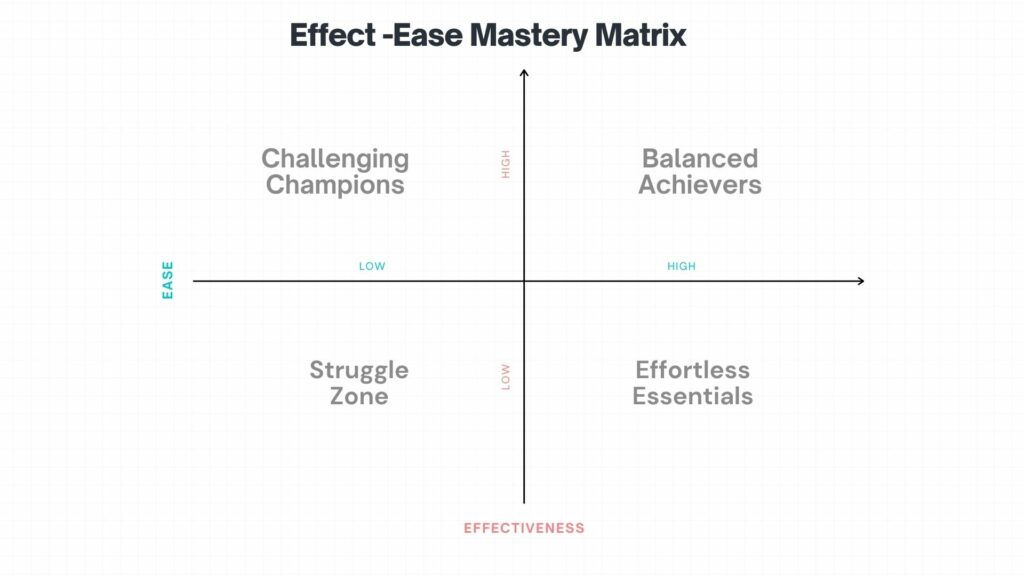
The Effect-Ease Mastery Matrix is a tool that helps individuals evaluate and categorize habits based on two critical dimensions: Effectiveness in achieving your goals (vertical axis) and Easiness to incorporate and continue (horizontal axis). This can effectively work as a habit-building worksheet. By plotting habits on this matrix, individuals can gain insights into the balance between the effort required to establish a habit and its potential impact on achieving personal or professional goals. Each habit falls into one of four quadrants based on these two criteria.
Quadrant 1: Balanced Achievers
The Sweet Spot of Success
Habits in this quadrant strike a harmonious balance between effectiveness and ease of implementation. They are both effective in contributing to one’s goals and manageable in terms of the effort required. These are the habits that can bring about quite a big change with moderate levels of effort. But finding such habits may not be that easy. It will need a little creativity and innovation too. The tagline for this quadrant is “The Sweet Spot of Success,” highlighting the optimal balance achieved between effort and impact.
Quadrant 2: Challenging Champions
Where Grit Meets Greatness
This quadrant represents habits that are both challenging and highly effective. These habits may demand significant effort, discipline, and dedication but offer substantial rewards in terms of personal growth and goal achievement. If you have extremely high willpower and are highly adaptable to change you can pick on habits from this quadrant and you are good to go. Building these habits will bring you closer to your goals faster than anything else. The tagline for this quadrant is “Where Grit Meets Greatness,” emphasizing the resilience and determination required to conquer challenging but impactful habits.
Quadrant 3: Struggle Zone
Overcoming Obstacles on the Path to Mastery
In this quadrant, habits may be challenging to implement, but their impact on goal achievement is limited. These habits might demand a considerable amount of effort but may not bring significant results. The tagline for this quadrant is “Overcoming Obstacles on the Path to Mastery,” acknowledging the difficulties faced in pursuing habits with less tangible outcomes. Habits in this quadrant might be difficult to implement and may not bring significant results. But these may be those little things that can make you stand out from the rest of them. You should take up these only when you are the closest to your goals.
Quadrant 4: Effortless Essentials
Simplicity in Success
Here in this quadrant are habits that are easy to incorporate but do not have a high impact too. The habits that fall under this category are the ones that are not that important but you still have to do them anyway. Like, checking your emails every day. While they require minimal effort, their impact might be limited. Examples include cleaning up your desk, creating a to-do list, or minor daily tasks that don’t align with broader objectives. The tagline for this quadrant is “Simplicity in Success,” emphasizing the ease of incorporating these habits but also recognizing their limited impact. These are habits that aid your growth but do not directly impact it.
Anyone who starts building new habits should begin with something easy to incorporate and have maximum effectiveness in bringing them closer to their goals. Hence begin with habits in Quadrant 1. But also remember to not stop just there.
Effect-Ease Mastery Matrix For A Blogger
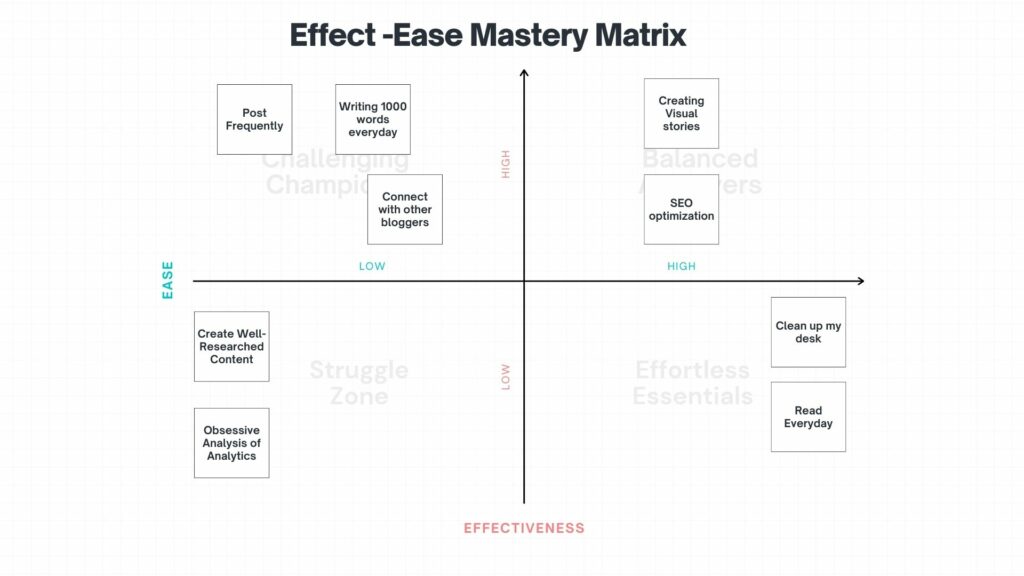
As a blogger when I divided my habits according to the effect-ease mastery matrix, this is how it looked:
Building habits is a task that needs determination, but it is important to choose habits that will keep you motivated enough to achieve your goals. If you keep on challenging yourself with habits that are tough to incorporate and do not give any immediate result you may lose your intrinsic motivation to keep going. Hence, this Effect-Ease Mastery Matrix acts as a tool for you to decide where you should start.
If someone deliberately distorts the truth in order to undermine your perception or emotions to manipulate you into thinking the way that suits their needs, you may find yourself being subjected to gaslighting. Gaslighting can come from anyone who is in a position of power. It can be by a romantic partner, a family member, a colleague, or your boss.
Gaslighting At Work
Gaslighting entails creating an impression that you are unstable, irrational, and lacking credibility. It manipulates you into doubting the reality of what you see and experience, making you believe that you are fabricating it, it is all in your mind and that others won’t trust or support you.
Sarah, a diligent and hardworking employee, found herself entangled in a web of gaslighting orchestrated by her supervisor, Mark.
It started innocently enough with small comments meant to undermine her confidence. Mark would casually say, “Are you sure you can handle that project? It seems a bit too complex for someone at your level.” These seemingly harmless statements planted seeds of self-doubt in Sarah’s mind, making her question her own abilities.
As time went on, the gaslighting escalated. Mark began distorting facts and rewriting incidents that actually happened. During team meetings, he would take credit for Sarah’s ideas, leaving her confused and questioning her own contributions. When she tried to raise concerns about this, he swiftly dismissed her, saying, “You must be mistaken. I don’t recall you ever bringing up that idea.”
The gaslighting extended beyond professional matters, infiltrating Sarah’s personal life. Mark started spreading rumors about her, planting seeds of doubt in the minds of their colleagues. He subtly implied that she was unreliable, untrustworthy, and not a team player. As a result, Sarah felt isolated as though nobody would believe her side of the story.
In moments of confrontation, Mark expertly employed manipulation tactics. He would employ a charming demeanor, reassuring Sarah that he had her best interests at heart. “You’re just being too sensitive,” he would say with a smile. “I’m here to guide you and help you improve.”
Sarah’s mental health suffered greatly under the weight of gaslighting. She found herself constantly on edge, doubting her own perceptions and second-guessing every decision she made. The once confident and motivated employee became anxious, demoralized, and drained.
Such is the power of gaslighting. You do not realize until you have been surrounded by it. The manipulator plays so viciously that you may never be able to recognize that you are being manipulated and hence, it is extremely important that you are educated about gaslighting and that you learn to recognize the subtle signs of gaslighting at work.
Signs Of Gaslighting At Workplace
Denying or Invalidating Experiences: “You’re overreacting. That never happened. You must be mistaken.”
A gaslighter may deny or downplay an employee’s concerns about inappropriate behavior or harassment, making them question their perception and memory of the event.
Blaming the Victim: “It’s your fault. You’re too sensitive and can’t handle criticism.”
A gaslighter may shift blame onto an employee for their own mistakes or shortcomings, making them feel guilty and responsible for the gaslighter’s actions or behavior.
Twisting the Truth: “I never said that. You must have misunderstood me.”
A gaslighter may manipulate facts or distort previous statements to confuse and undermine an employee’s confidence in their own recollection and understanding.
Undermining Self-Confidence: “You’re not capable of handling this. I’ll take care of it.”
A gaslighter may repeatedly undermine an employee’s abilities, belittle their accomplishments, or assign them tasks below their skill level, making them doubt their competence and contribution.
Gaslighting through Isolation: “Nobody else has a problem with it. You’re the only one.”
They may isolate an employee by convincing them that their concerns or perspectives are invalid and that nobody else supports or shares their viewpoint, further diminishing their self-confidence.
Creating Doubt in Relationships: “You can’t trust anyone else. I’m the only one looking out for you.”
They may attempt to isolate an employee from their support network by instilling doubt in their relationships with colleagues or superiors, making the employee rely solely on the gaslighter for guidance and validation.
Manipulating Information: “I never received that email. You must not have sent it.”
A gaslighter may manipulate or selectively withhold information to make an employee question their memory or doubt their own actions, causing confusion and undermining their credibility.
Impact of Gaslighting On Employee Mental Health
Gaslighting causes emotional distress and can lead to heightened anxiety, depression, and feelings of worthlessness.
Gaslighting erodes self-esteem by making individuals doubt their abilities, judgment, and overall self-worth. The consistent invalidation and undermining of their thoughts and experiences can leave them feeling inadequate and unimportant.
Gaslighting creates a stressful work environment as employees constantly feel on edge because of gaslighter’s manipulative tactics. This chronic stress can lead to physical symptoms such as headaches, insomnia, and digestive issues. [ Also read: 12 signs of stress and ways to deal with stress ]
Gaslighting at work often isolates individuals from their support networks. Gaslighters may create doubt about the victim’s credibility, making them feel like nobody else will believe or support them. This can lead to depression and loneliness.
The constant gaslighting and manipulation disrupt the clarity of thought and can lead to difficulties in performing tasks effectively. This impacts the employee’s decision-making abilities and cognitive functioning.
Gaslighting damages an individual’s trust in themselves and others. Victims may struggle to trust their own judgment and intuition, and this lack of confidence can spill over into other areas of their personal and professional lives.
In some cases, gaslighting at work can also lead to post-traumatic stress symptoms. The continuous manipulation, emotional abuse, and undermining of reality can result in flashbacks, hypervigilance, and a heightened state of arousal, similar to what individuals experience after traumatic events.
It is important to acknowledge the impact of gaslighting at work on mental health and provide support to individuals who have experienced or are experiencing gaslighting at the workplace. Creating a safe and supportive environment that promotes open communication, validation, and empowerment can help deal with the damaging effects of gaslighting and foster a healthier workplace culture.
How To Protect Yourself From Gaslighting At Work
You read Sarah’s story above but that was not the end to it.
Sarah’s breaking point arrived when she confided in a trusted coworker, Alex, who had noticed the subtle signs of gaslighting. Alex validated Sarah’s experiences and encouraged her to document instances of gaslighting. Together, they compiled a detailed record of conversations, meetings, and witnessed incidents.
Armed with evidence, Sarah mustered the courage to confront the situation head-on. She scheduled a meeting with the HR department, providing them with her documented experiences. Sarah expressed how the gaslighting tactics had affected her mental well-being and created a toxic work environment.
The HR department took her concerns seriously, launching an investigation into the matter. Through interviews and reviewing the evidence, they discovered a pattern of gaslighting behavior by Mark. As a result, the company implemented policies to address workplace gaslighting and provided training for employees on recognizing and addressing such behaviors.
Sarah’s bravery in standing up against gaslighting at work not only led to justice being served but also created a safer and more supportive work environment for herself and her colleagues. Her story became a powerful reminder that together, employees can combat gaslighting and foster a workplace culture built on trust, respect, and empathy.
You can read about how to protect yourself from gaslighting at work in the following story:
“I don’t want to ruin what we have by putting too much pressure on it.”
“I’m not sure if I’m ready to be exclusive.”
“I’m not looking for anything serious.”
“I like spending time with you, but I’m not sure what I want.”
“I’m not seeing anyone else, but I’m not ready to commit to you either.”
“Let’s just see where this goes.”
Are such sentences sounding familiar to you? Then this article is what you need to read right now. You might be in a situationship without even knowing it.
Table of Contents
What is a Situationship?
A situationship is when you have a romantic relationship where the status of your relationship is not defined. It is an undefined, unlabeled, non-committed relationship that is mostly sexual or casual in nature.
Sometimes this situationship may be a mutual decision but sometimes it so happens that you do not even know but you are stuck in such a relationship, where you give your 100% in a relationship while the other person is not ready to commit.
Situationship Vs Dating
Here is how a situationship is different than dating :
The first and foremost difference between situationship and dating is that while dating the status of the relationship is defined. Both partners know well the rules of dating and the boundaries of the relationship are also set. While in a situationship mostly both partners do not know where the relationship is going, what expectations one should have and where one should set the boundaries.
The level of commitment in a situationship and in dating also differ. Dating involves a deeper connection and a stronger commitment. Situationships on the other hand may have weaker commitments or no commitments at all.
Dating offers more clarity about the relationship and its future. It is hence good for people who want a long-term relationship. A situationship is short-term and temporary. It gives you more freedom of moving in and out of the relationship.
Signs That Show You Are in a Situationship
Here is how you can identify if you are in a situationship:
How To Get Out of an Unwanted Situationship
While a situationship can be a mutual unsaid decision between two people, sometimes you may get into one without knowing it consciously. Sometimes it may happen that you get into a relationship with more expectations while your partner may not be ready for it. This can create stress and also lead the relationship to become toxic.
Getting out of a situationship can be challenging, especially if you’ve developed feelings for your partner. However, it’s important to remember that you deserve to be in a relationship that meets your needs and provides you with the emotional support and commitment you desire. Here are some steps to help you get out of a situationship:
1. Accept your feelings and acknowledge them: It is not right or wrong to feel a certain way. Make sure you are fully aware of your emotions. Be honest with yourself about whether this situationship/ relationship is meeting your needs or is it taking away more from you than it can give back.
2. Communicate honestly: Have an honest conversation. If you have decided that you want to end this situationship for the better, you need to have an honest conversation with your partner. Communicate clearly your needs and issues. Make sure you give them closure and have one for yourself.
3. Set Boundaries: There may be situations when your partner does not want to end things and may persuade you to stay in the situationship. You should set clear boundaries and declare them to your partner.
4. Focus on self-care: Anything and everything that is hampering your peace of mind and impacting you negatively in any way need to go. The most important thing is self-care. Take some time out of your busy world and the toxicity of relations. This time needs to be only yours. Focus on things that you love, that help you grow and all this should be without bothering about the world. (Learn more about self-care here )
5. Do not hesitate to take support: Taking help from others is not a bad thing. If you are in a situation of cofusion or you need any kind of support you can always turn to people who are your well wishers. If you do not want to discuss your conditions with known people or you are not comfortable with and friends or family you can always connect for professional help to a counselor or coach.
Remember, getting out of a situationship can be difficult, but it’s important to prioritize your own needs and happiness. By taking the steps above, you can begin to move on from the situationship and find a relationship that provides you with the emotional support and commitment you desire.
How Can a Situationship Benefit You?
Situationship is not all bad if both partners are on the same page. A successful situationship can provide a lot of benefits, some of which are listed below:
1.Freedom and Independence: Being in a situationship keeps you away from the burden of expectations that many relationships carry. It can help you focus more on yourself and your own growth both personally and in your career.
2.Emotional companionship: At the end of the day, you do have someone to talk to and that is one of the major benefits that a situationship gives you.
3.Physical companionship: Physical intimacy releases hormones like oxytocin and endorphins, which can help reduce stress, promote relaxation, and improve overall well-being. It can serve as a way to unwind and escape from the pressures of daily life.
4.Exploration and self-discovery: A situationship can help you identify the various dynamic of different relations and help discover your needs from a relationship. It offers an opportunity to learn about one’s preferences, boundaries, and compatibility without the immediate commitment associated with a traditional relationship.
5.Being in the moment: In a situationship you can avoid all the pressure of creating a future together and just live in the moment. enjoy and explore this kind of relationship without any complications of thinking about what will happen next.
Situationships may have their benefits but they may not be suitable for everyone. Communication, honesty, and clear expectations are crucial to ensuring that both partners are on the same page and content with the arrangement.
Willpower, Determination, Conviction, Drive, and Self-control. There are many names by which you can call this emotion, but what it simply means is deciding upon something and seeing it through no matter what. Willpower is the ability to resist short-term temptations in order to achieve your long-term goals. A strong will can reap many benefits and help you reach your goals.
Table of Contents
Understanding Willpower and How It Works
Willpower is the ability to keep moving forward even when things are not going your way. When you have a deep-seated desire and the intention to fulfill it, that is what starts your journey toward anything in life. It is quite easy to build a desire and take a pledge to fulfill it. It is also easy to start on the path with your initial motivation to get something or achieve something. The real test begins when you face obstructions and failures. This is when your willpower comes into action and helps you to keep moving.
The most important thing here is the intention. Your intention and the intensity of your desires are the most important factor in determining the strength of your willpower. To keep moving and gather new energy every time you face any obstacle you need to have very strong conviction.
Harnessing the Power of Willpower to Reach Your Goals
When a river leaves its abode in the mountains to meet the sea, it has to cross through the heartland filled with many obstructions. There are times when it needs to break those obstacles and sometimes change its course, it needs to modify according to the needs of the time and situation.
There is no highway to reach your goals, you have to carve out a path like a river does in order to keep flowing.
Divya Toshniwal
One of the key factors in someone’s success is willpower. It is said that successful is that person who can get up one more time than the number of times he has failed. The energy that is needed to get up that one extra time is your determination. It is essential to have strong willpower in order to be successful in life because no success comes without facing failures or obstacles, and when that happens you need to keep your motivation levels up and your intentions intact. The hope for a bright future and achievement of goals needs the base of strong willpower to grow on.
Benefits of Strong Willpower
Increased Self-Control: Strong willpower can help you increase your self-control. It helps you fight the desire for instant gratification and avoid temptations. When you can avoid temptations that are immediately gratifying, you can focus on your long-term goals and align yourself with them.
Better Decision-Making: When you have the ability to avoid immediate temptation and have a long-term vision, it becomes easier for you to make decisions that would have a permanent and long-term impact on your dreams and goal.
Better Focus: Better willpower gives you the ability to avoid distractions that otherwise disrupt your concentration. This will help you use your time effectively and be more productive.
Avoid Procrastination: Your willpower can help you overcome procrastination and boost your productivity. Procrastination is the act of delaying or postponing tasks, often due to a lack of motivation, interest in the task at hand, or maybe sheer laziness. The entire concept of procrastination is based on weak willpower and the need to get instant gratification. Having strong willpower can eliminate a number of issues that are caused by procrastination.
Healthy Life: All the unhealthy lifestyle choices that we make in life are for instant gratification. We eat junk food because it gratifies our taste buds right now, we laze around and do not work out because it avoids the struggle that the body has to go through, we drink alcohol for the instant kick we get, and so on. We give in to our temptations. Having strong willpower will help you make healthy choices, such as exercising regularly, eating a balanced diet, and avoiding harmful habits like smoking or excessive drinking.
Increased happiness: By resisting temptation and making positive choices, you may experience greater feelings of accomplishment, satisfaction, and well-being in the long run. You will find yourself being more content in your life.
How to Improve Willpower and Avoid Temptations
Strengthening willpower is a gradual process and requires consistent effort and discipline. Be patient and persistent, and don’t be discouraged by setbacks or lapses. Here are a few things that will help you improve your willpower and avoid temptations for instant gratification.
Set realistic and achievable goals: Create a plan to achieve your long-term goals and make sure you break them down into some short-term goals. I call these mini-goals. Achieving these mini-goals in the journey will keep you motivated to focus on your long-term goals. This little satisfaction keeps you going and helps you avoid the diversions you may take for instant gratification.
Surround yourself with support: Be with friends, family, and supportive people who inspire you to achieve long-term goals and not with the ones who push you to give in to your temptations.
Identify your triggers: You will be surprised to know but there may be certain triggers to your temptations. You may tend to eat more junk food when you are stressed or you may binge-watch when you are delayed on your timeline to achieve a goal. Try to identify what breaks your ability to stay focused and determined and work on them.
Practice Mindfulness: Be here in this moment and avoid thinking about the things that tempt you to break down and leave behind your long-term goals. Mindfulness can help increase self-awareness and improve decision-making by reducing the influence of emotions and impulses.
Avoid Decision Fatigue: Decision fatigue is a real problem. When you have to take multiple decisions you exhaust yourself more. And when you are mentally exhausted you tend to give in to your temptations more easily.
Get enough sleep: Sleep deprivation can decrease your mental strength and the capacity of your brain to work efficiently and push itself to work harder. In such situations, you will feel weaker and in reduced capacity to exert your willpower. [Also read: 7 SLEEP MISTAKES THAT YOU ARE MAKING AND HOW TO FIX THEM ]
Eat healthy and exercise regularly: When you are physically fit, you have more control over your mental strength too. You can thus have more conviction towards your goals and be more focused without having any distractions.
Everyone is different and what works for one person may not work for another. It’s important to experiment and find what works best for you.
Maintaining relationships is not an easy task. It is about adjusting to a new person, understanding and delicately balancing both your needs. With so much going on in your own personal life, adding the aspect of a relationship can be very taxing, but everyone needs a companion and hence we crave that togetherness. The problem arises when this relationship becomes a burden instead of a support. There are a variety of reasons why this may happen but let us talk about solutions and not problems. The solution is simple and that is maintaining mindful relationships.
Maintaining mindful relationships can be affected your mental health and having mindful relationships can turn around your mental health for the better too. Nobody is perfect, but two imperfect people can also make a perfect relationship that works for them.
Table of Contents
What are Mindful Relationships?
Most of us today are not paying too much attention to our relationships these days. We do a lot of stuff to get into a relationship with someone we like and then once we are comfortable with each other we start taking each other for granted. We spend more time on our phones than with our partners and this creates relationship loneliness. There are people in this world who don’t have someone to share their life with, but I believe the worst is the case for those who do have someone and still are lonely. It is extremely important for us to realize this loneliness and turn it around by being more mindful in our relationships.
Mindful relationships are relationships where individuals practice mindfulness and consciously be aware of their interactions and communication with one another. This type of relationship is characterized by open and honest communication, empathy, non-judgment, and a focus on personal growth and self-improvement. The goal is to cultivate a deeper connection, understanding, and appreciation for one another.
Effect of Bad Mental Health on Relationships
When you are in a relationship, your personal mental health will matter a lot. If you carry the baggage of emotional setbacks and mental health issues it is bound to affect your relationships too. Bad mental health can have a significant impact on relationships in several ways:
Communication issues: Mental health struggles can make it difficult for individuals to express themselves, leading to misunderstandings and conflict. People may also be hesitant to express themselves or too arrogant and loud in their expressions due to previous bad experiences. These little misunderstandings and communication gaps can create a big rift between the partners.
Intimacy issues: These can be both physical and mental. When someone goes through mental health issues it may become tougher for them to be physically intimate in their relationships. But it is not restricted to only physical intimacy, any form of intimacy where they feel vulnerable may become tough for them.
Stress and Burnout: Troubled mental health in one person can create stress and burnout in both partners when in a relationship. This puts an additional strain on the relationship, which itself is going through its own phase of adjustments. Your stress can create an unpleasant atmosphere where it can become the cause of killing the positivity and joy in your relationship and may put off your partner too. [ Also read: The unrecognized signs of stress and how to effectively deal with stress and burnout]
Emotional outbursts: Mental health problems can lead to mood swings, irritability, and outbursts, making it challenging to manage emotions in a healthy and productive way. When you have unregulated emotions even the littlest of things can tip you. This makes it extremely tough for your partner to navigate through. It is like always walking on eggshells and never knowing how you would react.
Toxicity: A toxic relationship is where you are suffering from dynamics and behaviors that are physically, mentally, or emotionally taxing. One of the things that majorly lead to a toxic relationship is the mental health conditions of one/both partners. [Also read how to deal with toxic relations]
Insensitivity: Your mental health issues can make you insensitive towards your partner’s feelings and vice versa.
In a mindful relationship, partners prioritize their mental and emotional well-being and make an effort to stay present in the moment. They listen actively, communicate openly, and seek to understand each other’s perspectives and emotions. They also work to recognize and manage their own thoughts, feelings, and reactions and avoid reactivity.
Practicing mindfulness in relationships can lead to greater empathy, compassion, and intimacy. It can also help to reduce conflicts, increase resilience, and promote personal growth for both partners.
However, it requires effort and commitment from both partners and requires continuous self-reflection and communication. Maintaining a mindful relationship requires regular intentional practices and a commitment to personal growth and development.
How To Maintain Mindful Relationships
It’s important to seek professional help if mental health struggles are affecting a relationship. With the right support, individuals can learn to manage their mental health, improve communication, and strengthen their relationships. But here are a few practices that can help you cultivate a mindful relationship.
Practice Self Awareness
To know and understand your partner, you need to understand yourself first. If you do not know where you stand you cannot create a path to where you want to go. Hence self-awareness is the first step in any journey you want to take. Understand your value systems, temperament, your personality, your interests, your strengths, and weaknesses before you try to analyze the other person. [Also read: Vitals of self-awareness]
Open Communication
While getting into a relationship, the worst mistake we do is creating a fake impression. After a few days when we cannot carry the burden of the fake personality we were carrying, the relationship collapses. Hence, it is very important to be true to yourself and to your partner from the beginning of a relationship. Encourage open, honest, and non-judgmental communication with your partner.
Listen Actively
Most of us listen with a purpose and sadly the purpose is to give back a reply. This is where miscommunication starts when you do not listen to understand what the other person is saying but give them a reply. Practice active listening, showing empathy and understanding of your partner’s perspective.
Stay Present
One of the biggest issues that are faced by most people in a relationship is that their partners spend more time on their phones than with them. Every individual has so many distractions that the ability to just be there in the moment is almost disappearing. Make an effort to stay present at the moment, instead of getting lost in thoughts or distractions.
Regulate Your Emotions
Your unmanaged emotions can be a big issue not only for you but also for your partner. Learn to regulate your emotions in a healthy way and avoid reactivity. Try to build emotional resilience. Understand more about emotional intelligence and how you can use the power of your emotions.
Practice Gratitude
The need to always have more is what is killing relationships these days. We focus more on what our partners did not do for us than whatever they have done for us. If they have a good sense of humor, we complain they are not caring enough, if they are caring we say they are possessive, if they give us freedom and space then we complain they don’t spend enough time with us, and so on. Nothing ever is enough. We have forgotten to appreciate what they do for us. Express appreciation and gratitude for your partner and the relationship. It will change your relationship to a great extent.
Foster empathy
Empathy is a very crucial tool to cultivate mindful relationships. The ability to understand something from your partner’s point of view will help you see the larger picture and avoid any kinds of miscommunications and misunderstandings. Seek to understand and empathize with your partner’s feelings, experiences, and perspectives.
Be Kind and Give Compliments
A few words of kindness on a hectic and stressful day can bring a smile to your partner’s face. If they have had a tough day take the burden off their shoulders, help them relax, treat them with something they love, or maybe give them some ‘me time’. Tell them you are proud of them. Tell them they deserve this break. Show kindness and compassion to your partner, even in challenging times.
Set Boundaries
Clearly define and communicate your needs and boundaries in the relationship. Both you and your partner should be aware of your respective boundaries. Both of you should respect each other’s individuality and identity in this relationship.
Invest in Self-Growth
A very crucial aspect of mindful relationships is that you do not forget yourself and your personal growth. Personal stagnation can also lead to stagnation in your relationships which may lead to feelings of being stuck. Cultivate personal growth and self-improvement to enhance your relationship and bring more positivity to it.
Benefits of Mindful Relationships on Your Mental Health
There are a number of improvements that you will notice in your mental health when you start practicing mindfulness in your relationships. Here are a few that may motivate you to do so.
Reduced Stress and Anxiety
When you are in a mindful relationship, your partner becomes your companion and not a competitor. You do not have to fight with them to make them understand your stressors and anxiety. They would know your needs and respect your boundaries. They will make your life easier, hence, reducing overall stress and anxiety in your life and improving your mental health.
Increased Feelings of Security
Mindful relationships lead to a sense of security in relationships. It assures you that you have a safe space to talk. A place where you will not be judged and where you can open your heart in front of your partner without the fear of what they would think.
Improved Connectedness
In a world that is full of profit and loss-based relationships, you have someone whom you can rely on for good and honest opinions and suggestions. Someone is there to love you and guide you without being biased. When you are attentive toward each other and listen to each other you can connect to each other smoothly.
Decreased Loneliness and Depression
Mindful relationships can provide a source of support and reduce feelings of loneliness and depression. Having a space that is safe and non-judgmental helps you process your emotions well. Having someone to listen to you and empathize with you reduces feelings of loneliness. But most importantly compassion, compliments, kindness, and appreciation are what help you deal with the feelings of depression and loneliness that a lot of us suffer from today.
Increased Resilience and Emotional Regulation
Mindful relationships help you to manage your own emotions and build better emotional resilience. Your partner acts as a support towards your personal emotional growth. They help you develop greater resilience and coping skills in managing difficult emotions, promoting overall well-being.
Increased Self-confidence
Hearing the words of kindness and appreciation gives your self-confidence a boost. Even when the world is against you, there is a feeling of support from your partner and sometimes that is more than enough to keep going and achieving your goals.
Personal Growth
In a mindful relationship, your partner makes sure that you are not held back. They will support your growth and work for it along with you. They will inspire you to grow and achieve goals that you could not even imagine for yourself. Since they show unconditional confidence in you and you can trust them for putting on the table their honest opinions and suggestions, it helps you a lot in your personal journey of growth.
Remember, mindfulness in relationships takes effort and commitment, and it’s a continuous process of self-reflection, growth, and communication.
P.S. It’s important to seek professional help if mental health struggles are affecting a relationship. With the right support, individuals can learn to manage their mental health, improve communication, and strengthen their relationships. To build stronger connections and cultivate mindful relationships you can also connect to a relationship coach to help you navigate through this wonderful journey.
” Nah, I’ll do it tomorrow”. This is exactly how I felt when I started to write this article. Procrastination is one of the most common problems that we have. We leave everything till the 11th hour. We don’t want to work on things unless we absolutely have to. And then sometimes it is too late. We knew we could have done it better but there was no time left.
In this article today, let’s explore what procrastination is, why we procrastinate, and also the strategies that helped me overcome procrastination.
Table of Contents
What is Procrastination?
Procrastination is the act of delaying or postponing tasks, often due to a lack of motivation, interest in the task at hand, or maybe sheer laziness. People who procrastinate may also have difficulty starting or completing projects and may engage in activities that are not related to the task at hand as a way of avoiding it. It can lead to feelings of guilt, stress, and a lack of productivity. Procrastination is a common problem and can have a negative impact on both personal and professional life thus it is of utmost importance that we understand the root causes of procrastination and also learn the strategies to overcome them.
Why Do We Procrastinate?
Procrastination is a common problem and is faced by many people, especially in our generation. With so many alternatives aiding the process of procrastination, it becomes really tough to stay focused and complete the task at hand. Procrastination is a complex behavior that can stem from multiple causes and might vary from person to person. Here are a few causes of procrastination that you should be aware of :
Too many distractions: The ultimate reason for procrastination for our generation is that we have too many distractions, the most contributing factor being cell phones. We are so involved in the world of digital media and they are so well designed to keep us hooked.
Fear of failure: Another huge cause of procrastination is the fear of not being successful in the task at hand. When we fear that we will fail, we tend to avoid doing the task altogether.
Lack of motivation: If you do not have a strong reason behind doing a particular task, you probably would not like to spend any time on it. Unless we are motivated enough to do a particular task it will be put off for as long as we can.
Perfectionism: Some individuals may have high standards for themselves and may procrastinate because they are unable to start a task until they believe they have all the information they need to complete it perfectly.
Instant Gratification: The need to be instantly gratified is a major cause of procrastination. Instant gratification is the desire for immediate satisfaction or reward. The need to get the results now and here makes the person choose a task that instantly gives them something, instead of the long-term goals and their long-term benefits.
Emotional and psychological issues: Some people may procrastinate as a result of underlying emotional or psychological issues, such as depression, anxiety, or ADHD.
Poor organization and time-management skills: Some people do not procrastinate purposely. It is just their poor management skills. Such people do not have an idea about organizing their time or tasks and hence they end up being procrastinators.
Side Effects of Procrastination
Procrastination can have a number of negative impacts on your life. For some people, the degree of these negative impacts may be manageable, while others may have to face a lot of troubles and this habit of procrastination can hamper their life to a great extent.
It causes stress and anxiety. This is the most common side effect of procrastination. When you put off a task for a long time, they cause more stress and anxiety as the deadline comes close.
Reduced Creativity: Since procrastination leaves you with less time, there is a high chance that you would just try to finish the task somehow before the deadline. Hence you never get enough time to explore more aspects of it creatively.
Missed Opportunities: This habit of procrastination may make you lose many opportunities as you tend not to immediately act and grab them.
Poor performance: Since you have limited and lesser time before the deadline, you just want to complete the task anyhow. This reduces your efficacy and performance in the given task. Hence the results are also not that satisfying.
Relationship issues: If you are a procrastinator, you may not be able to fulfill your duties in a relationship in a timely manner. This causes a drift between the partners and may lead to an unhealthy and unsatisfying relationship.
Financial Issues: This habit of procrastination may also lead to financial issues as individuals may miss out on opportunities or not be able to complete tasks that could lead to financial gain. There may be times when procrastination can contribute to a direct financial loss.
Low Self-esteem: Procrastination can lead to feelings of guilt and low self-esteem, as individuals may feel that they are not capable of completing tasks in a timely manner.
Strategies to Overcome Procrastination
Here are a few strategies that may help you to overcome procrastination
2-minute rule: If a task is going to take less than 2 minutes then promise yourself to never leave it for later. Something that will take 2 minutes now, may pile up to take an hour when left for later. So take out those 2 minutes right away and complete the task.
To-Do List: Every morning set up a to-do list and place it somewhere you can see. Prioritize your task according to urgency and importance and set deadlines for them. When you keep seeing it again and again you would tend to get up and do the task finally. Having a complete morning routine also helps you to stay more active.
Divide and rule: Break down the larger tasks into smaller and more manageable ones. This will make you feel less overwhelmed and the goals more actionable. So one major goal gets organized into several mini-goals. Mini-goals help a lot to overcome procrastination.
Rewards on Mini-Goals: Every time you achieve a mini-goal, reward yourself with something. This will help you manage your need for instant gratification and keep you motivated for the future.
Visualization techniques: Think about the time when the task would be over and visualize the results it will provide. This will keep you motivated throughout and help you overcome procrastination.
Set goals that resonate with your values: Setting SMART (Specific, measurable, attainable, realistic, and timely) goals are good but you should also consider HEART goals.
Mindfulness practice: Practice mindfulness and stay present at the moment. This can help you stay focused on the task at hand and avoid getting lost in thoughts about the future or past. This will help you overcome procrastination. You can also try mindfulness meditation to keep your mind focused.
Use Focus mode on your phones: To overcome procrastination you need to remove your distractions first. You can use an app to set focus mode on your phone where only the apps you want will be active while the rest of the apps will be disabled for the time being.
Know why you started: The best way to overcome procrastination is to find your inner motivation by reminding yourself why you started.
Be kind to yourself: Finally, be kind to yourself. Remember that everyone struggles with procrastination at times and that it’s not a character flaw but a habit that can be changed.
Trauma can happen to anyone and everyone. In fact, in life, most of us face at least one traumatic event. Whether it be a death of a loved one, a physical injury or accident, some natural disaster, or loss of finances and security. Any such event can cause trauma. But how a person reacts to trauma is different for each individual. Every person has their own strategies for dealing with trauma
This article explores the cause of trauma, the signs of unhealed trauma, the psychological disorders that can be caused by trauma, and also the strategies for dealing with trauma.
Table of Contents
What Can Cause Trauma?
There can be a number of incidents that may be a cause of trauma for an individual. These incidents may be a one-time event or something that has built itself into trauma due to a continuously stressful environment. The following are some examples of what may be a cause of trauma:
Abuse in any form, be it physical or emotional.
Witnessing a violent event like war, terrorism, murder or so.
Sudden loss of loved ones or a major financial setback.
Witnessing or being a part of a traumatic event at work, such as a first responder or a healthcare worker
Diagnosis of a life-threatening disease.
Natural disasters, such as earthquakes or hurricanes
Any accidents such as car accidents or plane crashes.
Neglect or abuse during childhood leaves a lifelong impact.
What Are the Signs of Trauma?
The signs of trauma can vary for different individuals. The following story lists a few signs of unhealed trauma.
Psychological Issues Caused by Traumatic Events
Traumatic events may lead to a number of psychological issues. These issues can be for a temporary phase but sometimes they may also leave an impact for a lifetime.
Depression: Trauma can lead to depression by altering the way the brain processes emotions. Traumatic experiences can cause negative changes in the way the brain processes and interpret memories, leading to a greater likelihood of developing depression.
Anxiety: Traumatic events create a fear of repetition. What if this happens again? This causes anxiety in the individual which when not addressed can lead to anxiety disorders.
Post-traumatic stress disorder [PTSD]: The memories of the traumatic event are not processed properly and are instead stored in a way that causes them to be easily triggered. PTSD can develop after a single traumatic event or after experiencing multiple traumatic events over time.
Acute Stress Disorder [ASD]: Acute Stress Disorder (ASD) is a condition that can develop after a person experiences a traumatic event. It is characterized by symptoms that are similar to those of Post-Traumatic Stress Disorder (PTSD) but occur within the first month after the traumatic event. While most people with ASD recover within a few days or weeks, some will go on to develop PTSD.
Anger Issues: Trauma can cause anger issues because it can lead to feelings of powerlessness, fear, and vulnerability. These feelings can be overwhelming and difficult to process, which can lead to frustration and anger.
Reactive Attachment Disorder: Reactive Attachment Disorder (RAD) is a condition that can develop in children who have experienced trauma in their early care. Children with RAD have difficulty forming healthy attachments with caregivers and may display withdrawn emotionally withdrawn, or indiscriminate social behavior.
Strategies for Dealing with Trauma
Practicing Self-Care
The most important task that one should focus on after a traumatic experience is to get back into the zone of taking care of self. Self-care activities like going on a walk, taking a proper diet, listening to some music, getting a massage, etc. help you recover. It impacts both your body and your mind and helps them heal.
Professional Counselling
Sometimes trauma can be so impactful that it disrupts your entire life and if you are not being able to navigate through it, it is better to seek professional help. This can help individuals learn coping skills, gain insight into their experiences, and learn to manage their symptoms of trauma-related psychological issues.
Engaging in Different Activities
Engaging in different interesting activities will help you take your mind off the memories and leftover emotions after a traumatic event. You can choose to take a vacation, switch a job, take up a new course of study, or maybe just find a new hobby. Just keep your brain engaged so that it does not get a lot of time to overthink.
Taking relief from some form of addiction may seem a very reliable and good option when you go through a traumatic event initially. But, in the long run, these addictive substances can become a reason why you are not being able to cope with the trauma and move on in your life.
Support Groups
Support Groups can help individuals who have experienced trauma by providing a safe and supportive space for them to process and understand their experiences.
Group Therapy
Group therapy provides a sense of ‘you are not alone’ it creates a pattern of normalization. When you see other people go through different traumatic experiences and cope with them to move on in life, it motivates you to do that as well. You can learn about various coping mechanisms that are being used by the group members and create one for yourself with help from the others. The most important part however is that it reduces isolation and creates emotional support for you.
Art / Dance Therapy
Alternative therapies like art therapy and dance therapy can work wonders in dealing with trauma. I have faced many cases where people don’t want to talk about their trauma. Talking about it makes things worst for them and they feel like reliving the entire incident. Hence alternative therapies provide them with a release without even talking about anything.
Spiritual Practices
Although they are old school, some spiritual practices can be a great support in dealing with trauma.
Toxic relationships can be harmful to your well-being. Learn to recognize the warning signs of a toxic relationship and take steps to protect yourself. From constant criticism to physical abuse, these tips will help you identify and address toxic behavior.
Table of Contents
What is a Toxic Relationship?
A toxic relationship is where you are sufferring from dynamics and behaviors that are physically, mentally or emotionally taxing. So much so that they hamper you peace of mind and sometimes can go to so extreme that you are not able to carry out even your day to day activities.
In a toxic relationship, one or both parties may feel trapped, controlled, or manipulated and the relationship is often characterized by a lack of trust and healthy communication. These types of relationships can have a negative impact on a person’s self-esteem, mental health, and overall well-being. It’s essential to recognize and address toxic behavior in order to improve or end the relationship.
How Can a Toxic Relationship Harm You?
Being in a toxic relationship can be extremely harmful for you. Here are a few impacts that it may have on your life.
Physical abuse can lead to injuries, chronic pain, and long-term health problems.
Constant criticism or disrespectful behavior can lead to feelings of worthlessness and self-doubt.
Living in a constant state of stress or fear can lead to mental health issues such as anxiety and depression.
A toxic relationship can make it hard for you to trust others in future relationships. Being in a toxic relationship can make it hard for you to maintain healthy relationships with others
Being in a toxic relationship can make you shut down your feelings as you are used to being denied validation for your own feelings.
Sometimes a toxic relationship can be so traumatic that it can lead to major psychological issues like PTSD.
Signs of a Toxic Relationship
There are various warning signs that we keep ignoring in case of a toxic relationship. Sometimes because of love and affection, sometimes because of lack of courage, and sometimes just because it is easier to tolerate than to fight for our peace. Here are a few signs that you should consider being a red flag in a relationship.
If your partner is physically abusive, there is no second thought about it. You immediately need to take action against them and save yourself from such a relationship.
Gaslighting or manipulation by your partner. If you feel you are being controlled by your partner and that you are stuck somewhere it’s a clear red flag.
Your partner is not willing to take any responsibility for their own actions and blames you for everything that goes wrong.
If your partner criticizes you for your every move and nothing you do is ever enough for them your relationship has turned toxic.
Your partner is disrespectful towards you and humiliates you in private and/ or public.
When your partner is emotionally unstable and their own emotional burdens are hampering your peace and your life it is better to start searching for solutions.
Another hidden sign of a toxic relationship is when your partner makes it your responsibility to keep them happy and guild you into feeling bad if they are upset for some reason.
You and your partner do not have any healthy communication and every conversation turns into a fight.
Another red flag is your partner being overly possessive about you and jealous of every person you talk to or connect to.
How to Deal With a Toxic Relationship?
If you suspect that you are in a toxic relationship, it’s important to take steps to protect yourself and address the problem. Here are some things you can do:
Setting Boundaries : You need to make it very clear to the other person what is and what isn’t acceptable to you. Be very clear in communication your likes and dislikes. Tell them what is acceptable to you and what are the things that you cannot tolerate. Boundaries have to be both emotional and physical at times. Assess both your needs and find the right balance that is acceptable to both of you. It’s also important to remember that boundaries can change over time and to be willing to adjust them as needed.
Recognize and Accept the Issues : Every relationship has their own issues. There will be differences between you and your partner no matter how well you blend in with each other. The problem arises when you are not ready accept that there is a problem. Recognize the problem and do not deny it. You can address and issue only when you understand it.
Work on Your Communication Patterns : Identify your communication pattern. Are you passive aggressive, do you avoid having difficult conversations, are you very competitive towards one another , are you both emotionally volatile and so on . Work on validating each others feelings. You may not agree with each other’s point of views but validate their feelings and perspectives. This leads to open and effective communication.
Consider Couple’s Therapy : Being stuck in a toxic relationship does not always mean that you partner is purposely making your life hell. At times they might not even realise what is happening and at times you may not realise that the issues are not that big as you think them to be. Consider going for couples therapy to get more clarity and balance your relationship in a way that works for both of you.
Get out of the relationship : Ultimately, if the relationship is toxic and cannot be repaired, it may be best to end it. Remember that you deserve to be in a healthy and happy relationship. It’s also important to seek help as soon as possible if you feel that you’re in a toxic relationship which cannot be saved, as this can help to mitigate some of the harmful effects that such a relation may leave on you.
Focus on self: To maintain your physical and mental health , it is important that you work on building your strengths, developing your mental health and focus on your growth. Build a self-care routine focusing on overall growth.
It’s important to remember that toxic relationships often progress over time, so it’s important to address issues as soon as they arise. Don’t hesitate to reach out for help if you need it.
Art has been an intrinsic part of us since pre-historic times, even when we did not speak and converse in words. The therapeutic aspects of art although have been rediscovered during the Second World War based on the concepts given by Carl Jung.
What is Art Therapy?
Our subconscious mind manifests itself through images and thus art therapy can be both a cathartic process and discovery of what is not evident. Art therapy is a form of psychotherapy that uses art as a means of expression and communication. 93% of what we communicate is expressed non-verbally while words are considered to be only 7% of the entire communication. Some non-verbal gestures are conscious while the others are subconscious. Hence there is a lot to explore in the non-verbal section of expression and communication.
Even when so many complex languages with so many words have been developed there are still times we say ‘ I don’t have words to express how I feel about this.’
Art therapy is used to help individuals explore their emotions, thoughts, and experiences in a nonverbal way, and can be used to treat a wide range of mental health conditions, such as anxiety, depression, and trauma.
Uses Of Art Therapy
A major question that arises here is when should you use art therapy. The short answer to it is anywhere and anytime. The helpful answer, however, would be when you can get some examples of where you can use art therapy.
Below are listed some uses of art therapy. The list is not exhaustive.
You can use it for expression of emotions.
Art therapy allows individuals to express their emotions in a nonverbal way, which can be especially helpful for those who have difficulty expressing themselves verbally. People can use symbols, colors and patterns in order to express the way they feel. Sometimes they may not even know the emotions they are going through but creating a piece of art may help them discover it.
You can use it for self-awareness
Any creative process, including art, brings you closer to yourself. They let your thoughts run wild and bring you out of inhibitions and into a journey of self-exploration. Art therapy may help you in gaining insights about your dreams, strengths, fears, and much more.
You can use it for stress-relief
Using art therapy as a creative and meditative process can help you relax and let go of any stress you are holding. Mandala art and finger paintings works very well for this.
For people who have gone through a traumatic experience, talking about it can send them further into a spiral. Talk therapies can be useful once they have caught hold of some emotions. In such situations art therapy acts as a medium for coping up with the trauma in a safe and controlled atmosphere. it gives you a space to let it all out.
You can use it to boost your self-esteem
Art therapy leaves you with a product, something that you have created. Hence, providing a feeling of creation and satisfaction within you . This impacts your subconscious mind in a way that boosts your self-esteem.
You can use it to improve communication
Art therapy can help individuals communicate their thoughts and feelings to others in a way that is less confrontational and more easily understood. It can be used for couples therapy and family therapy when communicating in words are increasing the issues.
There are a variety of techniques and materials used by art therapists . The different types of art therapies are listed below.
What are the Different Types of Art Therapy?
Art therapy is not limited to traditional art forms such as drawing, painting, and sculpture. It also include other aspects like collage making, sand art , thread works, crochet , knitting, shadow art, and much more.
There are a variety of techniques that are used by art therapists around the world and each has their own uses and benefits.
Traditional Art Therapy
This type of therapy involves the use of traditional art materials, such as paint, pencils, and clay, to create art. This style of therapy can be used for a number of purposes including self-awareness, emotional regulation, expression or to gain insight into your own needs and desires. Creating mandalas is also a part of this kind of therapy.
Expressive Art Therapy
This type of therapy incorporates multiple art forms, such as music, drama, and dance, to help individuals express themselves in a nonverbal way. Expressive art therapy can be used to address a wide range of mental health conditions, including anxiety, depression, and trauma.
Play Therapy
This type of therapy is usually used with children who are small. A variety of play materials and toys are used to help children express their thoughts and feelings in a safe and easier way since children may not be able to express themselves verbally.
Sand Tray Therapy
Based on the work of Dora Kalff and Carl Jung, Sand Tray Therapy is a form of art therapy that uses miniature figures and a sandbox to create symbolic representations of the individual’s inner world. It’s based on the assumption that the individual’s unconscious will be able to express itself through the manipulation of the sand and figures.
Group Art Therapy
Group art therapy involves the use of art-making as a means of communication within a group setting, which can be helpful for individuals who may benefit from the support and feedback of others. This can be effectively used to create team building experiences and resolving conflicts within groups as well.
Craft Therapy
Creating craft items like stuff from crochet , masks , home decors etc can also act as a therapeutic medium. Crochet can be really meditative and also the end product when created gives you a sense of accomplishment.
These are some examples of the most common types of art therapy, but the field is constantly evolving and new techniques are being developed and explored.
You can check this book out for detailed art therapy techniques :
The mid-life crisis comes into the picture of an adult around the age of 40 to 55. This is a stressful time in an adult’s life when they shift to a new zone in their professional and personal lives. Their sense and dimension of responsibilities change from what they used to be at a young age. A person also starts to think about the limited number of years they have and what they want to accomplish in them. They start doubting the meaning of their life and their desire to leave an impact and live fruitful life increases. Along with all the emotional turmoil that a person is going through in this phase of life, there is also a significant impact on their cognitive health. Focusing on your cognitive health in a mid-life crisis can be a life-changing step you take. But before we start with how to maintain your cognitive health in a mid-life crisis let us understand what a mid-life crisis is.
What is the Mid-Life Crisis?
Have you ever asked yourself ‘ WHO AM I? ‘ or ‘WHERE AM I GOING? ‘ or sometimes it may be ‘ WHAT THE HELL AM I DOING WITH MY LIFE?’
A mid-life crisis can be defined as a time period of emotional turmoil and anxiety that is suffered particularly by people ages 40-55. This confusion and anxiety are created by the difference in where they are in life and what they want in life.
According to Erikson, in midlife, a person faces the crisis of generativity vs stagnation.
The mid-life crisis generally begins due to the unwelcome changes that aging brings about. It can be a realization of your own mortality, changes in your health conditions, panic over unrealized ambitions, changes in your appearance, your children becoming more self-dependent, changes in your financial stability, and so on.
Signs That You Are Going through a Mid-Life Crisis
Decreased self-confidence
Overly concerned about your appearance or what others think about you
Sudden changes in mood and increasing irritability
Reduced motivation levels and doubts regarding the goals you have set.
Thoughts about your existence, the purpose of your life or death.
Reduced energy levels and sexual desires.
Boredom and /or frustration with your job, relationship, or life in general.
The mid-life crisis has a huge psychological impact on an individual and along with that, there is also a decrement in the cognitive abilities to deal with. It is important that in such a stage of life, along with increased attentiveness towards one’s physical health, there also should be equal attention paid to one’s cognitive health.
Cognitive abilities that start decrementing along with age are mostly – memory, processing speed, organization, and orientation. With a reduction in the capacity to store and recall things the reduced memory capacity of individual impacts the overall productivity of the individual. As the ability to process data reduces the efficiency of the individual reduces too.
Various research has shown that cognitive abilities are high during mid-life. Research also shows that how you deal with this mid-life crisis and how you use your cognitive abilities during this time period sets the stage for your cognitive health in the coming years.
How to Maintain Cognitive Health in a Mid-Life Crisis?
The following things can help in maintaining cognitive health during a mid-life crisis:
1. Brain-training Games: It is important that we engage in mentally challenging activities regularly in order to keep our brains active and working. Solve puzzles, and crosswords or learn a new skill. Challenge your brain with something new. So, if you have been an accountant or a data analyst for 25 or 30 years then you should probably take an art class or an archery class. The basic message is to do something new and unrelated to what you have been doing as a profession. You will develop new synapses for everything new you learn.
2. Social Interaction: Research has shown that social interactions boost your cognitive abilities. Participation in social activities can have a significant impact on lowering the risk of cognitive decline. Building social networks and participating in social activities can be extremely effective for improving your cognitive function.
3. Physical Fitness: Physical workouts can help improve your cognitive function. It reduces anxiety and depression too. In older adults, higher muscle strength is associated with slower cognitive decline. Physical exercise helps to develop better memory, enhances mood, and also improves sleep.
4. Adaptability: The world is changing and it is changing quickly. It is obvious that many of us do not feel at par with the upcoming generation, technological advancement, and the changing thought process of people. Everything may seem so different than it was when you were growing up. You may feel left behind and that may add to your mid-life crisis. Being adaptable and open to new experiences will create new paths and will help you to be in touch with what really is going on in the world.
5. Good Sleep Hygiene: Sleep patterns can be disturbed during this phase of life, the reasons for which can be multiple. Having good sleep can be a life-changer to maintaining your cognitive health in a mid-life crisis. To do so it is important to build a sleep hygiene routine.
6. Healthy Diet: High consumption of fruits and vegetables have been linked to reduction in cognitive disorders. Plant based food are best to improve you cognitive function. Poor diet that are classified as junk food and aren’t enough nutritious are linked to demetia and other cognitive disorders in old age.
7. Stop Multi-tasking: Multi-tasking also impacts your cognition adversely. When you mullti-task, the capacity of your brain to perform decreases. Multi-tasking slows you down and also lowers your IQ. It was believed that this decline in cognition was temporary , but the new studies have shown otherwise. Multi-tasking can cause permanent damages.
8. Meditation: Meditation can improve a number of cognitive functions including attention, memory, decision making and executive functioning. Meditation help you focus on the current moment and thus reduces overthinking and its accompanying adverse mental health issues like depression and anxiety.
9. Learn to Manage Stress : Stress is inevitable , you cannot eliminate it from your life. So instead of trying to avoid any stressful situation learn how to manage stress. Here are few tried and tested ways to reduce stress.
Breaking news: The Oxford dictionary added ‘goblin mode ‘ as the word of the year 2022.
The use of the word ‘goblin mode’ started around the year 2009 but it actually caught up more in the pandemic and post-pandemic years. Used as slang to fill in the gap for a word to embrace your natural instincts, this word caught up quickly in the post-pandemic years when people started bothering less and less about the world around them and focusing on themselves. This goblin mode trend went viral in 2022 when people were not willing to go back to the pre-pandemic normals.
Meaning Of Goblin Mode by Oxford Dictionary:
The exact meaning of the term as given by the oxford dictionary is “a type of behavior which is unapologetically self-indulgent, lazy, slovenly, or greedy, typically in a way that rejects social norms or expectations.”
In Simpler terms :
It is slang used for behavior that breaks or ignores societal norms and focuses on self-indulgence. It provides the term for a lifestyle where one can get in touch with their basic instincts and act on them without thinking about what impact or impressions it creates on society or the people around them. It is being absolutely reckless and losing yourself. It can be termed as the opposite of working on self-improvement.
In other terms, you can also say goblin mode is giving in to your ID and ignoring what your super-ego tries to convey.
Goblin Mode Examples:
Quiet-quitting; which is doing no work or less work while you are still at work
Binge-watching TV/ Series/ Reels or Shorts without taking into consideration the time lost or the impact it has on people around you.
Sitting in your pajamas or undies all day taking work-from-home opportunities every now and then.
Binge-eating and not caring about the fallen breadcrumbs on the bed.
Why are more and more people going into Goblin Mode?
It has not been easy for all of us to go through the previous few years. The pandemic and post-pandemic years have been challenging physically, mentally, and emotionally. It has not been easy to cope with the losses we have faced and also the changes we had to deal with in this period. From an outgoing active lifestyle to being locked down and isolated, this change has been terrible for a lot of people. It has also resulted in a hidden depression epidemic. Many have lost their jobs, many have lost their loved ones and many have lost their purpose in life.
Goblin mode actually acts as a quick fix to all these. Not caring about anything and doing what your basic instinct says is instant gratification for yourself to make you feel good or at least stop yourself from feeling bad about something that is not going your way. It consists of majorly unhealthy coping mechanisms for adverse situations in life.
So instead of working on healthy coping mechanisms that have a long-term effect, you choose the unhealthy coping mechanisms for instant gratification.
Adverse Effects of Goblin Mode
It may make you feel good for some time but this can be extremely harmful to you in the long term. Here are the bad effects of goblin mode that can leave a long-term negative impact on your life.
You lose touch with the reality
You waste a lot of your time on things that have no impact on your future, or worse, they negatively impact your future.
You create relationship loneliness for yourself and your partner.
You get addicted to harmful substances.
After a certain time, you start feeling empty, deprived, and depressed.
It can cause physical and mental health problems.
Giving into your impulses reduces your energy levels and hampers your dedication towards working on your life goals.
It negatively impacts your self-control and inner strength.
If you are in constant goblin mode it is also a sign of depression.
While this term is graciously accepted by the oxford dictionary, we hope goblins would not be offended for being stereotyped and elves, dwarves, pixies, and many more won’t start fighting for their share in the pages. And I sincerely hope that graciously accepting a term will not result in accepting this lifestyle too. Self-care is not bad but being able to differentiate between healthy and unhealthy practices is what makes or breaks your life.
Not a single one of us has been devoid of a crisis situation. We have all been in a place where things seem out of hand and we do not really know what to do. We all have a fight-or-flight response in such situations. Some of us may also have a freeze or fawn response. But what is the right way to manage a crisis? Well first of all there is no one right way. But I did find some things when I started reading psychology. I have always focused on using the concepts of psychology in everyday life so that we have the tools to handle any situation before it even arises. This is my attempt to give you a practical approach to crisis management using dialectical behavior therapy.
To start with let us define what a crisis situation is. In simple words, a crisis situation is any event that has a potentially negative outcome. There can be a number of events in your everyday life that may have negative outcomes, but you will not classify all of them as crisis situations. So to clear that up – a crisis situation can be where –
There is a potentially negative outcome
The incident is unexpected
It can be linked to an emotional turmoil
It causes interruptions in basic day-to-day functioning
It has the potential to cause permanent damage
The knowledge about the situation is limited
Worst Things To Do In A Crisis Situation
What is Dialectical Behaviour Therapy?
DBT is a kind of cognitive behavior therapy that works on evidence-based principles to bring about changes in our personalities and deal with interpersonal conflicts. It also works very well for intra-personal conflicts. DBT uses mindfulness-based strategies to synthesize a balance of acceptance and change. Though generally used to treat personality disorders there are many aspects of DBT that can be used for our everyday conflicts and emotional regulation. There are 4 components of Dialectical Behaviour Therapy:
Mindfulness
Interpersonal Effectiveness
Distress Tolerance
Emotional Regulation
Here we will focus on the distress tolerance skill set of DBT and how it can help us in crisis management.
Warning: DBT is a complex therapy and hence I would not suggest you do self-treatments if the crisis situation is out of your hands. This article is only written to make you aware of the concepts and use it for your regular crisis management situations. If the situations are overwhelming to you, please take professional help.
Crisis Management Using Distress Tolerance Skills of DBT
Pain and distress are part of life but dwelling on a problem is not going to change anything. Also refusing to accept these situations will also lead to suffering. The goal of distress tolerance skills in DBT is to accept, find meaning and tolerate the crisis.
Change causes crisis and crisis causes change.
Hence any attempts at change will produce some sort of crisis in life and hence it is very important for each individual to be able to handle the crisis.
Crisis Management Using STOP Skills
STOP is the Abbreviation for the following steps that you can take in order to have more clarity on the crisis situation and your direction of dealing with it. What actions you take to handle the crisis situation is a secondary matter. The first thing you need to deal with is your own emotions.
S: Stop: Just pause where you are and try to halt the chain of thoughts that your mind is building. Think about what steps you can take in order to stop the suffering in short term, which may or may not actually bring any change in the crisis. Overthinking is one of the major issues so try to identify your patterns of overthinking and find ways to stop overthinking.
T: Take a step back: When you are in a situation it is tough to look at things clearly. So, take a step back and look at the bigger picture from a distance. Think about what are the options that can help you reach your goals and survive this crisis.
O: Observe: Observe the external and internal circumstances. Think about how you feel and what you would like to feel about the entire situation. Observe which thoughts are increasing your suffering in this crisis.
P: Proceed Mindfully: What are the alternative thought that can help you feel better in this crisis situation? What are the thoughts that can make you feel empowered? These are the questions that you need to mindfully deal with.
Crisis Management Using Urge Surfing
In any crisis situation, you would have some urges to indulge in activities that are listed as worse things to do in a crisis situation above. This skill helps you to deal with that urge.
Urges last generally intense for 20-30 minutes. So when dealing with the urges it is better to let the wave pass. You cannot avoid the wave and you cannot deny it. Hence it is important to be open to your urges. This does not mean I am suggesting that you give in to your urges. This would be devastating. All I am saying is let yourself acknowledge that there is an urge and it is ok to have this urge but every urge doesn’t need to be acted upon. Remind yourself that you do have a choice. Ask yourself what are the benefits of acting upon these urges now. What are the drawbacks of acting upon these urges?
Hold yourself strong for 30 minutes, and let the peak of the wave pass. It is in the nature of the wave to fall down again and hence your urges would be controllable after a span of time too. Divert your attention for those 30 minutes into some other activities. Some of the activities in the next section may help you.
Crisis Management using Distraction techniques like – ACCEPTS
Activities: Do activities that engage your brain enough to forget about things going on. A few examples include solving a puzzle, cleaning your home, calling a friend, picking up incomplete books or projects, painting, writing, and so on.
Contributing: Give something to someone else. I have always said that making someone else happy in turn releases happiness hormones for you and hence it makes you feel better even on the dullest of days.
Comparisons: Comparisons though not always healthy can some times give you relief. So think about how far you have come. Think about where you were a few years ago and how you have developed. Think about people who suffer worse than you. Be grateful for all the things you have.
Emotions: Cultivate a different emotion in order to overcome one. You can be in charge of your emotions hence when you want to distract your mind focus on the opposite of the emotion you are feeling right now. For example, if you are sad and depressed, just put on some comedy movie that would make you laugh. If you are feeling demotivated, borrow motivation from someone. You can do this by reading about things or by watching a video of people doing that.
Pushing Away: Sometimes when you are not ready to deal with something it is better to push it away. Not forever, but for the time being it can be the best solution for you.
Thoughts: Change your thoughts to think about something totally different from what you are currently feeling. Replace the negative emotions by going out of the way to do something totally different like saying the alphabet backward, or listing down all the states in the country.
Self-Soothing: Soothe your body with the help of sensations. These can be through sight (reading, watching, imagining), smell (aromatherapy or fresh flowers), hearing(music), touch (massage), and taste (food you love). These can give you temporary relief till the time you are ready to regulate your emotions.
Crisis Management using IMPROVE skills
The IMPROVE skills are about improving the moment you are in right now.
Imagery: Use visualization in order to create happier imagery in your mind. Like imagining your safe space, or successfully dealing with this situation.
Prayer: This may seem a bit old school but we Indians have highly believed in the power of prayers. So at this moment, pray and believe in your prayers.
Relaxation: Relaxation needs to be done both physically and mentally. You can use active relaxation for your body by working out or dancing. You can also use passive relaxation by sleeping or getting a massage. Meditation is the best option for mental relaxation but music or indulging in a hobby can also work wonders.
One thing in a moment: Focus on what you are doing right now, and only on that. Mindfulness is a tool that helps a lot to feel better at the moment.
Vacation: Take a break, if possible go someplace else, and if it’s not possible take at least a mental vacation. Learn to separate work and relations, and take short breaks during the entire day. these things will help you tone down the overwhelming feeling that comes with a crisis.
Encouragement: Be your own best friend. If your best friend comes to you with a crisis, you don’t panic, you provide them with solutions like a life coach. So, become the same for yourself.
These are some distress tolerance skills from dialectical behavior therapy that you can use for crisis management. If you wish to read more about DBT here are some book suggestions:
Troubles are everywhere. We face issues in relationships, we face issues at work, and we face issues relating to our own physical and mental health. Even on my happiest days if I look around I find someone or the other facing some kind of issue. Right now, most people are concerned about rising prices and thus expenses. The ones who do not have to worry about their finances are helpless as they face issues in their personal relations. The ones who are lucky enough to be out of relationship mess and financial dilemmas are physically unfit or maybe just not happy with where their lives are going.
I have had many coaching clients who have just one little complaint. They are not finding their life meaningful. They say they do not know where they are going and whether they are happy doing what they are doing. This makes them sad, and although they have a life that most people would kill for, they still feel gloomy and depressed.
Though this issue is deep-seated and needs personally customized plans for every individual here I want to address a general problem and unique solutions to it.
The question that I want to address today is simple.
How to uplift your spirits when you are sad.
If the reason behind your sadness is external circumstances and is out of your control:
In situations where everything is out of your control, it becomes tougher to let it go and uplift your spirits. But the most important point to remember here is that there is actually nothing you can do to change the circumstances. You are unhappy about people dying but you cannot stop the war between the 2 countries. You don’t like government policies but it is not in your hands alone to change the government. You don’t like the way a certain person behaves but you cannot change their behavior. You don’t like that your boss prefers your colleague over you but you cannot change their behavior. You do not like your job but that is what keeps your family going so you can’t quit. All you can do is change the way you react to things and make things easier for yourself.
Sleep for some time. It might sound like a silly suggestion to start with but it works wonders. When there is something that is disturbing you and you can do nothing about it sleeping for some time can give your brain the relaxation it has been craving from all that overthinking. When you wake up you will feel a little better.
Cry if you need to. There have been many pieces of research on why people feel better after crying and what it reveals is crying releases oxytocin and endorphins. These happiness hormones help deal better with both emotional and physical pain.
Schedule meetings with people you like. Meet them and divert your attention to things that make you feel better.
Do something for someone else. Evolution has wired us to help each other. Our bodies are structured in such a way that when we give to others or help others it helps release happiness hormones like oxytocin and reduces cortisol (stress hormones). Read more here.
Listen to Music. Research has shown that listening to music can reduce anxiety, stress, blood pressure and in fact also relieve you from pain (both mental and physical). It improves your mood.
Have a Gratitude Jar. This will need a little preparation but can work wonders when you are sad. Whenever something good happens to you make a note of it, fold the paper and put it in a jar. The next time when you are upset pick out random chits and start reading them. You can also do it with a gratitude journal.
Go for walks. Being close to nature and working out both can help you curb your stress hormones and thus going for a walk becomes the most desirable option.
If the reason for your sadness is internal and you can make some changes to feel better:
For times when there is something that you can do about the situation and bring about a change here are the things that you can do to uplift your spirits.
Focus on facts. Many a times we overthink and make things worse for ourselves. In order to uplift your mood the first step you need to do is stop overthinking and focus on reality.
Create an action plan. Once you can stop your overthinking the next step is to take action.For example, if you do not love your job and you are not being able to make the switch because of financial responsibilities, then start working on making a shift. Learn how to reduce you expenses. Try to find things you love and how you can make a career in them. Follow the HEART model for setting goals. Initially just use your spare time and weekends to work on it and then you can make a permanent switch when it is possible. No matter what the issue, even creating an action plan to bring about the change can uplift your spirits.
Talk about it. Talk to people about it and not with the ones who will make you further gloomy. Have a set of solution-oriented people. The ones who can actually give you some great suggestions for working on your current situation.
Work on improving your mental health. Check your belief system, and work on strengthening it. Create your own calm and work on things that make you anxious. Connect with a professional who can help you identify why you are feeling a certain way and what changes you can bring in your life to make you feel good about it. Spend time with yourself and for yourself. Indulge in self-care.
Learn to say no. There may be times when you overburden yourself just to please others. Work on saying no and being able to live with the fact that you cannot make everybody happy all the time.
Among the various tools of brainstorming, mind-mapping has been the most popular and common among life coaches all around the world. Whether it is for setting up your goals or taking action on achieving them, mind-mapping works on both aspects. Whether it is to create something from scratch or to resolve issues in already established ideas, mind mapping is an efficient tool for both. There are various benefits of mind-mapping but before we get into that we need to understand what is mind-mapping and how this tool exactly works.
What is Mind-Mapping?
Mind-mapping is a graphical representation of the brainstorming you do around a central idea. The process to use the mind-mapping tool is simple. Mind-mapping starts with one central idea and whatever related information or ideas you have around that central idea are noted down around that idea displayed as different branches. Similar ideas are grouped under one branch. This helps you get all information and creative ideas on one screen to view in one glance.
The Benefits of Mind-Mapping as a Tool for Coaching
Makes learning meaningful – Mind- Mapping promotes conceptual learning instead of rote learning. When graphically represented the connections between the ideas come our clearer and stronger. This makes learning more meaningful.
Increases Creativity- One of the benefits of mind-mapping is that is promotes and increases creative thinking abilities. Mind mapping allows you to expand on ideas using trigger words. It creates association between the ideas which helps you to identify connections that were not visible otherwise.
Helps with Memorization- When you see connections between your ideas it becomes easier to memorize the concepts. Rote learning is a formula of past and now it is important to understand the concepts and connections to work on ideas.
Simplifies – The greatest benefit of mind mapping that I have found though is that it simplifies complex ideas, connections, processes and problems. When all the aspects of a particular concepts are laid out in front of you with all possible connections and the representations show you how each idea is derived it simplifies even the most complex problems.
How can you use Mind-Mapping to achieve your goals?
When we talk about coaching , most of us refer to coaching for goal achievement. So, let us now see how mind-mapping can help you have clearer goals and also a well defined path to achieve them.
Steps to follow:
Right your goal in the centre of the page
From the left side start building on paths that can lead to it from separate directions
To the right start building how achieving this goal will affect your life.
On the bottom set up alternative goals or opportunity cost
On the top list the obstacles that you may face and skills that you need.
Feel free to branch out anything you see relevant to the goal.
What you are today, is a result of what you have experienced in life. Your entire life and all its experiences have impacted how you think and behave today. So in short, whatever happens with you builds you the way you are. Although the entire world tells me this, I somehow do not believe it to be entirely true. If this is true then how can 2 people who have suffered the same trauma behave differently in life?
I believe that the external impacts you only to a certain extent and the rest is determined by how you react to the situations. A big deal of it depends on your psychological resilience. Psychological or Emotional resilience is the capacity to cope with a crisis situation or a stressful situation and return to a stable mental or emotional state. Resilience helps you to adapt to changing situations and build strength.
Some say resilience is inherited while some say it can be developed in later stages of life. I believe both statements are true. What you have inherited cannot be changed but what you can do is work on developing by taking help from your environment, specialists, and your own commitment towards personal development.
The oak fought the wind and was broken, the willow bent when it must and survived.
Robert Jordan
What is Resilience?
Resilience is the ability to use your mental and behavioral processes such that they help you deal with stressful situations and overcome the crisis in a smooth and balanced manner. This state of mind can change based on varied experiences in our life. Some people may develop endurance over time with day-to-day changes and crises while some may entirely lose their power of resilience to any traumatic situation. The environment you live in and the people you surround yourself with are major factors in building or diminishing your resilience over time.
Ways To Build Resilience
Though resilience cannot be created overnight, there are various ways to develop our psychological and emotional resilience. Working with a therapist or personal coach is one of the best ways to do it but other than that here are a few ways you can start on your way to building resilience.
Emotional Awareness
The first step to building resilience is to understand yourself and your emotions well. You first need to identify how you respond to any external stressors in life and what you truly feel about them. Be honest towards yourself and your emotions. Know your emotional strengths and weaknesses, understand emotional intelligence and work on developing it. Learn about the full spectrum of emotions and also learn to express them well.
Interpersonal Relationships
The people you spend your time with and how your relationships are with them can be very impactful on building your resilience. Being around people who suck up your positive energy or are negative in their own lives can be hazardous for your mental health and resilience. Learn how to identify such energy vampires and the ways to deal with such negative people.
Being around positive people and people who can support you in your hard times increases your chances of managing the crisis by multiples.
Avoid Overthinking
Getting out of your head is a good point to start while practicing to build resilience. Our own minds can be our best friends or our worst enemy. Life is full of ups and downs, it will have some positive thoughts and some negatives. It is always easier to fall prey to stressful and pessimistic thoughts and ruminate them over and over again. This spiral can lead to weakening your endurance levels for any external stressors.
You can read about the patterns of overthinking here and the ways you can overcome overthinking here.
Self-care
Learn to relax and give yourself some time. Do not overwork your mind. Self-care helps you to replenish your energy and direct it to higher productivity. When you focus on all-around self-care including its physical, mental, emotional, spiritual, and all other aspects it gives you a sense of completeness. Get regular sleep, engage in physical activities, eat healthy meals, listen to music that soothes you, make an effort to have fun, do the activities that make you feel good about yourself. A well-balanced self-care plan can help you refill your energies and build resilience.
Set Realistic Goals
Knowing your limitations is not putting yourself down. It is in fact the opposite. Do not burden yourself with unrealistic goals and expectations that lead to nothing but disappointments. Set your goals in consideration of your purpose, abilities, and capabilities. Check out these posts on achieving goals. these will help you to set realistic goals and achieve them.
Optimistic Outlook
By suggesting to have an optimistic outlook I do not promote having wishful thinking. The need is to be practically optimistic and not allow the toxic positivity all around to put you down. You don’t have to think positively about every adverse situation. Acceptance of the bad is also an important aspect of building resilience. Having a positive outlook is good in order to find the purpose behind the pain.
Long-Term Vision
Have a long term-vision for every crisis you face and every decision you make. The instant emotional reaction can be taken over with logical and factual thinking. The things that are causing panic in this instance, may not even be relevant in a few months, days, or even a few hours. Having a long-term vision will help you deal with the instant surge of emotions that you are facing and help you to build resilience.
These few tips will help you build resilience and deal with the stressors of life in an efficient manner.
Of all relationships you have in your life, be it with friends or family, a romantic relationship is the most special. You expect the most from it and you give the most in it. In spite of all you give and all you receive, you still have so many complaints from each other. You have so many fights and so many disagreements. To help you out in having a healthier relationship here are a few suggestions from my personal experience.
Solve problems without a third party
Every relationship has its share of fights. How you resolve your fight is of utmost importance, much more than how important the matter of fight was. If you bring in other people to resolve your fights, it is a red flag. Whether it be friends or family, do not take your unresolved issues to any third person. That is the first rule.
Reason one is because they don’t know this relationship as well as you do and two, they may find their own interest or may carry their own burdens in their suggestions.
Don’t compare your relationship with those in books and movies
This is one mistake that most of us make. Growing up we admire some Mr or Ms. Perfect from one of our favorite novels or perhaps a movie and then start imagining our life partner to be like them. You see the beautiful love stories and wish yours would turn out the same. You choose a partner that you think is like them and later in the relationship you realize they are not. The problem arises when you expect them to become the fictional character that you were in love with.
Shake yourself and realize, those were fictional characters created by storytellers so that you would love their stories. Such people don’t exist and nor do perfect relationships. The extra romantic and flawless relationships are just a work of fiction. In real life, you will fight, sometimes you will want the kill each other but the beauty lies in the fact that you still will want to live with each other.
My husband says, ‘ Marry the person you can fight with your entire life and still be together.’ Though I hated this when he said it to me for the first time, I can’t agree more today.
Love the person, not their image in your head.
Divya Toshniwal
Give each other space
Give each other the space to be themselves. Give them space to do what they love to do and allow them to spend their time as they wish to. Different interests and lifestyles mean more clashing if you want to stick around all the time with your partner. It is ok to do things separately. If you like reading while your partner loves to watch movies, it is absolutely ok. You are allowed to spend your leisure time without clinging to each other sometimes. It is good to spend time together but it isn’t necessary to always do that.
Listen
Most people suggest communicating well and no doubt that is extremely important for couples but to have a healthier relationship, it is more important to listen. Listen to each other’s stories, even when they don’t interest you. Your partner should always know that they have a safe space to go. No matter what’s good and what’s bad in the world there is one place where you can be you and no one is judging you.
In my opinion: If your partner thinks of you every time they have anything to say, then you have won. You have won at giving them safe space and becoming the comfort of your partner.
No matter how busy your days are, have at least one meal together. For most of us, we cannot have lunch together because of our work engagements, but breakfast or dinner together can be turning points. Having that time with each other where you can talk about your days and about further plannings can give you the ultimate communication you have been missing. Make a point to not talk about controversial topics at this time. Keep your conversations pleasant. If you don’t have much in common to talk about someday, watch a light comedy show like The Big Bang Theory, FRIENDS, Sarabhai vs Sarabhai, Sumit Sambhal Lega ( these are some of my personal favorites).
Another suggestion is to eat from the same plate. Though it may not seem to make a difference, trust me it does. ( unless you are having 2 different meals)
Understand the power of physical intimacy
Whether it is to resolve a fight or to express your love, physical intimacy can be the master key. Physical Intimacy doesn’t always mean having sex. A gentle touch, a kiss, or a hug, all are forms of physical intimacy. Physical intimacy is about the closeness between your bodies and the comfort you feel in them. A long hug gives you a release of oxytocin, increasing your feelings of love and trust towards each other. Hugs and cuddles are also said to reduce your stress, pain and also reduce the cravings for alcohol or any other substance abuse.
Find one common activity that both of you like
Most couples I have seen, try to highlight the ways they are different. Our food habits don’t match, our hobbies don’t match, our lifestyle is different or our life purpose is different. So, wake up. Your partner is a different person. If you wanted a person who is exactly like you then you should have cloned yourself to date with. Every person is different and so is your partner.
So to create that intimacy and spend some quality time together, find one activity that you can do together. Like me and my partner, we are poles apart in many aspects of our lives but the thing that is common is we love going on long bike rides and we love traveling. Every now and then even if it’s just for 2 days we go someplace away from our busy city life and enjoy a relaxing vacation. It refreshes both of us.
Following these 7 suggestions can bring about major changes in your relationship. Do let me know your experiences when you apply them.
Our generation has the most choices available to them in all sections of life. Whether it be what dress to wear, which car to drive, what we should have for lunch, or where our career should go we have choices. We have ample choices in both our personal and professional lives, much more than our parents or grandparents ever had. This is what has led to a new problem and that is the anxiety of opportunity cost.
What is Anxiety?
First of all, let us clarify what anxiety means here. Anxiety is a kind of natural response that your body provides when stuck in stressful situations. It’s a feeling of nervousness, restlessness, and sometimes also fear. Although anxiety is a natural response, sometimes this response is beyond our control and that is when it starts to cause a problem. Out of various things that lead to anxiety issues, overthinking is the biggest.
Anxiety can be identified with both physiological and emotional symptoms like shivering, sweating, freezing, rise in pulse, fatigue, irritability, insomnia, and many more.
What is Opportunity Cost?
Opportunity cost is what you sacrifice when you make a choice from the given options. For example, if you had 3 hours and a choice to either watch a movie or organize your home, whichever option you choose the rejected one becomes the opportunity cost. If you choose to organize your home you did it at a cost of 3 hours of entertainment.
It is the forgone benefit that could have been derived from the option that you did not choose.
What is Anxiety of Opportunity Cost/ Fear Of Better Options?
Our whole life we try to make the best possible decisions for a better future. What decision of today will impact my future how is absolutely unknown. Hence, very responsibly and carefully we choose the option that we think is best for our future. But now, we have so many choices. What if the choice we made is not perfect for us?
A client of mine had several options to choose from when she graduated from school. She had taken journalism as her career. She joined a fashion magazine and started working with many high-profile people immediately. She interviewed many renowned personalities. Things were looking up for a couple of years till she realized that she should have joined the local newspaper. She thought she could have grown more in that. I asked her why she had this sudden realization. She said too that- “I and my friend both had that opportunity and I chose to get into fashion leaving behind the local newspaper offer. Today she heads her team and I am almost at the same place where I started from. If I would have chosen that I would probably be in her place.”
As a response to this, I asked her if she wanted to be in her friend’s place, to which she said she was not sure.
This client of mine was excellent at what she does and sooner or later it was sure she will get much more than she got right now. She loved the glamour and the attention that came with it. She loved meeting these people and loved the world she was working in. But still, she was anxious, she was stressed, she was worried if she had made the right choice.
This is the anxiety of opportunity cost. They worry is that if I chose one option I have to leave behind the other and what if that other option is a better choice?
You can also refer to the anxiety of opportunity cost as FOBO or fear of a better option.
Do You Have FOBO?
Here are a few signs that will help you know if you have Fear of Better Options:
You spend hours in making simple decisions (even what to eat and which show to watch)
You are passionate but have a fear that your passion will not take you far.
You stay in a toxic relationship but refuse to be single.
You have a fear of being out-competed
You hold unrealistic standards and high expectations.
You constantly compare your life to others
You look back on options that you have rejected before.
How to deal with Anxiety Of Opportunity Cost/ FOBO?
Make your decisions process oriented. To satisfy your mind make sure that you convince it logically about why you are making a certain decision. This will help you stay focused and reason with yourself whenever you face FOBO.
Don’t focus on ‘Keeping up with the Joneses’. What is good for them may not be good for you. Every person has their own life trajectory and trust me you don’t want to take someone else’s life.
Make sure whatever goals you set in your life , resonates with your values and life purpose. [ See the HEART model for Goal Setting]
Define what matter to you and not what others say is important. once you know what matters to you , you can weigh your options accordingly to pick the best choice for yourself.
Focus on the long-term results and not short-term gains. Visualize its effect after say 3 years or 5 years.
Avoid decision fatigue. Yes , decision fatigue is real. After you make a lot of decisions , your mind loses the capacity to make any more, making you indecisive . Every mind has its own capacity and when you will be tired is not something I can tell you. My suggestion is to automate the processes of your daily life. Avoid making small decisions that would not really matter. Like what you are wearing and what you are going to eat. Keep your mind open for questions that matter to you the most. Minimalism helped me do this . It may help you too .
Learn to trust yourself. You know yourself the most and you are the one who can take the best decisions for your own life.
Walk before you run. Don’t jump in just now , weigh the pros and con’s and start walking on the path you choose.
Whenever you feel the anxiety of opportunity cost , take a pen and paper to list down all the reasons you chose what you did.
If only I had a dollar every time someone said – ” Your emotions are your weakness”, I would be a millionaire. For a major part of my life, I have heard from family, friends, and colleagues that my emotions are my weakness. They said I am taken advantage of because I am an emotional person. Yes, they were right on many occasions, I was in fact taken advantage of in many places. But in spite of that, I did not feel like my emotions were my weakness. In fact, many times I have put it under the list of my strengths. Later I got to know why. I was good at understanding emotional intelligence.
Emotions have been an integral part of us since primitive times. But for most of our time on earth, we have foolishly believed that emotions affect us negatively. We have been telling each other that we would do better in life only if we could be more logical than emotional. Nothing could be further than the truth. Emotions are the basic building block of our society. Then why is it so many times listed under weaknesses?
The answer to this question is very simple. The reason your emotions are your weakness is because you don’t understand them and you don’t know how to use them for your own benefit. Most of us have been treating our emotions as effects and not causes. We believe certain incidences trigger certain emotions in us. Hence emotions are believed to be on the reaction side of a transaction.
Till the time you believe that your emotions are just responses to the external stimuli, your emotions will be your weaknesses. This is because your emotions become dependent on the external stimulus and it gives the external stimulus power over your emotions.
While on the other hand, believing your emotions are on the causal side of a transaction will help you gain control of the situation and also of the external stimulus sometimes.
Benefits of Developing Emotional Intelligence
There are various benefits of having high emotional intelligence and it shows in all aspects of your life.
You are able to control impulsive behaviour.
You understand yourself better.
You can maintain better relationsips.
You have a better understanding of your strengths and weakness.
You have more responsive transactions than reactive.
You have better understanding of your mental health.
It improves your mental and physical health
You get better at communicating both professionally and personally.
It increases your social skills.
It develops empathy.
It helps you create internal motivation.
It helps in better stress management.
Theories Of Emotional Intelligence
Various theories have been proposed to understand emotional intelligence. Here is a brief about the 3 most important theories in the field of emotional intelligence.
Mayer and Salovey – EI Ability Model
One of my personal favorite Emotional Intelligence theories is the Mayer and Salovey Ability Model. According to them, emotional intelligence is all about understanding your emotions along with that of others and using these insights to guide your thoughts and behaviors. I find this definition of EI the most simple and crisp. Mayer and Salovey were the very first people to write about emotional intelligence, though the term is often related to Daniel Goleman the most as he popularized the concept with his book.
Mayer and Salovey describe emotional intelligence and its competencies in 4 broad categories:
Perceiving emotions: The ability to read between the lines, understanding body language and get what was not said. This will depend on your emotional state too and hence you also need to be cautious about over analyzing the situations.
Using emotions: This is about being able to use your emotions well to facilitate constructive cognitive activities. Using your emotions well refers to not being reactive but responsive to external disturbing stimuli.
Understanding Emotions: Perceived emotions can carry a wide variety of menings. The ability to understand emotions , whether it is yours or that of other people is also an important part of EI. Interpreting the causes behing the emotions is a huge aspect of understanding emotions.
Managing emotions: Managing emotions is a key part of EI as how you respond to your own emotions and how you treat the emotions of people around you is what defines your emotional intelligence.
Bar-on – EI Competency Model
As per the Bar-On competency model, Emotional Intelligence is a combination of emotional and social competencies. Hence this is also referred to as a mixed model. This model is derived from Darwin’s theories stating the importance of emotional expression in survival and adaptation. This model stresses how important it is to express ourselves emotionally in order to adapt and survive. It provides us with 15 social and emotional competencies that a person needs to develop to be emotionally intelligent. These competencies are related to understanding self and others, communicating with others, and coping with the changing demands of our everyday life. These competencies are listed below:
Self-regard
Self-actualization
Emotional Self-awareness
Emotional Expression
Assertiveness
Independence
Interpersonal Relationships
Empathy
Social Responsibility
Problem-Solving
Reality Testing
Impulse Control
Flexibility
Stress Tolerance
Optimism.
Daniel Goleman – Theory of EI
The most popular theory of Emotional Intelligence is the one given by Daniel Goleman. This theory outlines 5 components of EI :
Self-awareness
Self- regulation
Motivation
Empathy
Social skills
According to this theory, self-awareness, self-regulation, and motivation are listed under the personal competencies category while empathy and social skills are social competencies. There are 27 different competencies listed under these 5 broad categories. These competencies include self-confidence, self-assessment, self-control, trustworthiness, achievement drive, empathy, conflict management, influence, initiative, and many more.
I would like to end with a note that without emotions there is no society and without emotional intelligence, there is no growth. Emotional intelligence lets us know what experience we want to create for our lives and what we want to avoid. It gives us the liberty to choose our emotions and guide our thoughts for a constructive and meaningful life. The best part is that EI can be developed at any stage in life hence, it is never too late to start.
Imagine this – A child sitting beside you is very upset. When you ask them what happened and they say they lost a match. You give them a judgemental look and say- “That is so bad, you do not have it in you to win. This shows you will never amount to anything. You are a failure.” Will you actually ever do that to the child? No, your heart would never let you do that. Instead, you’ll probably say something like this- ” Oh! I understand why you are upset but don’t lose your heart. You will get plenty of matches to win in the future. Learn from your failure and work hard. I know you can do it.”
Now imagine both these conversations happened not with the child but with your reflection in the mirror.
Negative self-talk can destroy you. If you would not say those words to a child, make sure you do not say them to yourself.
A small voice inside of us is always talking to us. The conversation with this voice is what is known as self-talk. We listen very sincerely to this voice and this voice has the greatest impact on us. We believe this voice and whatever it says unconditionally. This is why the inner voice and what it says to us is so important.
Negative self-talk is when this voice becomes criticizing, limiting, disappointing, demotivating, incriminating condemning, and harsh towards you. It is all the negative statements that you tell yourself. If this voice within you is limiting your belief in your ability to do something, to be something, or to get something, then you need to be on alert mode now and freeze the frame right there. You need to step outside of the frame and rewind a little to reason with what your voice is saying.
Where does negative self-talk come from?
When you step out of the frame you will be clearer on where this negative self-talk is coming from. Negative self-talk comes from your negative self-beliefs. Over the course of time, influenced by our experiences and beliefs of important or influential people in our lives, we form beliefs about ourselves. Say, for example, if you have had a bad experience on stage in your past, you create a belief that you are not a good performer and that people will not like you. The next time you go on stage you will be more anxious as your inner voice is telling you that you are a bad performer. This anxiety will lead to further negative experiences, re-instating your original belief.
Or say you have had a very bad teacher in school, who instead of helping you face challenges has always demotivated you and put you down telling you that you will not be successful in any task you do. The voice of a teacher is quite influential in our early days and hence, listening to this multiple times you start believing that it is true. Creating a self-belief that you cannot be successful. Going forward in life this voice inside you will always limit you to take up any project as you’ll always have the fear of failure and the belief that you are not good enough.
A few Causes of Negative Self-Talk are listed below:
Poor role models while growing-up and now in life.
How Negative Self-Talk Damages Us ?
When the little voice in your head is constantly putting you down it becomes really tough for any external motivation to help you get up again. Negative Self-Talk Damages you in the following ways:
Lowers your self-esteem and confidence
Continues the vicious cycle of limiting beliefs.
Takes away your happiness
Results in internal conflicts
Stops you from setting goals of your desires.
Creates obstacles in every activity.
Leads to severe mental health issues like anxiety and depression.
It damages your personal and professional relationships
Distorts your view of people and situations.
Overcoming Negative Self-Talk
Now that you know the damages negative-self talk can cause to your life, I am sure you would also like to know how you can do some damage control. Overcoming negative self-talk is important but it will need some time and determination on your side.
Recognize your negative thoughts
The first step is to recognize your thoughts. As soon as you listen that the voice is saying something to you, stop, and recognize if the voice is saying something negative. Every time you need to be on alert mode to recognize if the voice inside you is limiting you or criticizing you. If you can recognize this voice, half of your work towards overcoming your negative thoughts is done.
Identify the patterns in your thought
Try to identify patterns in your thoughts. Look for connections and see if all your negative thoughts lead to a specific pattern. The pattern points to a specific cause in general which is leading you to have negative self-beliefs and talks. For example, if your thoughts are like,’ I need help in shopping, what if I get something wrong.’, ‘ I need to take ask someone to choose which project I should pick up.’ , ‘ I need to see if this makes everyone happy.’ , ‘ I am not sure if they will even listen to me. Such thoughts point towards a pattern and that is low-self esteem. write down the statements you say to yourself and identify the pattern.
Counteract with your self-talk
Whatever your inner voice is telling you, reason with it. Check the facts behind the statements. If your inner voice is telling you ‘ There is no point in trying, I will fail. ‘ Then ask that voice to give you proofs. Ask it how can it say so confidently that failure is invariable.
Practice affirmations
Positive affirmations when practiced daily can work wonders on your negative self-beliefs by impacting your subconscious thinking. So use positive affirmations relating to the pattern you have identified in your thoughts. Until the time you have not identified the pattern of your negative self-talk use general affirmations like-
” I love and accept myself.”
” I have all the power within me to achieve all my goals.”
” I am worthy of all great things in life.”
” I am a magnet for success”, and so on
Separate incidence from fate
You need to see your failures as isolated incidence. Just because you failed a particular time or maybe more than once does not mean that you are destined to fail. These were isolated incidents and not your fate.
Go easy on yourself
Realize that you are a human being and you are allowed to make mistakes. Don’t let the mistakes of your past burden your present to ruin a beautiful future. Accept your mistakes as learnings from the past and move on to create a better life. And, remember that you will make mistakes in the future too. So don’t let the fear of making mistakes hold you back.
Seek therapy for traumas of past / mental health issue
Sometimes taking professional help to deal with past traumas becomes necessary. Don’t avoid asking for help. In situations of severe anxiety and depression, I would suggest taking up therapy without losing time. Connect here.
Spend time on self-care
the most ignored aspect of our life is me-time/relax time /self-care. Whatever you name it you know in your heart that you are not taking out enough time for yourself. Self-care also has to be all-rounded. You should work on all types of self-care to balance your life. You can try a 30-day self-care challenge for starters here.
Stop comparing yourself with others.
Comparing yourself to others is a major setback in overcoming negative self-talk. Don’t compare your life to what you can see from the life of others. You never know how emotionally frustrated a person driving an Audi may be or how financially broke a person on vacation maybe. You never know who carries what kind of burden. The comparisons you make create negative beliefs in you regarding some aspects of your life that you believe to be perfect in others. Hence, don’t compare your life to the cover page of someone else’s.
Develop positive self-talk
Other than overcoming negative self-talk, it is also important to replace them with positive ones. Read books and articles that promote such behaviors. Be around people who are motivating and positive in life. reward yourself for little achievements and boost your confidence through any ways that seem appropriate.
Practicing these little things with high determination will help you in overcoming negative self-talk and boost your progress in life by multiples.
Imagine you have had the busiest week. You decide to just relax and do nothing this weekend. Your plan is to be in your pajamas and cuddle with a blanket, have a book in your hand, or watch a series on Netflix. The perfect weekend where you have no more activities listed and you get time to just relax. On Saturday you sleep till noon, wake up with finally completing your quota of sleep, you freshen up and sit with a cup of coffee and finally pick up that book which you have been wanting to read for so long when suddenly your phone buzzes. It is a notification that tells you your best friend is on a weekend getaway – off to the beach with a cocktail in her hand it says.
There is a sudden flow of emotion that travels through your body. The blissful happy state that you were in a couple of minutes ago is gone and you have a surge of negative emotions like disappointment, jealousy, sadness, and something unexplained. This is FOMO and we are trying to understand here what triggers it and how to cope with it.
What Is FOMO?
‘Fear of Missing Out’ popularly known as FOMO is a real problem. FOMO diverts you from what you have to what you do not have in a matter of seconds, because someone else has it. So instead of being blissfully happy for the relaxed and free time, you have today, you are unhappy that someone is enjoying a vacation.
FOMO is the anxiety you feel when you see someone achieving something and the inadequacy you feel about your own achievements. It is the disappointment you feel when you look at #couplegoals posts on Instagram and worry that you are missing out on beautiful relationships. FOMO is when you are confused between what you feel you should be doing and what you really want to do.
The Myth About this Fear Of Missing Out is that it’s a recent discovery. Nothing can be farther from the truth. The term may have been coined in recent years but this phenomenon has existed since forever. It is a basic nature of us homo sapiens and hence we can conclusively say that we cannot make it go away. All we can do is understand it better and act such that the fear doesn’t overpower our life. Our Fear Of Missing Out tells us something and we need to be on alert mode and improve our inner listening in order to find what.
What Triggers FOMO?
Unchecked use of social media is one of the biggest triggers of ‘FOMO’ Fear of missing out’ .
Lack of self-awareness.We are not able to analyze what we really want.
We are bad at predicting how the fulfillment of want will actually impact us.
We want to do it all at once.
Being excluded from events and social gatherings.
Negative Self-perception
Constant comparisons with others. It can be you or someone else in your life making these comparisons.
Once you understand your triggers, coping up with FOMO becomes easier.
Coping up With FOMO
The first step in coping up with FOMO is to understand that it is not a monster but a messenger. A messenger that is secretly telling you to look into what is wrong. Fear pops up when you suspect something to be wrong and that is what you need to analyze here. Why are you sad that your friend is partying when you absolutely wanted to relax in your pyjamas today. See what this messenger is trying to tell you.
Stop comparing your life with that of others. Every person has their own journey, their own ups and downs, and their own destination. You cannot compare your life with the cover page of someone else’s book. Remember their story is hidden deep in between the pages.
Check your use of social media and control it. the biggest hurdle in coping up with FOMO is the extensive usage of social media, and I don’t want to say anything else about it. You already know how it is harming you.
Stay away from Energy Vampiresand people who put you down on making the choices you have made for your life.
Learn to find your purpose and stick to it no matter what the people around you say. Remember no one else is living your life. You are. and you need to make decisions accordingly.
You have to accept the fact that everything will not go as you want it to. Life is unpredictable and hence there will be diversions from your plan. Just because someone else got there faster doesn’t mean you’ll not reach there. So be patient.
Learn to be in the present. Thinking about what has happened in the past and what will happen in the future is out of your control and the sooner you accept this, the better it is for your progress.
Maintain a facts journal to control your negative thoughts. Most of what we feel in the ‘fear of missing out’ experience is due to negative self-beliefs and hence it is important to find these patterns and replace them with positive self-beliefs.
Understand that happiness is not dependent on a single variable. It is in fact a complicated combination of so many things that happen simultaneously in your life.
Coping up with FOMO is a very simple task if you just understand the reasons for your FOMO and you get to know yourself better. Every person is important in this world in their own unique way. some will have one experience while others will have some other. There is something good in your life and something in mine. Some factors are not working for me while some might not work for you. (Watch ‘It’s a wonderful life‘ if you have not yet.)