Divya Toshniwal

Practical Psychology, Relationships & Personal Growth

Menu
  • Home
  • Blogs
  • Podcasts
  • Books
  • Web Stories
  • Connect
Menu

Category: Personal Growth

habit building tool : effect-ease mastery matrix

Effect-Ease Mastery Matrix: Definitive Tool To Build Habits For Success

Posted on January 3, 2024September 14, 2026 by Divya Toshniwal

Success being a very relative term can differ for every individual. But one definition is common: success is when you achieve the goal that you had set for yourself.

-Divya

Table of Contents

  • Effect-Ease Mastery Matrix
    • Quadrant 1: Balanced Achievers
    • Quadrant 2: Challenging Champions
    • Quadrant 3: Struggle Zone
    • Quadrant 4: Effortless Essentials
  • Effect-Ease Mastery Matrix For A Blogger

We all have goals and we all want to achieve them. At the beginning of each year, we set New Year’s resolutions for ourselves. We set high goals and dedicatedly try to achieve them with all the effort that we can possibly put into it. For a few days, everything seems up, and then one day we fall. Well, that is not the problem. The problem is that we don’t get up again.

Goal setting is easy but to work on them and achieve them, we need dedication, consistency, and habits.

So, when I understood this very basic problem and very simple solution, I started working on my habits. I listed down all the habits that could get me closer to my goal and incorporated all of them into my daily routine. Things were good for the next week and then the habits slipped out of my routine one after the other. I was back to my normal self by the end of the 44th day. My simple solution was not so simple after all.

Eventually, after working on myself for a long time, I came up with the Effect-Ease Mastery Matrix (EEMM) tool to Build Habits.

Effect-Ease Mastery Matrix

The Effect-Ease Mastery Matrix is a tool that helps individuals evaluate and categorize habits based on two critical dimensions: Effectiveness in achieving your goals (vertical axis) and Easiness to incorporate and continue (horizontal axis). This can effectively work as a habit-building worksheet. By plotting habits on this matrix, individuals can gain insights into the balance between the effort required to establish a habit and its potential impact on achieving personal or professional goals. Each habit falls into one of four quadrants based on these two criteria.
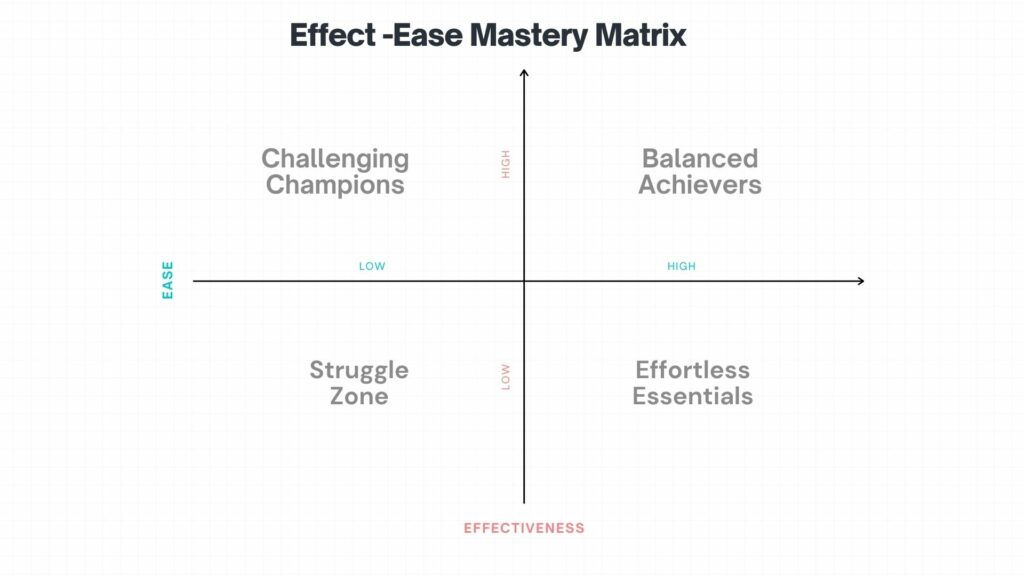
Effect-Ease Mastery Matrix : Habit Building Tool

Quadrant 1: Balanced Achievers

The Sweet Spot of Success

Habits in this quadrant strike a harmonious balance between effectiveness and ease of implementation. They are both effective in contributing to one’s goals and manageable in terms of the effort required. These are the habits that can bring about quite a big change with moderate levels of effort. But finding such habits may not be that easy. It will need a little creativity and innovation too. The tagline for this quadrant is “The Sweet Spot of Success,” highlighting the optimal balance achieved between effort and impact.

Quadrant 2: Challenging Champions

Where Grit Meets Greatness

This quadrant represents habits that are both challenging and highly effective. These habits may demand significant effort, discipline, and dedication but offer substantial rewards in terms of personal growth and goal achievement. If you have extremely high willpower and are highly adaptable to change you can pick on habits from this quadrant and you are good to go. Building these habits will bring you closer to your goals faster than anything else. The tagline for this quadrant is “Where Grit Meets Greatness,” emphasizing the resilience and determination required to conquer challenging but impactful habits.

Quadrant 3: Struggle Zone

Overcoming Obstacles on the Path to Mastery

In this quadrant, habits may be challenging to implement, but their impact on goal achievement is limited. These habits might demand a considerable amount of effort but may not bring significant results. The tagline for this quadrant is “Overcoming Obstacles on the Path to Mastery,” acknowledging the difficulties faced in pursuing habits with less tangible outcomes. Habits in this quadrant might be difficult to implement and may not bring significant results. But these may be those little things that can make you stand out from the rest of them. You should take up these only when you are the closest to your goals.

Quadrant 4: Effortless Essentials

Simplicity in Success

Here in this quadrant are habits that are easy to incorporate but do not have a high impact too. The habits that fall under this category are the ones that are not that important but you still have to do them anyway. Like, checking your emails every day. While they require minimal effort, their impact might be limited. Examples include cleaning up your desk, creating a to-do list, or minor daily tasks that don’t align with broader objectives. The tagline for this quadrant is “Simplicity in Success,” emphasizing the ease of incorporating these habits but also recognizing their limited impact. These are habits that aid your growth but do not directly impact it.

Anyone who starts building new habits should begin with something easy to incorporate and have maximum effectiveness in bringing them closer to their goals. Hence begin with habits in Quadrant 1. But also remember to not stop just there.

Effect-Ease Mastery Matrix For A Blogger

As a blogger when I divided my habits according to the effect-ease mastery matrix, this is how it looked:
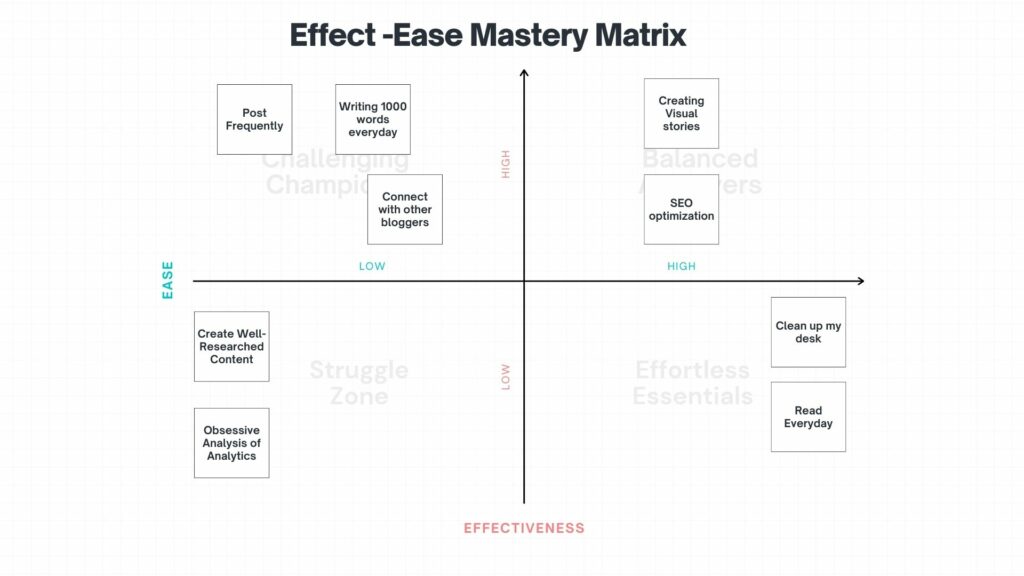
Building habits is a task that needs determination, but it is important to choose habits that will keep you motivated enough to achieve your goals. If you keep on challenging yourself with habits that are tough to incorporate and do not give any immediate result you may lose your intrinsic motivation to keep going. Hence, this Effect-Ease Mastery Matrix acts as a tool for you to decide where you should start.

how to strengthen your willpower and avoid temptations

Boosting Your Willpower: How to Avoid Temptations and Strengthen Your Willpower

Posted on March 1, 2023September 14, 2026 by Divya Toshniwal

Willpower, Determination, Conviction, Drive, and Self-control. There are many names by which you can call this emotion, but what it simply means is deciding upon something and seeing it through no matter what. Willpower is the ability to resist short-term temptations in order to achieve your long-term goals. A strong will can reap many benefits and help you reach your goals.

Table of Contents

  • Understanding Willpower and How It Works
  • Harnessing the Power of Willpower to Reach Your Goals
  • Benefits of Strong Willpower
  • How to Improve Willpower and Avoid Temptations

Understanding Willpower and How It Works

Willpower is the ability to keep moving forward even when things are not going your way. When you have a deep-seated desire and the intention to fulfill it, that is what starts your journey toward anything in life. It is quite easy to build a desire and take a pledge to fulfill it. It is also easy to start on the path with your initial motivation to get something or achieve something. The real test begins when you face obstructions and failures. This is when your willpower comes into action and helps you to keep moving.

The most important thing here is the intention. Your intention and the intensity of your desires are the most important factor in determining the strength of your willpower. To keep moving and gather new energy every time you face any obstacle you need to have very strong conviction.

Harnessing the Power of Willpower to Reach Your Goals

When a river leaves its abode in the mountains to meet the sea, it has to cross through the heartland filled with many obstructions. There are times when it needs to break those obstacles and sometimes change its course, it needs to modify according to the needs of the time and situation.

There is no highway to reach your goals, you have to carve out a path like a river does in order to keep flowing.

Divya Toshniwal

One of the key factors in someone’s success is willpower. It is said that successful is that person who can get up one more time than the number of times he has failed. The energy that is needed to get up that one extra time is your determination. It is essential to have strong willpower in order to be successful in life because no success comes without facing failures or obstacles, and when that happens you need to keep your motivation levels up and your intentions intact. The hope for a bright future and achievement of goals needs the base of strong willpower to grow on.

benefits of strong willpower

Benefits of Strong Willpower

  • Increased Self-Control: Strong willpower can help you increase your self-control. It helps you fight the desire for instant gratification and avoid temptations. When you can avoid temptations that are immediately gratifying, you can focus on your long-term goals and align yourself with them.
  • Better Decision-Making: When you have the ability to avoid immediate temptation and have a long-term vision, it becomes easier for you to make decisions that would have a permanent and long-term impact on your dreams and goal.
  • Better Focus: Better willpower gives you the ability to avoid distractions that otherwise disrupt your concentration. This will help you use your time effectively and be more productive.
  • Avoid Procrastination: Your willpower can help you overcome procrastination and boost your productivity. Procrastination is the act of delaying or postponing tasks, often due to a lack of motivation, interest in the task at hand, or maybe sheer laziness. The entire concept of procrastination is based on weak willpower and the need to get instant gratification. Having strong willpower can eliminate a number of issues that are caused by procrastination.
  • Healthy Life: All the unhealthy lifestyle choices that we make in life are for instant gratification. We eat junk food because it gratifies our taste buds right now, we laze around and do not work out because it avoids the struggle that the body has to go through, we drink alcohol for the instant kick we get, and so on. We give in to our temptations. Having strong willpower will help you make healthy choices, such as exercising regularly, eating a balanced diet, and avoiding harmful habits like smoking or excessive drinking.
  • Increased happiness: By resisting temptation and making positive choices, you may experience greater feelings of accomplishment, satisfaction, and well-being in the long run. You will find yourself being more content in your life.
how to strengthen willpower and avoid temptations

How to Improve Willpower and Avoid Temptations

Strengthening willpower is a gradual process and requires consistent effort and discipline. Be patient and persistent, and don’t be discouraged by setbacks or lapses. Here are a few things that will help you improve your willpower and avoid temptations for instant gratification.

  • Set realistic and achievable goals: Create a plan to achieve your long-term goals and make sure you break them down into some short-term goals. I call these mini-goals. Achieving these mini-goals in the journey will keep you motivated to focus on your long-term goals. This little satisfaction keeps you going and helps you avoid the diversions you may take for instant gratification.
  • Surround yourself with support: Be with friends, family, and supportive people who inspire you to achieve long-term goals and not with the ones who push you to give in to your temptations.
  • Identify your triggers: You will be surprised to know but there may be certain triggers to your temptations. You may tend to eat more junk food when you are stressed or you may binge-watch when you are delayed on your timeline to achieve a goal. Try to identify what breaks your ability to stay focused and determined and work on them.
  • Practice Mindfulness: Be here in this moment and avoid thinking about the things that tempt you to break down and leave behind your long-term goals. Mindfulness can help increase self-awareness and improve decision-making by reducing the influence of emotions and impulses.
  • Avoid Decision Fatigue: Decision fatigue is a real problem. When you have to take multiple decisions you exhaust yourself more. And when you are mentally exhausted you tend to give in to your temptations more easily.
  • Get enough sleep: Sleep deprivation can decrease your mental strength and the capacity of your brain to work efficiently and push itself to work harder. In such situations, you will feel weaker and in reduced capacity to exert your willpower. [Also read: 7 SLEEP MISTAKES THAT YOU ARE MAKING AND HOW TO FIX THEM ]
  • Eat healthy and exercise regularly: When you are physically fit, you have more control over your mental strength too. You can thus have more conviction towards your goals and be more focused without having any distractions.

Everyone is different and what works for one person may not work for another. It’s important to experiment and find what works best for you.

dealing with trauma

8 Strategies for Dealing with Trauma: Navigating the Healing Journey

Posted on January 23, 2023September 14, 2026 by Divya Toshniwal

Trauma can happen to anyone and everyone. In fact, in life, most of us face at least one traumatic event. Whether it be a death of a loved one, a physical injury or accident, some natural disaster, or loss of finances and security. Any such event can cause trauma. But how a person reacts to trauma is different for each individual. Every person has their own strategies for dealing with trauma

This article explores the cause of trauma, the signs of unhealed trauma, the psychological disorders that can be caused by trauma, and also the strategies for dealing with trauma.

Table of Contents

  • What Can Cause Trauma?
  • What Are the Signs of Trauma?
  • Psychological Issues Caused by Traumatic Events
  • Strategies for Dealing with Trauma
    • Practicing Self-Care
    • Professional Counselling
    • Engaging in Different Activities
    • Avoid Addictive Substances
    • Support Groups
    • Group Therapy
    • Art / Dance Therapy
    • Spiritual Practices

What Can Cause Trauma?

There can be a number of incidents that may be a cause of trauma for an individual. These incidents may be a one-time event or something that has built itself into trauma due to a continuously stressful environment. The following are some examples of what may be a cause of trauma:

  1. Abuse in any form, be it physical or emotional.
  2. Witnessing a violent event like war, terrorism, murder or so.
  3. Sudden loss of loved ones or a major financial setback.
  4. Witnessing or being a part of a traumatic event at work, such as a first responder or a healthcare worker
  5. Diagnosis of a life-threatening disease.
  6. Natural disasters, such as earthquakes or hurricanes
  7. Any accidents such as car accidents or plane crashes.
  8. Neglect or abuse during childhood leaves a lifelong impact.

What Are the Signs of Trauma?

The signs of trauma can vary for different individuals. The following story lists a few signs of unhealed trauma.

Signs Of Unhealed Trauma

Psychological Issues Caused by Traumatic Events

Traumatic events may lead to a number of psychological issues. These issues can be for a temporary phase but sometimes they may also leave an impact for a lifetime.

  1. Depression: Trauma can lead to depression by altering the way the brain processes emotions. Traumatic experiences can cause negative changes in the way the brain processes and interpret memories, leading to a greater likelihood of developing depression.
  2. Anxiety: Traumatic events create a fear of repetition. What if this happens again? This causes anxiety in the individual which when not addressed can lead to anxiety disorders.
  3. Post-traumatic stress disorder [PTSD]: The memories of the traumatic event are not processed properly and are instead stored in a way that causes them to be easily triggered. PTSD can develop after a single traumatic event or after experiencing multiple traumatic events over time.
  4. Acute Stress Disorder [ASD]: Acute Stress Disorder (ASD) is a condition that can develop after a person experiences a traumatic event. It is characterized by symptoms that are similar to those of Post-Traumatic Stress Disorder (PTSD) but occur within the first month after the traumatic event. While most people with ASD recover within a few days or weeks, some will go on to develop PTSD.
  5. Anger Issues: Trauma can cause anger issues because it can lead to feelings of powerlessness, fear, and vulnerability. These feelings can be overwhelming and difficult to process, which can lead to frustration and anger.
  6. Reactive Attachment Disorder: Reactive Attachment Disorder (RAD) is a condition that can develop in children who have experienced trauma in their early care. Children with RAD have difficulty forming healthy attachments with caregivers and may display withdrawn emotionally withdrawn, or indiscriminate social behavior.
strategies for dealing with trauma

Strategies for Dealing with Trauma

Practicing Self-Care

The most important task that one should focus on after a traumatic experience is to get back into the zone of taking care of self. Self-care activities like going on a walk, taking a proper diet, listening to some music, getting a massage, etc. help you recover. It impacts both your body and your mind and helps them heal.

Professional Counselling

Sometimes trauma can be so impactful that it disrupts your entire life and if you are not being able to navigate through it, it is better to seek professional help. This can help individuals learn coping skills, gain insight into their experiences, and learn to manage their symptoms of trauma-related psychological issues.

Engaging in Different Activities

Engaging in different interesting activities will help you take your mind off the memories and leftover emotions after a traumatic event. You can choose to take a vacation, switch a job, take up a new course of study, or maybe just find a new hobby. Just keep your brain engaged so that it does not get a lot of time to overthink.

[Also read – Patterns of overthinking and how to overcome them.]

Avoid Addictive Substances

Taking relief from some form of addiction may seem a very reliable and good option when you go through a traumatic event initially. But, in the long run, these addictive substances can become a reason why you are not being able to cope with the trauma and move on in your life.

Support Groups

Support Groups can help individuals who have experienced trauma by providing a safe and supportive space for them to process and understand their experiences.

Group Therapy

Group therapy provides a sense of ‘you are not alone’ it creates a pattern of normalization. When you see other people go through different traumatic experiences and cope with them to move on in life, it motivates you to do that as well. You can learn about various coping mechanisms that are being used by the group members and create one for yourself with help from the others. The most important part however is that it reduces isolation and creates emotional support for you.

Art / Dance Therapy

Alternative therapies like art therapy and dance therapy can work wonders in dealing with trauma. I have faced many cases where people don’t want to talk about their trauma. Talking about it makes things worst for them and they feel like reliving the entire incident. Hence alternative therapies provide them with a release without even talking about anything.

Spiritual Practices

Although they are old school, some spiritual practices can be a great support in dealing with trauma.

Spiritual Practices for Healing Past Trauma
effective uses and types of art therapy

Effective Uses and Types Of Art Therapy

Posted on January 15, 2023September 14, 2026 by Divya Toshniwal

Art has been an intrinsic part of us since pre-historic times, even when we did not speak and converse in words. The therapeutic aspects of art although have been rediscovered during the Second World War based on the concepts given by Carl Jung.

What is Art Therapy?

Our subconscious mind manifests itself through images and thus art therapy can be both a cathartic process and discovery of what is not evident. Art therapy is a form of psychotherapy that uses art as a means of expression and communication. 93% of what we communicate is expressed non-verbally while words are considered to be only 7% of the entire communication. Some non-verbal gestures are conscious while the others are subconscious. Hence there is a lot to explore in the non-verbal section of expression and communication.

Even when so many complex languages with so many words have been developed there are still times we say ‘ I don’t have words to express how I feel about this.’

Art therapy is used to help individuals explore their emotions, thoughts, and experiences in a nonverbal way, and can be used to treat a wide range of mental health conditions, such as anxiety, depression, and trauma.

uses of art therapy

Uses Of Art Therapy

A major question that arises here is when should you use art therapy. The short answer to it is anywhere and anytime. The helpful answer, however, would be when you can get some examples of where you can use art therapy.

Below are listed some uses of art therapy. The list is not exhaustive.

You can use it for expression of emotions.

Art therapy allows individuals to express their emotions in a nonverbal way, which can be especially helpful for those who have difficulty expressing themselves verbally. People can use symbols, colors and patterns in order to express the way they feel. Sometimes they may not even know the emotions they are going through but creating a piece of art may help them discover it.

You can use it for self-awareness

Any creative process, including art, brings you closer to yourself. They let your thoughts run wild and bring you out of inhibitions and into a journey of self-exploration. Art therapy may help you in gaining insights about your dreams, strengths, fears, and much more.

You can use it for stress-relief

Using art therapy as a creative and meditative process can help you relax and let go of any stress you are holding. Mandala art and finger paintings works very well for this.

Also read : 14 Tried and Tested Ways To Reduce Stress

You can use it for coping with trauma

For people who have gone through a traumatic experience, talking about it can send them further into a spiral. Talk therapies can be useful once they have caught hold of some emotions. In such situations art therapy acts as a medium for coping up with the trauma in a safe and controlled atmosphere. it gives you a space to let it all out.

You can use it to boost your self-esteem

Art therapy leaves you with a product, something that you have created. Hence, providing a feeling of creation and satisfaction within you . This impacts your subconscious mind in a way that boosts your self-esteem.

You can use it to improve communication

Art therapy can help individuals communicate their thoughts and feelings to others in a way that is less confrontational and more easily understood. It can be used for couples therapy and family therapy when communicating in words are increasing the issues.

There are a variety of techniques and materials used by art therapists . The different types of art therapies are listed below.

types of art therapy

What are the Different Types of Art Therapy?

Art therapy is not limited to traditional art forms such as drawing, painting, and sculpture. It also include other aspects like collage making, sand art , thread works, crochet , knitting, shadow art, and much more.

There are a variety of techniques that are used by art therapists around the world and each has their own uses and benefits.

Traditional Art Therapy

This type of therapy involves the use of traditional art materials, such as paint, pencils, and clay, to create art. This style of therapy can be used for a number of purposes including self-awareness, emotional regulation, expression or to gain insight into your own needs and desires. Creating mandalas is also a part of this kind of therapy.

Expressive Art Therapy

This type of therapy incorporates multiple art forms, such as music, drama, and dance, to help individuals express themselves in a nonverbal way. Expressive art therapy can be used to address a wide range of mental health conditions, including anxiety, depression, and trauma.

Play Therapy

This type of therapy is usually used with children who are small. A variety of play materials and toys are used to help children express their thoughts and feelings in a safe and easier way since children may not be able to express themselves verbally.

Sand Tray Therapy

Based on the work of Dora Kalff and Carl Jung, Sand Tray Therapy is a form of art therapy that uses miniature figures and a sandbox to create symbolic representations of the individual’s inner world. It’s based on the assumption that the individual’s unconscious will be able to express itself through the manipulation of the sand and figures.

Group Art Therapy

Group art therapy involves the use of art-making as a means of communication within a group setting, which can be helpful for individuals who may benefit from the support and feedback of others. This can be effectively used to create team building experiences and resolving conflicts within groups as well.

Craft Therapy

Creating craft items like stuff from crochet , masks , home decors etc can also act as a therapeutic medium. Crochet can be really meditative and also the end product when created gives you a sense of accomplishment.

These are some examples of the most common types of art therapy, but the field is constantly evolving and new techniques are being developed and explored.

You can check this book out for detailed art therapy techniques :

250 Brief, Creative & Practical Art Therapy Techniques

crisis management using dialectical behavior therapy

Crisis Management Using Dialectical Behavior Therapy (DBT)

Posted on November 23, 2022September 14, 2026 by Divya Toshniwal

Not a single one of us has been devoid of a crisis situation. We have all been in a place where things seem out of hand and we do not really know what to do. We all have a fight-or-flight response in such situations. Some of us may also have a freeze or fawn response. But what is the right way to manage a crisis? Well first of all there is no one right way. But I did find some things when I started reading psychology. I have always focused on using the concepts of psychology in everyday life so that we have the tools to handle any situation before it even arises. This is my attempt to give you a practical approach to crisis management using dialectical behavior therapy.

IN THIS ARTICLE:

  • What Is a Crisis Situation?
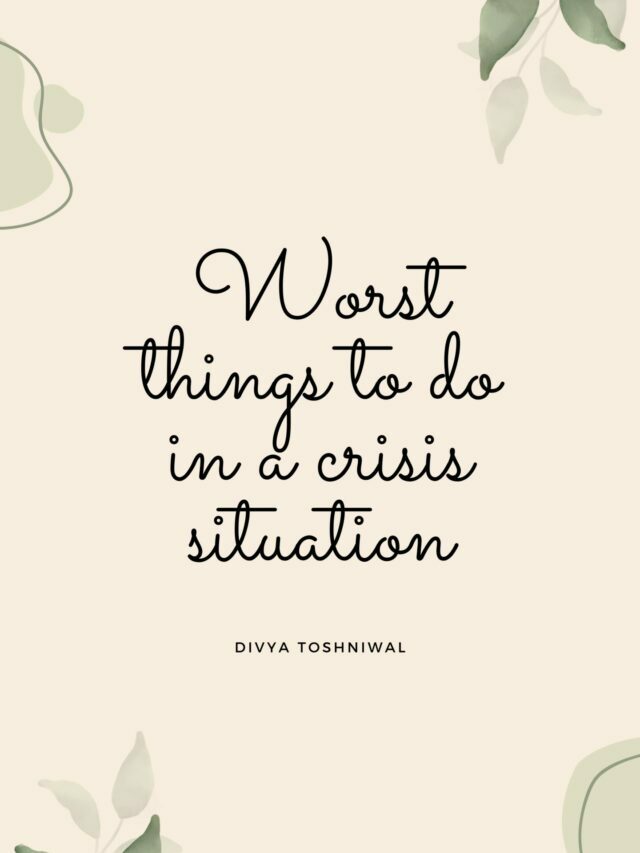
  • Worst Things To Do In A Crisis Situation
  • What is Dialectical Behaviour Therapy?
  • Crisis Management Using Distress Tolerance Skills of DBT
  • Crisis Management Using STOP Skills
  • Crisis Management Using Urge Surfing
  • Crisis Management using Distraction techniques like – ACCEPTS
  • Crisis Management using IMPROVE skills

What Is a Crisis Situation?

To start with let us define what a crisis situation is. In simple words, a crisis situation is any event that has a potentially negative outcome. There can be a number of events in your everyday life that may have negative outcomes, but you will not classify all of them as crisis situations. So to clear that up – a crisis situation can be where –

  1. There is a potentially negative outcome
  2. The incident is unexpected
  3. It can be linked to an emotional turmoil
  4. It causes interruptions in basic day-to-day functioning
  5. It has the potential to cause permanent damage
  6. The knowledge about the situation is limited

Worst Things To Do In A Crisis Situation

Worst Things To Do In A Crisis Situation

What is Dialectical Behaviour Therapy?

DBT is a kind of cognitive behavior therapy that works on evidence-based principles to bring about changes in our personalities and deal with interpersonal conflicts. It also works very well for intra-personal conflicts. DBT uses mindfulness-based strategies to synthesize a balance of acceptance and change. Though generally used to treat personality disorders there are many aspects of DBT that can be used for our everyday conflicts and emotional regulation. There are 4 components of Dialectical Behaviour Therapy:

Mindfulness

Interpersonal Effectiveness

Distress Tolerance

Emotional Regulation

Here we will focus on the distress tolerance skill set of DBT and how it can help us in crisis management.

Warning: DBT is a complex therapy and hence I would not suggest you do self-treatments if the crisis situation is out of your hands. This article is only written to make you aware of the concepts and use it for your regular crisis management situations. If the situations are overwhelming to you, please take professional help.

Crisis Management Using Dialectical Behavior Therapy (DBT)

Crisis Management Using Distress Tolerance Skills of DBT

Pain and distress are part of life but dwelling on a problem is not going to change anything. Also refusing to accept these situations will also lead to suffering. The goal of distress tolerance skills in DBT is to accept, find meaning and tolerate the crisis.

Change causes crisis and crisis causes change.

Hence any attempts at change will produce some sort of crisis in life and hence it is very important for each individual to be able to handle the crisis.

Crisis Management Using STOP Skills

STOP is the Abbreviation for the following steps that you can take in order to have more clarity on the crisis situation and your direction of dealing with it. What actions you take to handle the crisis situation is a secondary matter. The first thing you need to deal with is your own emotions.

  • S: Stop: Just pause where you are and try to halt the chain of thoughts that your mind is building. Think about what steps you can take in order to stop the suffering in short term, which may or may not actually bring any change in the crisis. Overthinking is one of the major issues so try to identify your patterns of overthinking and find ways to stop overthinking.
  • T: Take a step back: When you are in a situation it is tough to look at things clearly. So, take a step back and look at the bigger picture from a distance. Think about what are the options that can help you reach your goals and survive this crisis.
  • O: Observe: Observe the external and internal circumstances. Think about how you feel and what you would like to feel about the entire situation. Observe which thoughts are increasing your suffering in this crisis.
  • P: Proceed Mindfully: What are the alternative thought that can help you feel better in this crisis situation? What are the thoughts that can make you feel empowered? These are the questions that you need to mindfully deal with.

Crisis Management Using Urge Surfing

In any crisis situation, you would have some urges to indulge in activities that are listed as worse things to do in a crisis situation above. This skill helps you to deal with that urge.

Urges last generally intense for 20-30 minutes. So when dealing with the urges it is better to let the wave pass. You cannot avoid the wave and you cannot deny it. Hence it is important to be open to your urges. This does not mean I am suggesting that you give in to your urges. This would be devastating. All I am saying is let yourself acknowledge that there is an urge and it is ok to have this urge but every urge doesn’t need to be acted upon. Remind yourself that you do have a choice. Ask yourself what are the benefits of acting upon these urges now. What are the drawbacks of acting upon these urges?

Hold yourself strong for 30 minutes, and let the peak of the wave pass. It is in the nature of the wave to fall down again and hence your urges would be controllable after a span of time too. Divert your attention for those 30 minutes into some other activities. Some of the activities in the next section may help you.

Crisis Management Using Dialectical Behavior Therapy (DBT)

Crisis Management using Distraction techniques like – ACCEPTS

  • Activities: Do activities that engage your brain enough to forget about things going on. A few examples include solving a puzzle, cleaning your home, calling a friend, picking up incomplete books or projects, painting, writing, and so on.
  • Contributing: Give something to someone else. I have always said that making someone else happy in turn releases happiness hormones for you and hence it makes you feel better even on the dullest of days.
  • Comparisons: Comparisons though not always healthy can some times give you relief. So think about how far you have come. Think about where you were a few years ago and how you have developed. Think about people who suffer worse than you. Be grateful for all the things you have.
  • Emotions: Cultivate a different emotion in order to overcome one. You can be in charge of your emotions hence when you want to distract your mind focus on the opposite of the emotion you are feeling right now. For example, if you are sad and depressed, just put on some comedy movie that would make you laugh. If you are feeling demotivated, borrow motivation from someone. You can do this by reading about things or by watching a video of people doing that.
  • Pushing Away: Sometimes when you are not ready to deal with something it is better to push it away. Not forever, but for the time being it can be the best solution for you.
  • Thoughts: Change your thoughts to think about something totally different from what you are currently feeling. Replace the negative emotions by going out of the way to do something totally different like saying the alphabet backward, or listing down all the states in the country.
  • Self-Soothing: Soothe your body with the help of sensations. These can be through sight (reading, watching, imagining), smell (aromatherapy or fresh flowers), hearing(music), touch (massage), and taste (food you love). These can give you temporary relief till the time you are ready to regulate your emotions.
Crisis Management Using Dialectical Behavior Therapy (DBT)

Crisis Management using IMPROVE skills

The IMPROVE skills are about improving the moment you are in right now.

  • Imagery: Use visualization in order to create happier imagery in your mind. Like imagining your safe space, or successfully dealing with this situation.
  • Meaning: Change how you think about the situation. Try to make lemonade with the lemons life has given you. and, if you do not like lemonade then read this.
  • Prayer: This may seem a bit old school but we Indians have highly believed in the power of prayers. So at this moment, pray and believe in your prayers.
  • Relaxation: Relaxation needs to be done both physically and mentally. You can use active relaxation for your body by working out or dancing. You can also use passive relaxation by sleeping or getting a massage. Meditation is the best option for mental relaxation but music or indulging in a hobby can also work wonders.
  • One thing in a moment: Focus on what you are doing right now, and only on that. Mindfulness is a tool that helps a lot to feel better at the moment.
  • Vacation: Take a break, if possible go someplace else, and if it’s not possible take at least a mental vacation. Learn to separate work and relations, and take short breaks during the entire day. these things will help you tone down the overwhelming feeling that comes with a crisis.
  • Encouragement: Be your own best friend. If your best friend comes to you with a crisis, you don’t panic, you provide them with solutions like a life coach. So, become the same for yourself.

These are some distress tolerance skills from dialectical behavior therapy that you can use for crisis management. If you wish to read more about DBT here are some book suggestions:

  • Calming the Emotional Storm
  • The Dialectical Behavior Therapy Skills Workbook

How to Uplift Your Spirits When You Feel Gloomy

Posted on November 11, 2022September 14, 2026 by Divya Toshniwal
How to uplift your spirits on a sad day

Troubles are everywhere. We face issues in relationships, we face issues at work, and we face issues relating to our own physical and mental health. Even on my happiest days if I look around I find someone or the other facing some kind of issue. Right now, most people are concerned about rising prices and thus expenses. The ones who do not have to worry about their finances are helpless as they face issues in their personal relations. The ones who are lucky enough to be out of relationship mess and financial dilemmas are physically unfit or maybe just not happy with where their lives are going.

I have had many coaching clients who have just one little complaint. They are not finding their life meaningful. They say they do not know where they are going and whether they are happy doing what they are doing. This makes them sad, and although they have a life that most people would kill for, they still feel gloomy and depressed.

Though this issue is deep-seated and needs personally customized plans for every individual here I want to address a general problem and unique solutions to it.

The question that I want to address today is simple.

How to uplift your spirits when you are sad.

If the reason behind your sadness is external circumstances and is out of your control:

In situations where everything is out of your control, it becomes tougher to let it go and uplift your spirits. But the most important point to remember here is that there is actually nothing you can do to change the circumstances. You are unhappy about people dying but you cannot stop the war between the 2 countries. You don’t like government policies but it is not in your hands alone to change the government. You don’t like the way a certain person behaves but you cannot change their behavior. You don’t like that your boss prefers your colleague over you but you cannot change their behavior. You do not like your job but that is what keeps your family going so you can’t quit. All you can do is change the way you react to things and make things easier for yourself.

  • Sleep for some time. It might sound like a silly suggestion to start with but it works wonders. When there is something that is disturbing you and you can do nothing about it sleeping for some time can give your brain the relaxation it has been craving from all that overthinking. When you wake up you will feel a little better.
  • Cry if you need to. There have been many pieces of research on why people feel better after crying and what it reveals is crying releases oxytocin and endorphins. These happiness hormones help deal better with both emotional and physical pain.
  • Schedule meetings with people you like. Meet them and divert your attention to things that make you feel better.
  • Do something for someone else. Evolution has wired us to help each other. Our bodies are structured in such a way that when we give to others or help others it helps release happiness hormones like oxytocin and reduces cortisol (stress hormones). Read more here.
  • Listen to Music. Research has shown that listening to music can reduce anxiety, stress, blood pressure and in fact also relieve you from pain (both mental and physical). It improves your mood.
  • Have a Gratitude Jar. This will need a little preparation but can work wonders when you are sad. Whenever something good happens to you make a note of it, fold the paper and put it in a jar. The next time when you are upset pick out random chits and start reading them. You can also do it with a gratitude journal.
  • Go for walks. Being close to nature and working out both can help you curb your stress hormones and thus going for a walk becomes the most desirable option.

If the reason for your sadness is internal and you can make some changes to feel better:

For times when there is something that you can do about the situation and bring about a change here are the things that you can do to uplift your spirits.

  • Focus on facts. Many a times we overthink and make things worse for ourselves. In order to uplift your mood the first step you need to do is stop overthinking and focus on reality.
  • Create an action plan. Once you can stop your overthinking the next step is to take action.For example, if you do not love your job and you are not being able to make the switch because of financial responsibilities, then start working on making a shift. Learn how to reduce you expenses. Try to find things you love and how you can make a career in them. Follow the HEART model for setting goals. Initially just use your spare time and weekends to work on it and then you can make a permanent switch when it is possible. No matter what the issue, even creating an action plan to bring about the change can uplift your spirits.
  • Talk about it. Talk to people about it and not with the ones who will make you further gloomy. Have a set of solution-oriented people. The ones who can actually give you some great suggestions for working on your current situation.
  • Work on improving your mental health. Check your belief system, and work on strengthening it. Create your own calm and work on things that make you anxious. Connect with a professional who can help you identify why you are feeling a certain way and what changes you can bring in your life to make you feel good about it. Spend time with yourself and for yourself. Indulge in self-care.
  • Learn to say no. There may be times when you overburden yourself just to please others. Work on saying no and being able to live with the fact that you cannot make everybody happy all the time.
How to feel happier on a sad day

benefits of using mind mapping tool

The Benefits of Mind-Mapping

Posted on March 11, 2022September 14, 2026 by Divya Toshniwal

Among the various tools of brainstorming, mind-mapping has been the most popular and common among life coaches all around the world. Whether it is for setting up your goals or taking action on achieving them, mind-mapping works on both aspects. Whether it is to create something from scratch or to resolve issues in already established ideas, mind mapping is an efficient tool for both. There are various benefits of mind-mapping but before we get into that we need to understand what is mind-mapping and how this tool exactly works.

What is Mind-Mapping?

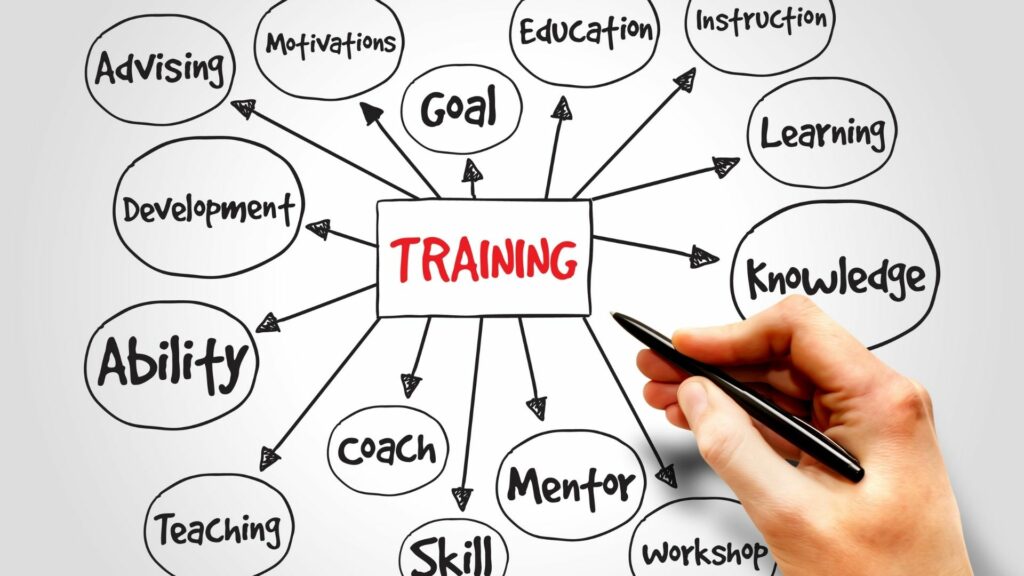
Mind-mapping is a graphical representation of the brainstorming you do around a central idea. The process to use the mind-mapping tool is simple. Mind-mapping starts with one central idea and whatever related information or ideas you have around that central idea are noted down around that idea displayed as different branches. Similar ideas are grouped under one branch. This helps you get all information and creative ideas on one screen to view in one glance.

The Benefits of Mind-Mapping as a Tool for Coaching

  1. Makes learning meaningful – Mind- Mapping promotes conceptual learning instead of rote learning. When graphically represented the connections between the ideas come our clearer and stronger. This makes learning more meaningful.
  2. Increases Creativity- One of the benefits of mind-mapping is that is promotes and increases creative thinking abilities. Mind mapping allows you to expand on ideas using trigger words. It creates association between the ideas which helps you to identify connections that were not visible otherwise.
  3. Helps with Memorization- When you see connections between your ideas it becomes easier to memorize the concepts. Rote learning is a formula of past and now it is important to understand the concepts and connections to work on ideas.
  4. Simplifies – The greatest benefit of mind mapping that I have found though is that it simplifies complex ideas, connections, processes and problems. When all the aspects of a particular concepts are laid out in front of you with all possible connections and the representations show you how each idea is derived it simplifies even the most complex problems.

How can you use Mind-Mapping to achieve your goals?

When we talk about coaching , most of us refer to coaching for goal achievement. So, let us now see how mind-mapping can help you have clearer goals and also a well defined path to achieve them.

Steps to follow:

  1. Right your goal in the centre of the page
  2. From the left side start building on paths that can lead to it from separate directions
  3. To the right start building how achieving this goal will affect your life.
  4. On the bottom set up alternative goals or opportunity cost
  5. On the top list the obstacles that you may face and skills that you need.
  6. Feel free to branch out anything you see relevant to the goal.

Example of mind-mapping:

mind-mapping

The 5 M’s of Achieving Your Goal

Posted on January 24, 2022September 14, 2026 by Divya Toshniwal

We all have dreams, we all have desires. Some are materialistic desires while others are emotional, social, or spiritual desires. But we all have desires. To transform my desires into goals I started using the H.E.A.R.T. Model for goal setting. Not only me but many of my clients have benefitted from this model too.

While talking about the HEART model I also talked about preparing for the action. If I had 7 hours to cut a tree I’ll spend 6 hours sharpening my axe. This article is about sharpening the axe.

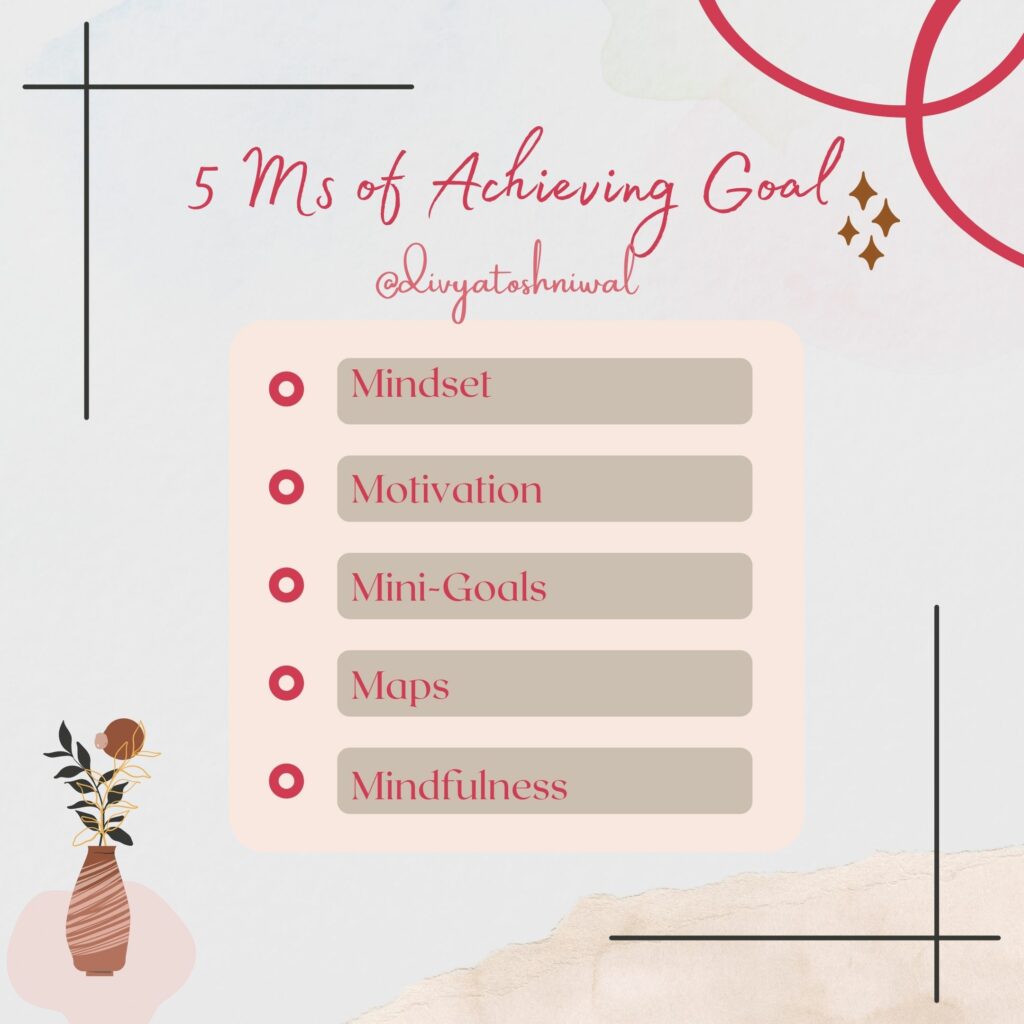
There are 5 M’s that you need to be aware of while working on achieving your goals.

5 M's of Achieving Goals

Mindset

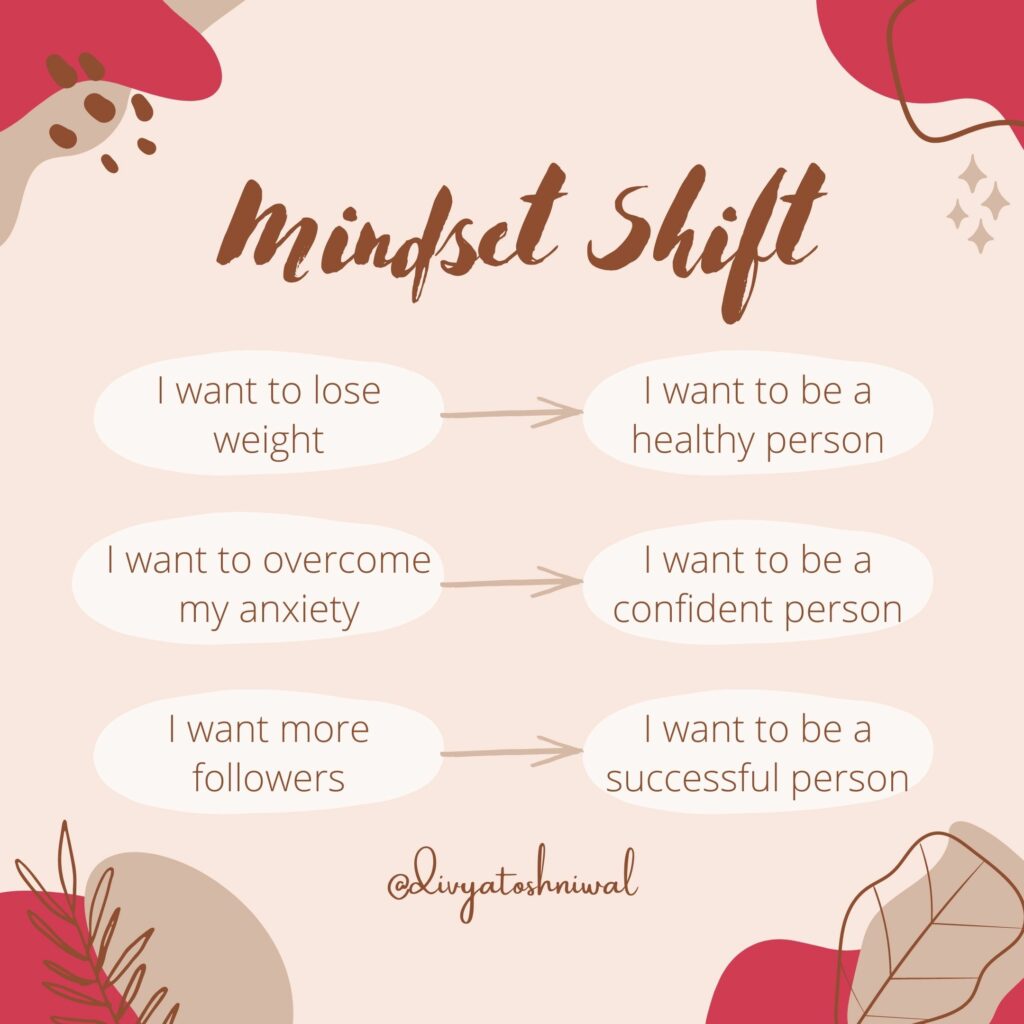
While talking about goals it is more important to set your mindset, than your targets. What I mean here is to set your mindset for the kind of person you want to become. The goal is to become a healthy person and not lose 10kgs. The goal is to become a good parent and not reduce scolding your kids. The goal is to become a rich person and not earn a million dollars. Set your mind like the person you want to become and start living like one. So when you make a decision on what you should eat ask yourself what would a healthy person eat. Make decisions like the person you want to become.

mindset shift

Motivation

Understand the Why?’ behind your goal. What is your motivation? Why are you setting up these goals? If you are not motivated enough to achieve your goals, you will not be able to leave your comfort zone and the growth zone definitely starts after that. Even if you are successful in the internal fights you would turn back at the first sight of external trouble and hence it is extremely important that you have a very strong motivating force for achieving your goals. This motivation can be internal or external, but in my opinion, internal motivations work better in the long run while external motivations are excellent for immediate gratification.

Mini-Goals

It is easier to achieve goals that can be achieved in a short span of time. It’s better to target reading one book a week than 52 books in a year. This way when you complete the book one of your mini-goals is already achieved. Your brain celebrates and is ready to accept next week’s goal. On the other hand, 52 books feel like a burden and if you are not able to read for a few weeks it feels like piling up and you are more likely to give up. When I started writing my book I set up mini-goals like creating a flow about what I want to say, then listing down the chapters, writing each chapter was a mini-goal, even- proofreading and creating the graphics were set up as goals. I celebrated each achievement and it motivated me to keep writing.

Maps

If you are going treasure hunting, don’t forget the map. If you want something, always remember that someone, somewhere in the world has created a map for it. Someone has been on this path and they have left breadcrumbs for you to follow. Find out about the people who have achieved the goal and also the ones who could not. You can learn a lot from their journey. Refer to the various maps created by these people and create your own map for reaching your goal. No, I am not telling you to follow someone blindly but I would strongly recommend taking suggestions from both who achieved or could not achieve their goals.

Mindfulness

Mindfulness is a very important quality that you need to develop in order to achieve your goals. Neither ruminating about the past nor planning the future is going to actually help you in achieving your goal. Rather, what will actually help is taking action in the present. Being in the present moment fully aware of what is happening around you is extremely helpful in grabbing the opportunities that come your way. Most of us lose many opportunities because we do not even realize that this opportunity has come our way. We are not able to identify the expressways and keep struggling in the smaller lanes.

There are many ways to develop mindfulness and one of my tried and tested ways is meditation. You can read about the types of meditation here.

To read similar articles on achieving goals click here.

9 Barriers In Achieving Your Goals You Can Break

Posted on January 19, 2022September 14, 2026 by Divya Toshniwal

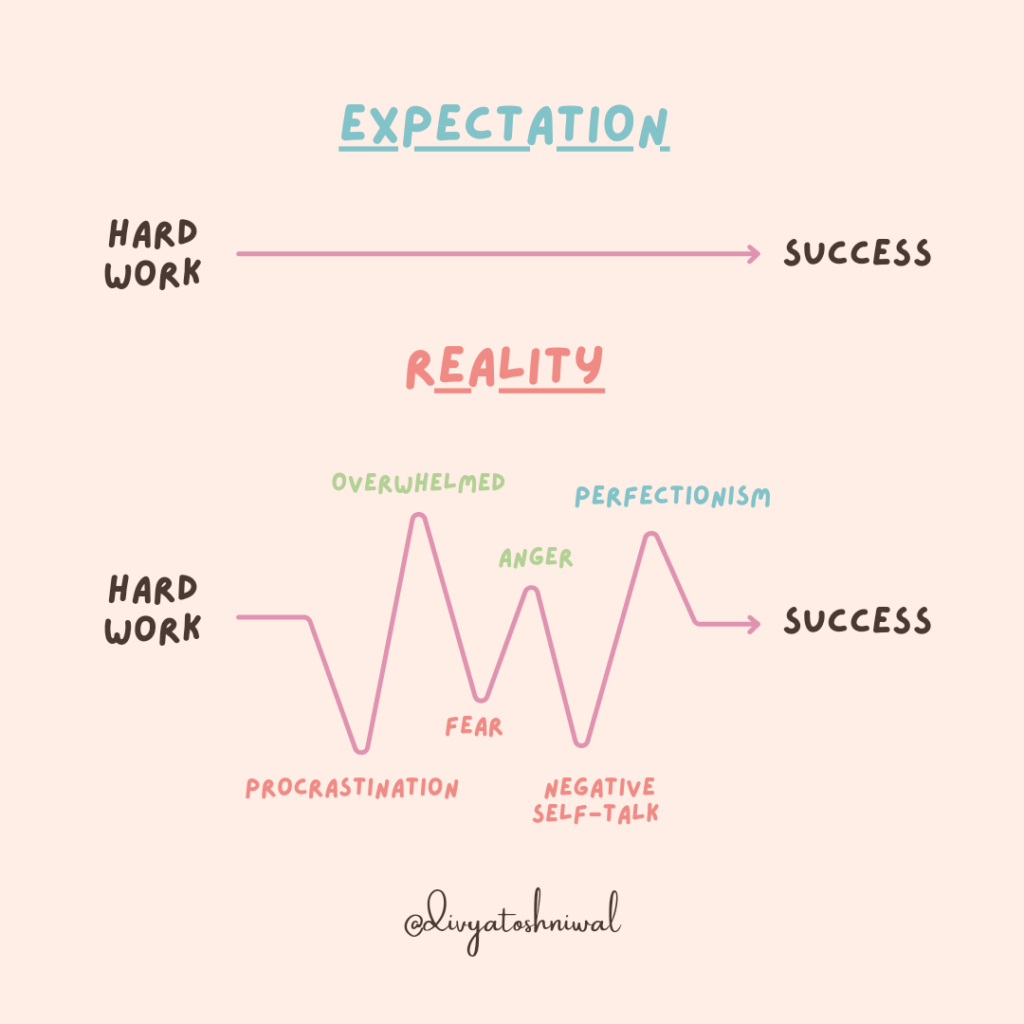
Achieving your goals is not going to be a smooth ride. You are not going to get a road without speed breakers. A few of these obstructions in achieving your goal will be absolutely out of your control while some you can manage to control. Having these internal obstacles is not defeating but doing nothing about them definitely is. I am listing down 9 different internal obstructions that I have faced along with my clients and also how you can deal with a few of them.

Break Barriers and achieve your goals

Perfectionism

How can being perfect be a barrier to achieving your goals? it should rather be motivation, right?

well, not always. Being perfect can lead to more harm than good in your journey towards success. I have faced this myself. I was not ready to present myself as a life coach until I have learned it all. I spent almost 3 years trying to understand all the things I need to learn and learning them. Every time I would set a date to make the announcement and every time I realized there is still more to learn. Learning would never end and it should never end. Learning is an ongoing process and hence no one can ever be perfect.

Don’t stop learning but don’t wait to be perfect too.

Procrastination

This is my favorite one. How many times do you think you tell yourself ‘ I’ll do that later.’ in one day? The first thing you need to do is count it. Once you are done counting, ask yourself why are you saying that. Procrastination (meaning – the act of putting off doing something that you should do till another day or time because you do not want to do it because it’s unpleasant or boring.) There can be a number of reasons for procrastination but only one way to deal with it. As Nike says ‘just do it.’

One of the best solutions that I have come up with to deal with procrastination is the 5-minute-rule. The 5-Minute-Rule to deal with procrastination is simply that if any task that you are supposed to do, is going to take less than 5 minutes to do, you would not postpone it. This has worked for me and many of my clients. Not only will this help you achieve your goals, but it will also make you more organized and save a lot of your time in the long run.

Losing Focus

This is the most common obstacle to achieving your goal. Most of us have been facing this lately and no doubt the biggest reason is our smartphones and the pinging notifications. Your phone never lets you leave its side. As soon as you lock the screen and try and focus on work again there comes a ‘ping’ and here you go back to your phone. One thing leads to another and there go the next 20 minutes of your life.

The best way to deal with the distractions is to remove them. Simply remove them and don’t exert your willpower. You don’t have an infinite stock of it. Simply remove your distractions. So if your biggest distraction is your phone, switch it off or at least put it on focus mode.

Feeling Overwhelmed

You are bound to feel overwhelmed if you take up goals that are too difficult to achieve or those which have a lot of aspects attached to them. It takes a toll on your confidence or blocks a large portion of your mind in assessing the next steps and calculating all the variables. Such goals stop you from moving forward even when you keep working on them the entire day. The reason is that you are not able to take any actionable steps.

The best solution is to simplify your goals and divide them into smaller goals. So if you have a goal for the year, divide it into 12 monthly goals, the weekly goals, and then daily goals, making them easier, clearer, and achievable. Do not underestimate the power of small steps.

Boredom or Retreat

Too simple goals or goals that are not challenging enough can also be the reason why you are not being able to achieve them. Have you ever thought about visiting the nearest tourist place to your city ? you always feel like- ‘we can go there anytime. Let us go to some other good (far away) place. ‘. This has happened to me so many times and in spite of living in Kolkata for 25 years, I have never been to Darjeeling while I have traveled to Mussoorie, Nainital, and Kashmir.

The same applies to our goals. We procrastinate and say it’s too easy it can be done anytime. But that anytime never comes. So don’t make your goals too easy to achieve.

Drama Seeking Behavior

For people who love drama, the fights between two colleagues, banter in the house, and back-bitching from people(or sometimes even self), be aware, this is taking up so much time of your life that it is pulling you behind and not letting you achieve your goals. This can be the silliest and most daunting barrier that you’ll ever face in achieving your goals.

So just stop, which one of your colleagues is going to win the fight is not going to make any difference in your life. Understand the reason behind this behavior. Even though it is the silliest obstacle it might be one of the toughest to deal with. Mostly, people who seek drama in others’ life are ones who do not have fulfilling lives themselves. So, connect to someone who can help you create a fulfilling life for yourself.

Negative Self-talk

“I have failed before, I will fail again”

“Nobody wants what I have to offer”

” I don’t have the right connections”

“This is way out of my league”

Do these statements sound familiar? Well, then you are a victim of negative self-talk. The irony is that you are the victim and you are the assailant too. Creating self-awareness is very important to understand why are you saying these negative statements to yourself. Imagine if your best friend came to you and told you a business idea, would you say this to them?

Dig deeper into your beliefs, see what are the beliefs you hold for yourself and why do you hold these beliefs. Eliminate the negative beliefs and move on. It will take some time and some practice, nothing happens overnights. But things will change. Start talking to yourself positively. Learn more on how to overcome negative self-talk here.

Fear

One of the most common reasons you are not able to achieve your goals is- fear. Fear of the unknown. Many of us are not being able to move forward just because we are too comfortable where we are. Even when we are not happy, we prefer to stay because there is a certainty. We prefer not to venture into the unknown as here at least we know what’s going to happen. Even Elsa could realize her true power only when she ventured into the unknown, so take that lesson from Disney.

Anger

Anger – it’s the most dangerous emotion to face. Yes, it’s a part of our emotions wheel and yes, everyone is bound to face it. But, how you deal with it is what will make all the difference. Do you rise above it and move forward, or will you let your energy burn in the heat of it(remember you have limited energy for each day)? Keeping any kind of anger or disappointment within you can cause a lot of your energy to burn without any fruitful results in your favor.

So ask yourself – are you angry when someone gets a promotion and you don’t? are you angry when things don’t work for you and they work for someone else? are you angry when you can’t perform as much as you expected to? and how do you react to your emotion of anger?

Take your anger out in productive ways. Empty yourself of this negative energy. I am not going to tell you to count backward and breathe deep. Because this kind of anger may not even surface but it’s there. So you need to dig deeper to see where it arises from and how it affects you. This will help you change your thought patterns when you start working on your emotions.

To understand your own obstacles and how you can deal with them, You can connect to me for personal virtual sessions

Break Barriers and achieve your goals

HEART Model For Goal Setting

Posted on January 14, 2022September 14, 2026 by Divya Toshniwal

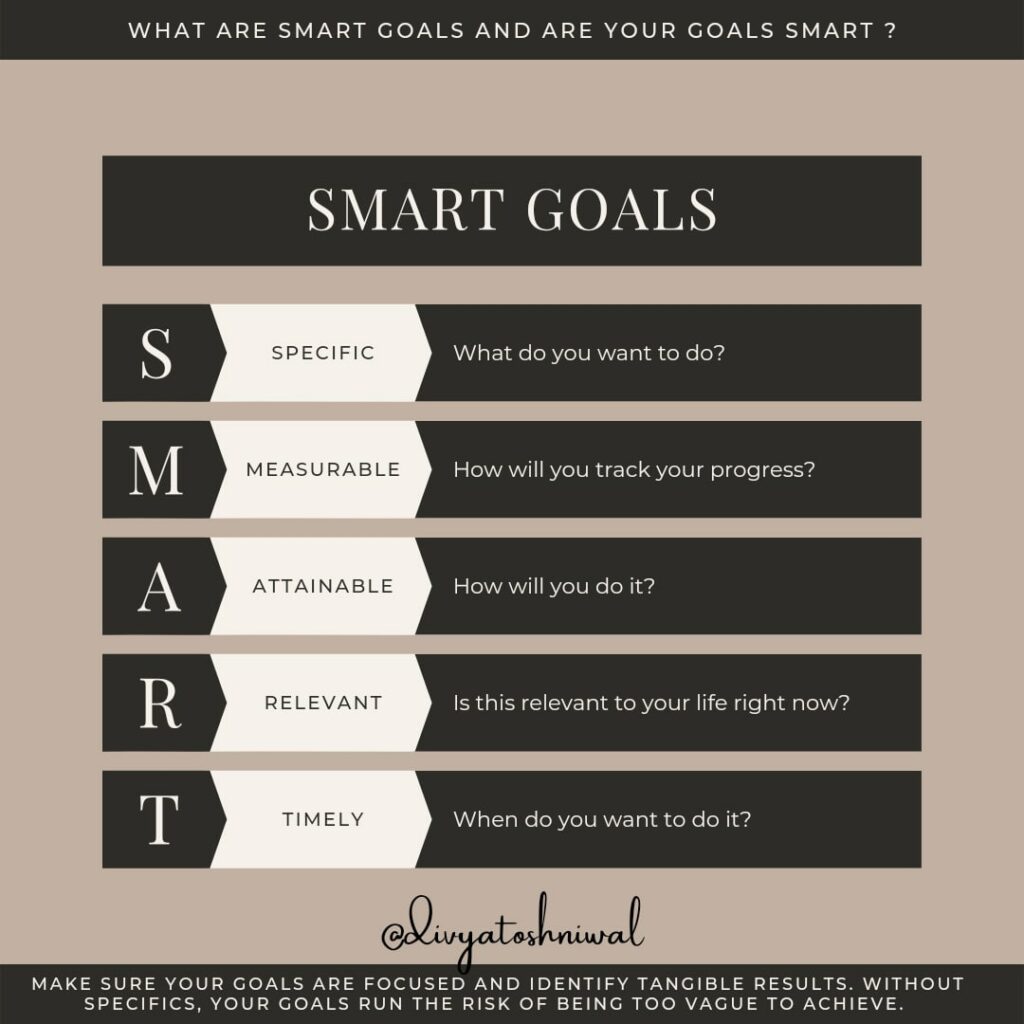
While talking about achieving your goals the most prominent thing you’ll hear is to be determined, take the first step, and make your goals SMART. Smart word here isn’t used literally but as an abbreviation for the model used for goal setting .

SMART model of goal setting in life coaching

The new innovative approach that I applied to myself a few weeks ago, however, is a little different and more fulfilling. The model that I am talking about is the HEART model for goal setting.

Why HEART you ask? Because something that comes from your heart and has your emotions attached is always more powerful than something that comes from your mind.

HEART model for goal setting in coaching

The HEART model for goal setting is closer to you emotionally and has extra motivation and impact when you move forward to achieve it. Even when things do not work out the way you want them to and even when you are not getting desired results, you are bound to try harder for things that are closer to your heart, in comparison to things that your mind is telling you to achieve.

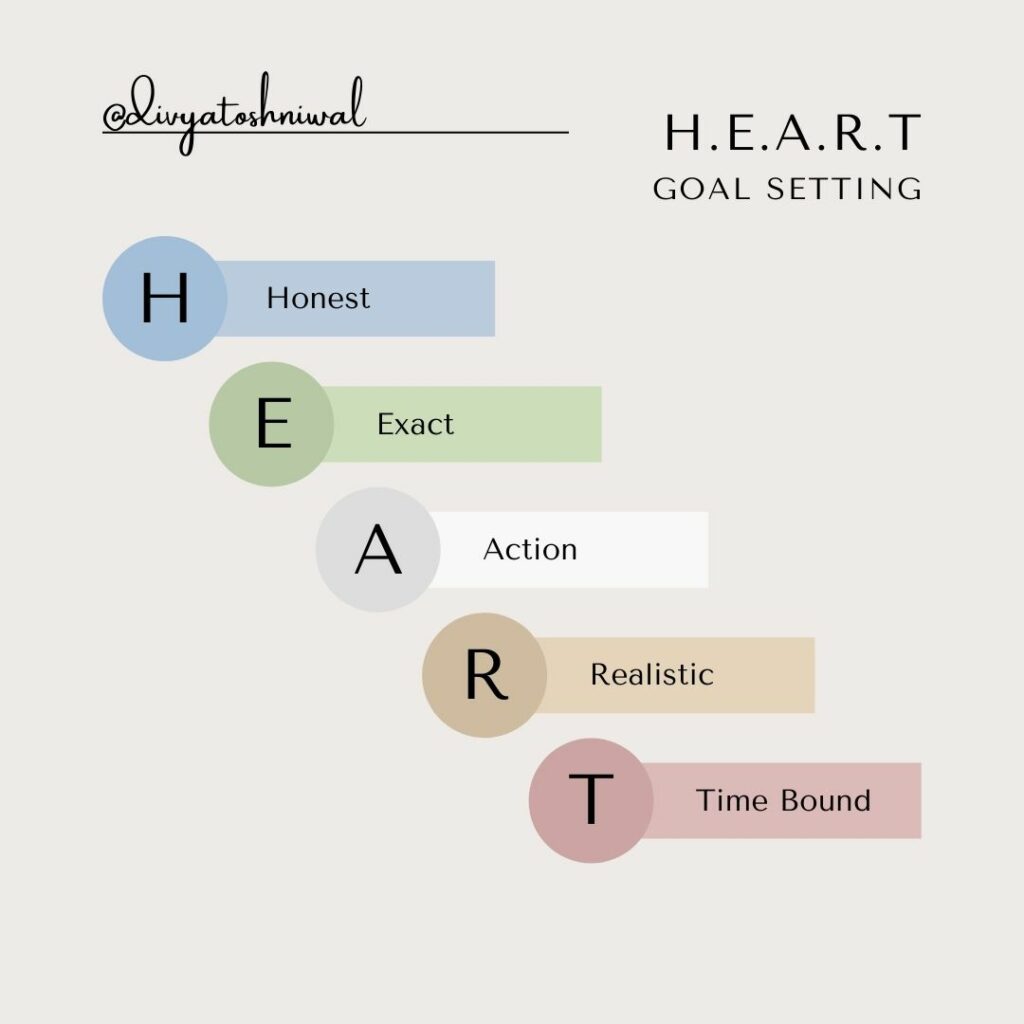
This is what the H.E.A.R.T. model for goal setting stands for :

H stands for Honest :

So the first thing that you should ask yourself is whether your goals are honest towards your life vision, mission and purpose. Are they consistent with your ambitions and aspirations? If your life mission is extremely humanitarian and you set up a capitalistic goal for yourself there are chances that you would quit as soon as you start facing obstacles. Capitalistic goals would not provide enough fuel for you to keep going in the downtime.

E stands for Exact :

This is what you exactly want and what exactly would you need to achieve these goals. Determine the resources and skills required. Break down your goals into smaller chunks and prepare to achieve one at a time. So if you have a yearly goal, break it down into monthly and weekly goals. Make your statements exact. A wise man once said ‘ If I was given 7 hours to chop down a tree, I would spend 6 hours sharpening my axe’. So, prepare well.

A stands for Action:

A goal without a plan is just wishful thinking and words without actions mean nothing. To achieve your goals, in the exact center of the heart model is- Action. To take action for your goals it is important that you ask yourself the right questions. Questions like = ‘ What is the one small step that I can take today?’ The hardest part is actually not solving a problem but asking the right questions that can lead you to solve the problem.

R stands for Realistic:

As I said before, a goal without a plan is just wishful thinking. So in order to make a plan to achieve your dreams you need to consider the realities around them. What are the possible obstacles that might come in your way? Do you have the time and energy to give into this goal? What are your other obligations? How much are you willing to give for this dream of yours?

T stands for Time-Bound:

And yes, your goal needs to have a deadline. No, it’s not that you cannot achieve a goal after the deadline, but plans with a deadline are more effective in general. So set time for each step you take and mark your achievement with each step crossed. This will also give you the motivation to keep moving forward.

H.E.A.R.T. model for goal setting in life coaching.

The most important thing is that you need to celebrate and reward yourself for even the smallest of your achievements and for every step you take toward your goals.

Self-Care Habits To Help You Deal With Depression

Self-Care Habits To Help You Deal With Depression

Posted on December 3, 2021September 14, 2026 by Divya Toshniwal

Table of Contents

  • What Is Depression?
  • What Is Self-Care?
  • Self-Care Habits That Can Help To Fight Depression

What Is Depression?

Depression can mean something different for each individual and hence to define depression is not the right thing to do. As for the meaning of the word depression, Google says: “a feeling of unhappiness that lasts for a long time. Depression can be a medical condition and may have physical signs, for example being unable to sleep, etc.”

Different symptoms are reported in depression, all of which may not be present at all times for all people. But some symptoms would definitely be present. You can learn to identify the Symptoms of Depression.

What Is Self-Care?

To make yourself a priority. While in depression the worst thing we do is avoid our own well-being. We do not pay attention to our physical or mental health because our emotions are not in balance. The lack of energy and interest makes us avoid the most important thing in life- Ourselves. When I went into depression I realized I did all the stuff that I could for people around me. I smiled for other people in my life, I tried hiding my emotions, my true self. I did all the work that was needed to be done but after that, I had no energy left. I had no energy left for myself.

Later, a few things in my life made me realize the importance of me. I understood the importance of self-love and self-care. one of the greatest changes in my life was brought by dance and movement therapy. I took a Diploma course on Dance and movement therapy that helped me overcome my depression to a great extent.

I understood that taking care of yourself is not selfish, I understood that it’s ok to think about yourself, and I understood that I can take care of my loved ones only when I am alright. If I am weak, physically, mentally, or emotionally it will take a toll on all aspects of my life and the people associated with me. I researched more and read more about self-care and I understood that self-care is not expensive and is not a luxury that normal people cannot afford. We can practice self-care every day.

But while suffering through a depressive episode, the daily self-care is sometimes not enough. Daily self-care acts as a maintenance dose but right now you need to put some extra effort to help you deal with depression.

Read also: 8 Types Of Self Care That You Should Bring In Your Life

Self-Care Habits That Can Help To Fight Depression

When it comes to self-care for depression not everything and anything will work for you. The reason for depressive episodes can be varied and hence the way you can overcome your depression also might vary from another person whom you have seen coming out of depression. All I am saying is what worked for them might not work for you. Hence I am trying to list down a few options for self-care that help in overcoming depression and you can try them to understand what works for you the best.

  1. Develop an exercise routine. This is not an option. No matter what the reason of your depression is, you need to get up from the bed and move your body( unless you have a severe physical ailment) . There should be at least 30 – 40 minutes in your day where you do some form of physical activity and your heartbeat goes up. The choice of workout, however, is entirely your choice. For me , aerobics and dancing works the best. I also love to go out on walks in parks. Being close to nature is another thing that makes me happy.
  2. Continuing on my previous point of being close to nature, another aspect of self-care is also taking small little breaks from your monotonous life and going on small vacations also help to overcome depression.
  3. Practice Positive Affirmation. Create positive affirmations for yourself, anything that suits you and relates to your life. Repeating the positive affirmations would help you design an optimistic mindset. And here by optimistic mindset I don’t mean wishful thinking. It is just being able to accept the possibility of something very positive happening in your life. Mindset would make it reality.
  4. If the reason for your depression is loneliness and not having enough people around, then social self-care is something that becomes of utmost importance. It is not always the case that we are alone. Sometimes we shut everyone out so hard that we end up creating that loneliness for ourselves. So, the next time someone calls you, don’t avoid talking and reply to messages. The next time someone invites you for a meetup or a gathering say YES. Commit to one social meetup each week . If there is not invite from others then go ahead and invite someone on your own. For times when going out is not possible take help of video calls.
  5. If the reason for your depression is financial then start now to build some economic stability for yourself. It is never too late and the situation you are in can be changed. Nothing will change overnight but trust me when I say things will change. Learn how financial self-care is important and how you can build the economic stability you want.
  6. If the reason of your depression is not feeling loved enough or losing a romantic partner then PLEASE start loving yourself again. We often indulge in our relationships so much that we stop loving ourselves and that is what leads to being sad and lonely (whether you are in a relationship or broken apart). Love Yourself First. It is not being Selfish.
  7. Spend some time in knowing yourself better. One of the greatest ways to do that is through journaling. Get some journal prompts for self-awareness, get a journal, and depending on how creative you are, some stationery. Find some time every day to come closer to yourself. Do not edit or re-edit your words. Just write in a flow.
  8. Dedicate some time to developing your spiritual practice. The form may be anything that helps you . For me meditation and reading good books help the most. If you believe in energy healing or practice do that. If you believe in crystals then use their power . But by getting into such healing I don’t mean that go to a healer pay them a handsome amount and get healed . I would suggest , learn these things for yourself. Start with a book , get into a course and understand the very basic of healing yourself .
  9. Soothe all your five senses. Organize your space so that you live in a clutter-free home and office . The aesthetics of your home and office help a lot to reduce stress. What you look at the entire day is an essential part of your life. Listen to good music , it will help you relax better. Eat the food you love and soothe your taste buds . But do not forget to eat healthy too as what you eat becomes very important in dealing with depression. Massage your feet and hands. If need be go get a full body massage to relax and make you feel pampered and last but not the least your olfactory senses may help a great deal. That is why aroma therapy is getting so popular nowadays. Go get some good fragrances in form of a candle or diffuser and it will make you feel good.
  10. Practice mindfulness. Be in the present moment as much as you can. Thinking about the past and worrying about the future is going to contribute only to overthinking. Hence practice mindfulness exercises and help your mind stay in now and here.

Ways to Self-care are many but the basic philosophy behind it is that you are your longest commitment and your relationship with anyone or anything can never be above your relationship with yourself.

Above all this, I would always suggest that there is no harm in asking for help. If you are feeling depressed and are not being able to handle things on your own then seek help from the people around you and if need be, seek professional help. You can connect with me here to book an online counseling session.

Recent Posts

  • Adulting is Hard, Micro-Retirements are Your Sassiest Escape Hatch
  • Reclaim Your Time, Reclaim Your Peace: Setting Boundaries with a Graceful ‘No’
  • The Orange Peel Theory: The Berries That Sealed Our Love
  • (no title)
  • Mimetic Desire: Do you really want what you think you want?
© 2026 Divya Toshniwal | Powered by Minimalist Blog WordPress Theme