Success being a very relative term can differ for every individual. But one definition is common: success is when you achieve the goal that you had set for yourself.
-Divya
Table of Contents
We all have goals and we all want to achieve them. At the beginning of each year, we set New Year’s resolutions for ourselves. We set high goals and dedicatedly try to achieve them with all the effort that we can possibly put into it. For a few days, everything seems up, and then one day we fall. Well, that is not the problem. The problem is that we don’t get up again.
Goal setting is easy but to work on them and achieve them, we need dedication, consistency, and habits.
So, when I understood this very basic problem and very simple solution, I started working on my habits. I listed down all the habits that could get me closer to my goal and incorporated all of them into my daily routine. Things were good for the next week and then the habits slipped out of my routine one after the other. I was back to my normal self by the end of the 44th day. My simple solution was not so simple after all.
Eventually, after working on myself for a long time, I came up with the Effect-Ease Mastery Matrix (EEMM) tool to Build Habits.
Effect-Ease Mastery Matrix
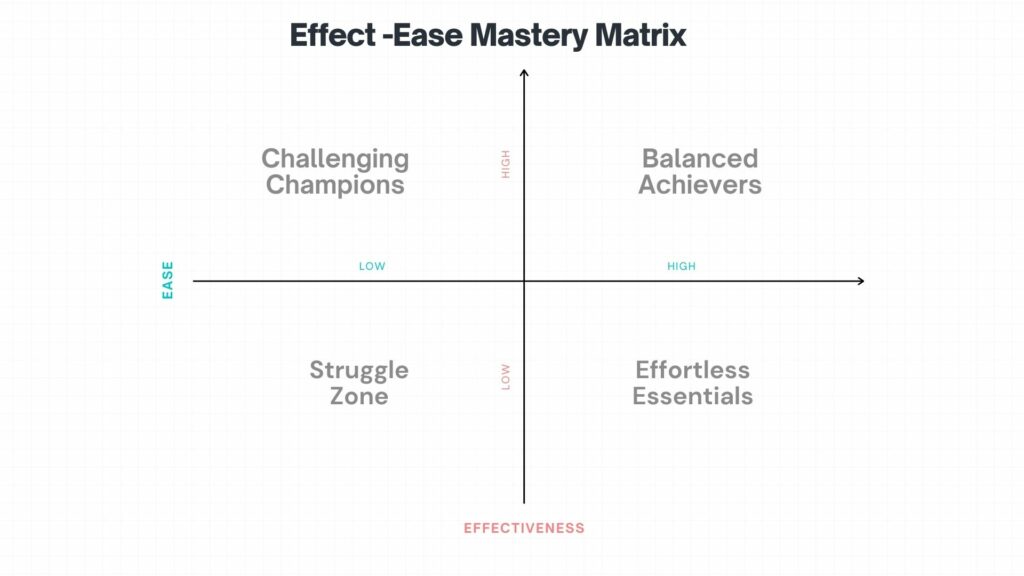
The Effect-Ease Mastery Matrix is a tool that helps individuals evaluate and categorize habits based on two critical dimensions: Effectiveness in achieving your goals (vertical axis) and Easiness to incorporate and continue (horizontal axis). This can effectively work as a habit-building worksheet. By plotting habits on this matrix, individuals can gain insights into the balance between the effort required to establish a habit and its potential impact on achieving personal or professional goals. Each habit falls into one of four quadrants based on these two criteria.
Quadrant 1: Balanced Achievers
The Sweet Spot of Success
Habits in this quadrant strike a harmonious balance between effectiveness and ease of implementation. They are both effective in contributing to one’s goals and manageable in terms of the effort required. These are the habits that can bring about quite a big change with moderate levels of effort. But finding such habits may not be that easy. It will need a little creativity and innovation too. The tagline for this quadrant is “The Sweet Spot of Success,” highlighting the optimal balance achieved between effort and impact.
Quadrant 2: Challenging Champions
Where Grit Meets Greatness
This quadrant represents habits that are both challenging and highly effective. These habits may demand significant effort, discipline, and dedication but offer substantial rewards in terms of personal growth and goal achievement. If you have extremely high willpower and are highly adaptable to change you can pick on habits from this quadrant and you are good to go. Building these habits will bring you closer to your goals faster than anything else. The tagline for this quadrant is “Where Grit Meets Greatness,” emphasizing the resilience and determination required to conquer challenging but impactful habits.
Quadrant 3: Struggle Zone
Overcoming Obstacles on the Path to Mastery
In this quadrant, habits may be challenging to implement, but their impact on goal achievement is limited. These habits might demand a considerable amount of effort but may not bring significant results. The tagline for this quadrant is “Overcoming Obstacles on the Path to Mastery,” acknowledging the difficulties faced in pursuing habits with less tangible outcomes. Habits in this quadrant might be difficult to implement and may not bring significant results. But these may be those little things that can make you stand out from the rest of them. You should take up these only when you are the closest to your goals.
Quadrant 4: Effortless Essentials
Simplicity in Success
Here in this quadrant are habits that are easy to incorporate but do not have a high impact too. The habits that fall under this category are the ones that are not that important but you still have to do them anyway. Like, checking your emails every day. While they require minimal effort, their impact might be limited. Examples include cleaning up your desk, creating a to-do list, or minor daily tasks that don’t align with broader objectives. The tagline for this quadrant is “Simplicity in Success,” emphasizing the ease of incorporating these habits but also recognizing their limited impact. These are habits that aid your growth but do not directly impact it.
Anyone who starts building new habits should begin with something easy to incorporate and have maximum effectiveness in bringing them closer to their goals. Hence begin with habits in Quadrant 1. But also remember to not stop just there.
Effect-Ease Mastery Matrix For A Blogger
As a blogger when I divided my habits according to the effect-ease mastery matrix, this is how it looked:
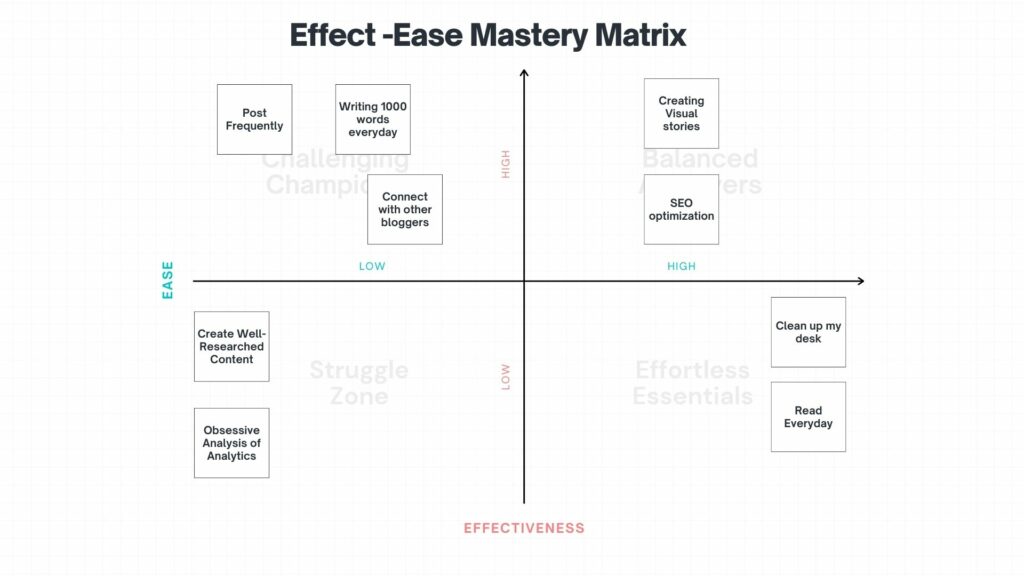
Building habits is a task that needs determination, but it is important to choose habits that will keep you motivated enough to achieve your goals. If you keep on challenging yourself with habits that are tough to incorporate and do not give any immediate result you may lose your intrinsic motivation to keep going. Hence, this Effect-Ease Mastery Matrix acts as a tool for you to decide where you should start.